
11th Circuit Rejects Keyword Advertising Liability–Deltona v. NOCO
This case involves two competitors in the vehicle-battery charger industry. The plaintiff calls its offering “Battery Tender” (based on the analogy of a ship’s tender) and claims trademark rights in the term. Believing that the term is generic, NOCO began using the term in reference to its own products. The plaintiff sued for trademark infringement and more. A jury found for the plaintiff and awarded $1.3M in actual damages and $5.75M in punitive damages. The judge added another $12M of equitable disgorgement and issued a permanent injunction, except with respect to keyword ads and comparative advertising.
Is “Battery Tender” Generic?
The court says that the term “battery tender” isn’t inherently generic because (1) the USPTO registered the term, and “registration puts a heavy thumb on the scale against genericness,” (2) it’s better characterized as a descriptive term because “tend is more a metaphorical than literal description of what a battery tender does,” and it has achieved secondary meaning over 30+ years, and (3) the plaintiff’s principal coined the term.
Keyword Advertising
Keyword bidding doesn’t constitute trademark infringement for a simple reason: It’s not “likely to cause consumer confusion with the plaintiff’s mark.” And it’s unlikely to cause consumer confusion with the plaintiff’s mark for an equally straightforward reason: The use of the plaintiff’s mark for keyword-bidding purposes occurs “behind the scenes,” so to speak. Consumers don’t—indeed, can’t—see the plaintiff’s mark—all that’s visible here is a NOCO ad….A consumer who sees a NOCO-sponsored ad, whether or not driven by keyword bidding, may well recognize the promoted NOCO product as an alternative to consider, but he’s unlikely for that reason alone to mistake it for Deltona’s own offering. Accordingly, confusion here depends on whether Deltona’s mark is visible in NOCO’s ad, not whether an ad that does not display or otherwise reference Deltona’s mark might have been (invisibly) triggered by the mark’s behind-thescenes use as a keyword.
The court acknowledges that keyword ads may distract consumers. However, “so long as NOCO’s ads don’t hold that company out as selling “battery tenders,” consumers aren’t likely to be confused—just potentially overwhelmed by the presence of alternative products.”
The court summarizes: “In holding that keyword bidding can’t constitute trademark infringement, we join the unanimous consensus of our sister circuits.” For this reason, the jury’s damages award needs to be reduced to the extent it was predicated on keyword ads.
Trademark Usage in Amazon Ad Text
This is wheelhouse trademark infringement; NOCO’s conduct was likely to mislead consumers into thinking that it sold “battery tenders.” NOCO insists that its ads weren’t confusing because Amazon marked them as “sponsored” and customers would therefore recognize them as ads. Even so, the sponsored ads’ content effectively stated that NOCO sold battery tenders, which it doesn’t—only Deltona does.
Usage in Amazon Product Description Text
Product descriptions are “below the line,” so to speak, and in smaller print—they are meant to inform a diligent customer rather than grab his attention. As a result, consumers are probably less likely to focus on them in the way they do the ads.
[Citation clearly needed for the last point. The panel appears to be making up hypotheses about consumer behavior.]
The court nevertheless ratifies the jury finding: “We think it clear that a reasonable jury could find that the product descriptions were part of an effort to misappropriate Deltona’s goodwill and confuse consumers.”
NOCO argued that the “battery tender” references in the product descriptions should be excused like keyword advertising. The court distinguishes product listings from keyword ads:
- “Even if less conspicuous or prominent than the ad’s main text, it isn’t entirely invisible to the consumer’s eye in the way that a behind-the-scenes keyword is.”
- The ad’s “sponsored” label would alert consumers of the differences between the companies. [This also seems like a dubious empirical claim.]
The court summarizes:
Even if consumers didn’t actually read NOCO’s product descriptions, NOCO impermissibly held itself out in those descriptions as a seller of battery tenders, rather than a provider of alternatives to battery tenders, as it did, for instance, when using a keyword-bidding strategy to drive traffic to its own products. The inclusion of “battery tender” in the description automatically not only affected Amazon search results but also drove shoppers searching for Deltona’s battery tenders to NOCO chargers without alerting them in any way—through a “sponsored” tag or otherwise—that they weren’t really looking at battery tenders.
[To be fair, NOCO’s attempts to equate keyword ads with product listings seems like it was never destined for success. NOCO had an appellate team of 7 Biglaw lawyers, apparently led by Jones Day and supported by Goodwin Proctor and Troutman Pepper. That’s a lot of very expensive lawyers who signed off on seemingly dubious positions. FWIW, Deltona’s appellate team was 3 lawyers from Shutts & Bowen.]
Other Marketing References
“The evidence supports the conclusion that, from the top down, NOCO actively tried to sow confusion about what a battery tender is.”
Injunction
Among other things, the lower court enjoined NOCO’s use of the term “tender,” even though Deltona’s trademark is “battery tender” and not just “tender.” The appellate court circles one of NOCO’s Amazon ads: “More Than Just A Tender. The Ultimate Charger.” To me, that sounds like comparative advertising or free use of a dictionary word that isn’t covered by a trademark registration, but the appellate court calls that a “loophole.” As a result, the appellate court upholds the injunction.
Implications
NOCO get a new trial to recompute actual damages, stripped of the keyword ads and some other pieces the appellate court reversed. I imagine the parties will settle rather than do a retrial because trial prep would likely cost more than any adjustments to the damages amount.
You can see what happens when a descriptive term (“battery tender”) gets weaponized. A competitor thought they could freely use the term, went too far, and will pay a high price for their error.
Despite the mostly-bad news for NOCO, the ruling does have a major bright spot: the court’s declaration that the 11th Circuit permits competitive keyword advertising, at least so long as the resulting ads don’t include the trademark in the text. This outcome isn’t surprising given how the 2nd and 9th Circuits have emphatically shut down keyword advertising cases. Still, extending that principle to a new geographic region is welcome news.
Emoji Discussion!
The court includes the following transcript of NOCO’s “virtual brainstorming session”:
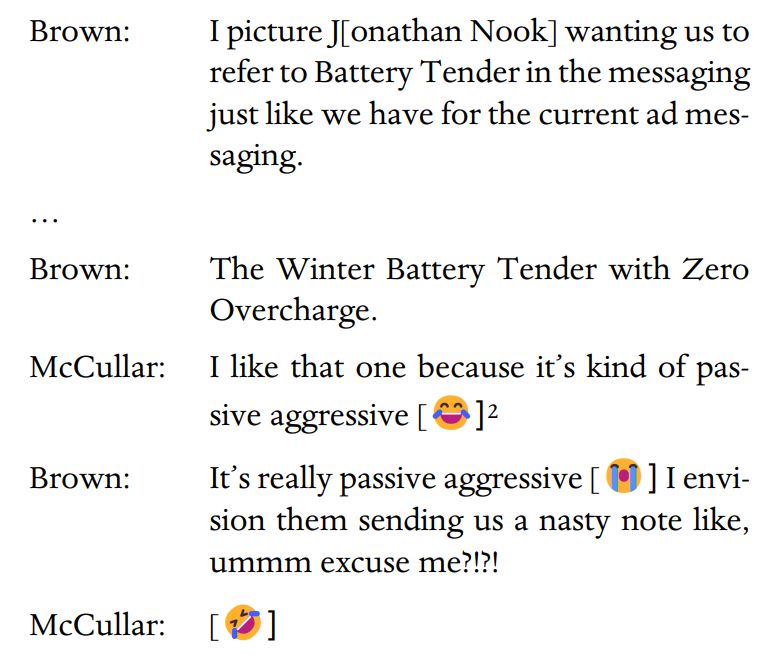
The opinion shows its emojis! Yay! However, FN 2 says:
The documents in the record converted the emojis to their shortcodes (e.g., :joy: or :rolling on the floor laughing:). For clarity, we have replaced the shortcodes with the actual emojis to reflect the exchange as it presumably appeared between the NOCO employees.
There are a couple of problems here:
- The parties didn’t properly prepare the evidence, so the emojis weren’t properly recorded in the record.
- The judge can’t accurately recreate the emojis this way. First, each platform depicts the shortcodes differently, and the judge doesn’t explain how he picked these particular depictions. The images he picked may not accurately reflect how the emojis were actually depicted. Plus, because emoji depictions evolve over time, shortcodes today may produce a different depiction than the shortcodes did at the relevant time period. Further, emojis may differ in how the sender and recipient see them. As I say in my judicial trainings on emojis, emoji depictions should come in pairs. The judge assumed a canonical depiction, but that is typically a fallacy.
Case Citation: Deltona Transformer Corporation v. NOCO Company, 2026 WL 2236806 (11th Cir. Aug. 4, 2026)
* * *
More Posts About Keyword Advertising
* Another Reminder: Lawsuits Over Competitive Keyword Ads Are Stupid
* Post-Mortem of a Misguided Logo Trademark Lawsuit–LegalForce v. Internet Brands
* The Initial Interest Confusion Doctrine Refuses to Die
* Court Rejects Initial Interest Confusion Claims for Competitive Keyword Ads–Regalo v. Aborder
* Lawsuits Over Competitive Keyword Advertising Are Still Stupid–NRRM v. American Dream Auto Protect
* NJ Supreme Court Blesses Lawyers’ Competitive Keyword Ads (With a Baffling Caveat)
* Ninth Circuit Tells Trademark Owners to Stop Suing Over Competitive Keyword Ads–Lerner & Rowe v. Brown Engstrand
* Second Circuit Tells Trademark Owners to Stop Suing Over Competitive Keyword Advertising
* Catching Up on Two Keyword Ad Cases
* Competitor Isn’t Responsible for Google Knowledge Panel’s Contents–International Star Registry v. RGIFTS
* TIL: “Texas Tamale” Is an Enforceable Trademark–Texas Tamale v. CPUSA2
* Internal Search Results Aren’t Trademark Infringing–PEM v. Peninsula
* When Do Inbound Call Logs Show Consumer Confusion?–Adler v McNeil
* Court Denies Injunction in Competitive Keyword Ad Lawsuit–Nursing CE Central v. Colibri
* Competitive Keyword Ad Lawsuit Fails…Despite 236 Potentially Confused Customers–Lerner & Rowe v. Brown Engstrand
* More on Law Firms and Competitive Keyword Ads–Nicolet Law v. Bye, Goff
* Yet More Evidence That Keyword Advertising Lawsuits Are Stupid–Porta-Fab v. Allied Modular
* Griper’s Keyword Ads May Constitute False Advertising (Huh?)–LoanStreet v. Troia
* Trademark Owner Fucks Around With Keyword Ad Case & Finds Out–Las Vegas Skydiving v. Groupon
* 1-800 Contacts Loses YET ANOTHER Trademark Lawsuit Over Competitive Keyword Ads–1-800 Contacts v. Warby Parker
* Court Dismisses Trademark Claims Over Internal Search Results–Las Vegas Skydiving v. Groupon
* Georgia Supreme Court Blesses Google’s Keyword Ad Sales–Edible IP v. Google
* Competitive Keyword Advertising Claim Fails–Reflex Media v. Luxy
* Think Keyword Metatags Are Dead? They Are (Except in Court)–Reflex v. Luxy
* Fifth Circuit Says Keyword Ads Could Contribute to Initial Interest Confusion (UGH)–Adler v. McNeil
* Google’s Search Disambiguation Doesn’t Create Initial Interest Confusion–Aliign v. lululemon
* Ohio Bans Competitive Keyword Advertising by Lawyers
* Want to Engage in Anti-Competitive Trademark Bullying? Second Circuit Says: Great, Have a Nice Day!–1-800 Contacts v. FTC
* Selling Keyword Ads Isn’t Theft or Conversion–Edible IP v. Google
* Competitive Keyword Advertising Still Isn’t Trademark Infringement, Unless…. –Adler v. Reyes & Adler v. McNeil
* Three Keyword Advertising Decisions in a Week, and the Trademark Owners Lost Them All
* Competitor Gets Pyrrhic Victory in False Advertising Suit Over Search Ads–Harbor Breeze v. Newport Fishing
* IP/Internet/Antitrust Professor Amicus Brief in 1-800 Contacts v. FTC
* New Jersey Attorney Ethics Opinion Blesses Competitive Keyword Advertising (…or Does It?)
* Another Competitive Keyword Advertising Lawsuit Fails–Dr. Greenberg v. Perfect Body Image
* The Florida Bar Regulates, But Doesn’t Ban, Competitive Keyword Ads
* Rounding Up Three Recent Keyword Advertising Cases–Comphy v. Amazon & More
* Do Adjacent Organic Search Results Constitute Trademark Infringement? Of Course Not…But…–America CAN! v. CDF
* The Ongoing Saga of the Florida Bar’s Angst About Competitive Keyword Advertising
* Your Periodic Reminder That Keyword Ad Lawsuits Are Stupid–Passport Health v. Avance
* Restricting Competitive Keyword Ads Is Anti-Competitive–FTC v. 1-800 Contacts
* Another Failed Trademark Suit Over Competitive Keyword Advertising–JIVE v. Wine Racks America
* Negative Keywords Help Defeat Preliminary Injunction–DealDash v. ContextLogic
* The Florida Bar and Competitive Keyword Advertising: A Tragicomedy (in 3 Parts)
* Another Court Says Competitive Keyword Advertising Doesn’t Cause Confusion
* Competitive Keyword Advertising Doesn’t Show Bad Intent–ONEpul v. BagSpot
* Brief Roundup of Three Keyword Advertising Lawsuit Developments
* Interesting Tidbits From FTC’s Antitrust Win Against 1-800 Contacts’ Keyword Ad Restrictions
* 1-800 Contacts Charges Higher Prices Than Its Online Competitors, But They Are OK With That–FTC v. 1-800 Contacts
* FTC Explains Why It Thinks 1-800 Contacts’ Keyword Ad Settlements Were Anti-Competitive–FTC v. 1-800 Contacts
* Amazon Defeats Lawsuit Over Its Keyword Ad Purchases–Lasoff v. Amazon
* More Evidence Why Keyword Advertising Litigation Is Waning
* Court Dumps Crappy Trademark & Keyword Ad Case–ONEPul v. BagSpot
* AdWords Buys Using Geographic Terms Support Personal Jurisdiction–Rilley v. MoneyMutual
* FTC Sues 1-800 Contacts For Restricting Competitive Keyword Advertising
* Competitive Keyword Advertising Lawsuit Will Go To A Jury–Edible Arrangements v. Provide Commerce
* Texas Ethics Opinion Approves Competitive Keyword Ads By Lawyers
* Court Beats Down Another Competitive Keyword Advertising Lawsuit–Beast Sports v. BPI
* Another Murky Opinion on Lawyers Buying Keyword Ads on Other Lawyers’ Names–In re Naert
* Keyword Ad Lawsuit Isn’t Covered By California’s Anti-SLAPP Law
* Confusion From Competitive Keyword Advertising? Fuhgeddaboudit
* Competitive Keyword Advertising Permitted As Nominative Use–ElitePay Global v. CardPaymentOptions
* Google And Yahoo Defeat Last Remaining Lawsuit Over Competitive Keyword Advertising
* Mixed Ruling in Competitive Keyword Advertising Case–Goldline v. Regal
* Another Competitive Keyword Advertising Lawsuit Fails–Infogroup v. DatabaseLLC
* Damages from Competitive Keyword Advertising Are “Vanishingly Small”
* More Defendants Win Keyword Advertising Lawsuits
* Another Keyword Advertising Lawsuit Fails Badly
* Duplicitous Competitive Keyword Advertising Lawsuits–Fareportal v. LBF (& Vice-Versa)
* Trademark Owners Just Can’t Win Keyword Advertising Cases–EarthCam v. OxBlue
* Want To Know Amazon’s Confidential Settlement Terms For A Keyword Advertising Lawsuit? Merry Christmas!
* Florida Allows Competitive Keyword Advertising By Lawyers
* Another Keyword Advertising Lawsuit Unceremoniously Dismissed–Infostream v. Avid
* Another Keyword Advertising Lawsuit Fails–Allied Interstate v. Kimmel & Silverman
* More Evidence That Competitive Keyword Advertising Benefits Trademark Owners
* Suing Over Keyword Advertising Is A Bad Business Decision For Trademark Owners
* Florida Proposes to Ban Competitive Keyword Advertising by Lawyers
* More Confirmation That Google Has Won the AdWords Trademark Battles Worldwide
* Google’s Search Suggestions Don’t Violate Wisconsin Publicity Rights Law
* Amazon’s Merchandising of Its Search Results Doesn’t Violate Trademark Law
* Buying Keyword Ads on People’s Names Doesn’t Violate Their Publicity Rights
* With Its Australian Court Victory, Google Moves Closer to Legitimizing Keyword Advertising Globally
* Yet Another Ruling That Competitive Keyword Ad Lawsuits Are Stupid–Louisiana Pacific v. James Hardie
* Another Google AdWords Advertiser Defeats Trademark Infringement Lawsuit
* With Rosetta Stone Settlement, Google Gets Closer to Legitimizing Billions of AdWords Revenue
* Google Defeats Trademark Challenge to Its AdWords Service
* Newly Released Consumer Survey Indicates that Legal Concerns About Competitive Keyword Advertising Are Overblown