
Spam-Filtered Email Service Unwinds a $13M Default Judgment–Imagination Products v. Omont
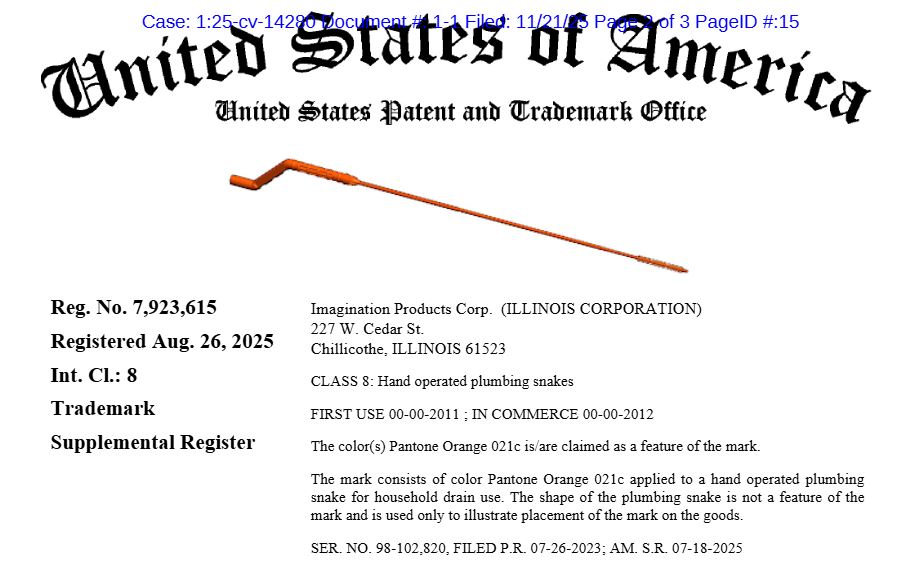 Imagination Products has a supplemental trademark registration in the color orange (Pantone Orange 021c) for hand-operated plumbing snakes. It claims that several defendants, including Omont, sell drain clog cleaning tools that violate its trade dress in the orange shade.
This is not a SAD Scheme case, but it is adjacent. The plaintiff sued the Chinese defendant but did not seek an ex parte TRO. It requested, and received, permission to serve the defendant by email. When the defendant no-showed, the court granted a default judgment to the plaintiff and awarded $13M+ damages against Omont.
If this had been a SAD Scheme case with a typical ex parte TRO, Omont would have learned of the proceedings, regardless of any attempted service, from the resulting marketplace freeze. Since that didn’t happen, Omont claims it first learned of the lawsuit when the marketplace delisted some of its items in response to the default judgment. The defendant went back into its email account, found the attempted email service in its spam folder, and then quickly ran to court to challenge the default judgment.
The court permits the challenge to the default judgment because:
defendant did not have notice of the suit. It is unsurprising that an email from an unknown foreign attorney would end up in defendant’s spam folder. Because, as defendant points out, there was no injunction in this case, there was no way for defendant—other than meticulously monitoring its spam folder—to learn about this litigation before the default judgment was entered against it. The court finds that the lack of notice afforded to defendant in these circumstances qualifies as “inadvertence, surprise, or excusable neglect.”
 (Raise your hand if you “meticulously monitor” your spam folder LOL. Then again, you should. All of the email notices I get about class action settlements affecting me always mysteriously seem to end up in my spam folder, so I do actually get a few pennies for sorting through the spam).
The court adds that Kangol also “clarified a couple of months after the default judgment was entered here [that] the Hague Service Convention prohibits service by email in China.” This is true but incomplete. Kangol held: “if the Hague Service Convention applies, then service was improper because the Convention prohibits service by email in China. But the district court must first determine whether the Convention applies at all,” and remanded the case to determine the applicability of the Hague Convention. This court doesn’t address that threshold issue explicitly in this opinion.
Because of the new information,
The default judgment order awards plaintiff $13,335,764.46 in damages from defendant. The court cannot sustain such a significant award on a default judgment entered against a defendant who was not properly served.
This is also not precise. The court cannot sustain *any* damages award–even $1–against a defendant who was not properly served. The problem isn’t the size of the damages award; it’s the lack of due process.
There’s another problem with this case: now that the defendant is available to point out the case’s flaws, the trade dress claim may fall apart. The court says “defendant has shown that it has a meritorious defense” because “Defendant challenges that plaintiff’s alleged trade dress is inherently distinctive or has acquired secondary meaning.” This makes sense, because a supplemental trademark registration does not establish the mark’s validity. So it’s possible, or perhaps probable, that the court will find that the plaintiff has no rights to the color orange–and never did.
AND YET…the doctrinal limitations of the supplemental registration were available to the court before issuing a $13M final judgment, yet the judge greenlighted the default judgment nonetheless. The plaintiff would have gotten away with it but for the post-default adversarial advocacy.
It would be more fun watching default judgments fall apart if the stakes weren’t so serious. These situations may indicate that the court reached the wrong final conclusion. Each time that happens, it’s a reminder that courts routinely chunk their independent evaluation of unopposed advocacy; and worse, judges routinely don’t sanction or punish plaintiffs in those circumstances. This system of lopsided advocacy is irreparably broken, which reinforces why we need more due process in our adversary-based adjudication system, not less.
 [Note 1: the court didn’t appear to take any steps to address the continued legitimacy of the trade dress claims against the other defaulted defendants, even though a busted trade dress would render the other default judgments also illegitimate. There are over $7M of other default judgments at stake, so this is not a small detail.].
[Note 2: Similarly, if email service against Omont was impermissible, does that mean or suggest that email service against the other defendants had the same defect? If so, that would be another reason to unwind the default judgments against them, but the court didn’t appear to ask that question either].
The “the email went to my spam folder” defense sounds a little like the venerable but typically mockable “dog ate my homework” defense (which doesn’t really even work in the digital era). Yet, the spam filter story has been told over and over about email service, and each failed service has extraordinary consequences for due process and the rule of law. The inevitability of spam filtered service emails–combined with the $13M mistake the court made predicated on email service–is a very good reason why email service should be extraordinarily rare, not a ready fallback when service is difficult via more traditional means.
Case Citation: Imagination Products Corp. v. ComingHere Direct, 2026 WL 3093999 (N.D. Ill. Oct. 16, 2026)
* * *
BONUS: Kiel James Patrick, LLC v. Schedule A Defendants, 2026 WL 3015613 (D.R.I. Oct. 7, 2026). Another TRO falls apart when the defendants show up. The false designation of origin claim becomes suspect:
the Court agrees with the Answering Defendants’ conclusion that “Plaintiff has not identified a single competent piece of evidence showing that the challenged images were copied from [its] website, altered from [its] photographs, or generated by AI to impersonate [it].” At this stage, the Answering Defendants are also correct that Plaintiff has failed “to identify the specific KJP image URLs, file names, metadata, EXIF data, watermark evidence, or reverse-image-search results that would be necessary to support such a claim.” Meanwhile, the Answering Defendants have offered product-image evidence from an “independent sourcing agent, 1688.com,” which illustrates that the images on their website were generated by a different commercial source than Plaintiff’s website. A review of Plaintiff’s website further reveals that the images submitted by the Answering Defendants look dissimilar to Plaintiff’s advertising materials, even if there is some similarity between the sweaters. Despite this similarity, the Court is only tasked with determining whether the challenged advertising imagery is likely to confuse consumers as to the origin of the sweaters. The Court cannot conclude so.
Same with the false advertising claim:
Plaintiff has not introduced any evidence that convinces this Court that the Answering Defendants made a false representation, nor that consumers have been misled or deceived by the images on the Answering Defendants’ website. Furthermore, there is no evidence on the current record that the Answering Defendants copied Plaintiff’s trademarks or made a particular claim about their products that is verifiably false or misleading. Plaintiff has also failed to provide any evidence of injury or anticipated injury
The court’s walking back of the plaintiff’s claims sure makes issuance of the original TRO look terrible.
It is not a happy development to see false designation of origin and false advertising claims rolled into the SAD Scheme, especially given their fact-dependent nature that increases the odds of ex parte judicial errors.

Prior Blog Posts on the SAD Scheme
- Judge Barker (E.D. Tex.) Disassembles Two SAD Scheme Cases
- Court Wipes Out SAD Scheme Default Judgment Due to Improper Email Service–Deckers v. Litfun
- SAD Scheme Plaintiff Must Pay $40k to Defendant–Guangzhou Tinpod v. Schedule A Defendants
- New York Judge Shuts Down a SAD Scheme TRO Request–CJB Global v. Schedule A Defendants
- Every SAD Scheme Opinion Is Weird In Its Own Way–Cai v. Chaozhoushi Yitong Dianzi Shangwu Youxiangongsi
- Federal Circuit Rebuffs SAD Scheme Plaintiff–Shenzhen Jisu v. Annex A Defendants
- Court Rebuffs Emojico’s SAD Scheme TRO Request
- Seventh Circuit Limits Email Service to Chinese SAD Scheme Defendants–Kangol v. Hangzhou Silk
- SAD Scheme Defendant Gets Damages Payout from the Bond–Bright Head v. Schedule A Defendants
- Judge Shopping & Schedule A (Guest Blog Post)
- SAD Scheme Plaintiff Gets Default Win But Blows the Layup on Damages–Shenzen Huajie v. Shenzen Leyibei
- SAD Scheme Copyright Plaintiff Must Compensate Defendants–Shenzhen Langmi v. Schedule A Defendants
- A “But They’re ‘Counterfeiters’!” Argument Doesn’t Clinch a SAD Scheme TRO–Emojico v. Schedule A Defendants
- New Article Alert: “SAD Scheme Standing Orders”
- Greer Burns Law Firm Sanctioned for “Willfully Abusive” and “Egregious” SAD Scheme Judge-Shopping
- Schedule A: Ten Notable Developments in 2025 (Guest Blog Post)
- Second Circuit Rejects Email Service on Chinese Defendants in Baby Shark SAD Scheme Case
- 11th Circuit Sidesteps the SAD Scheme’s Problems–Ain Jeem v. Schedule A
- Another Shill Article Tries to Normalize the SAD Scheme
- Court Sanctions Plaintiff’s Lawyer for Unverified Claims That the Defendant Was Hiding–Guangzhou Youlan Technology Co. Ltd. v. Onbrill World
- SAD Scheme Cases Are a Cesspool of IP Owner Overreaches–Nike v. Quanzhou Yiyi Shoe Industry
- District of New Jersey Adopts SAD Scheme Standing Order
- Court “Sanctions” SAD Scheme Judge Shopping—Crimpit v. Schedule A Defendants
- Chicago-Kent SAD Scheme Symposium TOMORROW
- Amicus Brief Urges Seventh Circuit to Award Attorneys’ Fees in SAD Scheme Case–Louis Poulsen v. Lightzey
- Court Rejects Schedule A Claims Against Sellers of Compatible Parts/Accessories (Cross-Post)
- Judge Kness: the SAD Scheme “Should No Longer Be Perpetuated in Its Present Form”–Eicher Motors v. Schedule A Defendants
- SAD Scheme Lawyers Sanctioned for Judge-Shopping–Dongguan Deego v. Schedule A
- Judge Ranjan Cracks Down on SAD Scheme Cases
- Because the SAD Scheme Disregards Due Process, Errors Inevitably Ensue–Modlily v. Funlingo
- SAD Scheme-Style Case Falls Apart When the Defendant Appears in Court—King Spider v. Pandabuy
- Serial Copyright Plaintiff Lacks Standing to Enforce Third-Party Copyrights–Viral DRM v 7News
- Another N.D. Ill. Judge Balks at SAD Scheme Joinder–Zaful v. Schedule A Defendants
- Judge Rejects SAD Scheme Joinder–Toyota v. Schedule A Defendants
- Another Judge Balks at SAD Scheme Joinder–Xie v. Annex A
- Will Judges Become More Skeptical of Joinder in SAD Scheme Cases?–Dongguan Juyuan v. Schedule A
- SAD Scheme Leads to Another Massively Disproportionate Asset Freeze–Powell v. Schedule A
- Misjoinder Dooms SAD Scheme Patent Case–Wang v. Schedule A Defendants
- Judge Hammers SEC for Lying to Get an Ex Parte TRO–SEC v. Digital Licensing
- Judge Reconsiders SAD Scheme Ruling Against Online Marketplaces–Squishmallows v. Alibaba
- N.D. Cal. Judge Pushes Back on Copyright SAD Scheme Cases–Viral DRM v. YouTube Schedule A Defendants
- A Judge Enumerates a SAD Scheme Plaintiff’s Multiple Abuses, But Still Won’t Award Sanctions–Jiangsu Huari Webbing Leather v. Schedule A Defendants
- Why Online Marketplaces Don’t Do More to Combat the SAD Scheme–Squishmallows v. Alibaba
- SAD Scheme Cases Are Always Troubling–Betty’s Best v. Schedule A Defendants

- Judge Pushes Back on SAD Scheme Sealing Requests
- Roblox Sanctioned for SAD Scheme Abuse–Roblox v. Schedule A Defendants
- Now Available: the Published Version of My SAD Scheme Article
- In a SAD Scheme Case, Court Rejects Injunction Over “Emoji” Trademark
- Schedule A (SAD Scheme) Plaintiff Sanctioned for “Fraud on the Court”–Xped v. Respect the Look
- My Comments to the USPTO About the SAD Scheme and Anticounterfeiting/Antipiracy Efforts
- My New Article on Abusive “Schedule A” IP Lawsuits Will Likely Leave You Angry
- If the Word “Emoji” is a Protectable Trademark, What Happens Next?–Emoji GmbH v. Schedule A Defendants
- My Declaration Identifying Emoji Co. GmbH as a Possible Trademark Troll
Pingback: It's Hard to Win a Schedule A Case Without Filing the "Schedule A"-Speedy Simulator v. Schedule A Defendants - Technology & Marketing Law Blog()