
More Data on Online Age Authentication Balk Rates

Created by ChatGPT May 2026
In a prior post, I surveyed the rates at which consumers do not complete online age authentication processes, what I call the “balk” rate. There is no single canonical balk rate. It varies by destination behind the authentication wall, the method of authentication, demographics, and many other factors.
In my prior post, I mentioned a study from a mostly Carnegie Mellon team. I had seen a summary of the study, but the full study has now been posted. It’s worth digging into the details a little deeper.
Balk Rates by Modality
In the context of trying to complete the academic study, this chart summarizes the study participants’ balk rates by authentication modality:
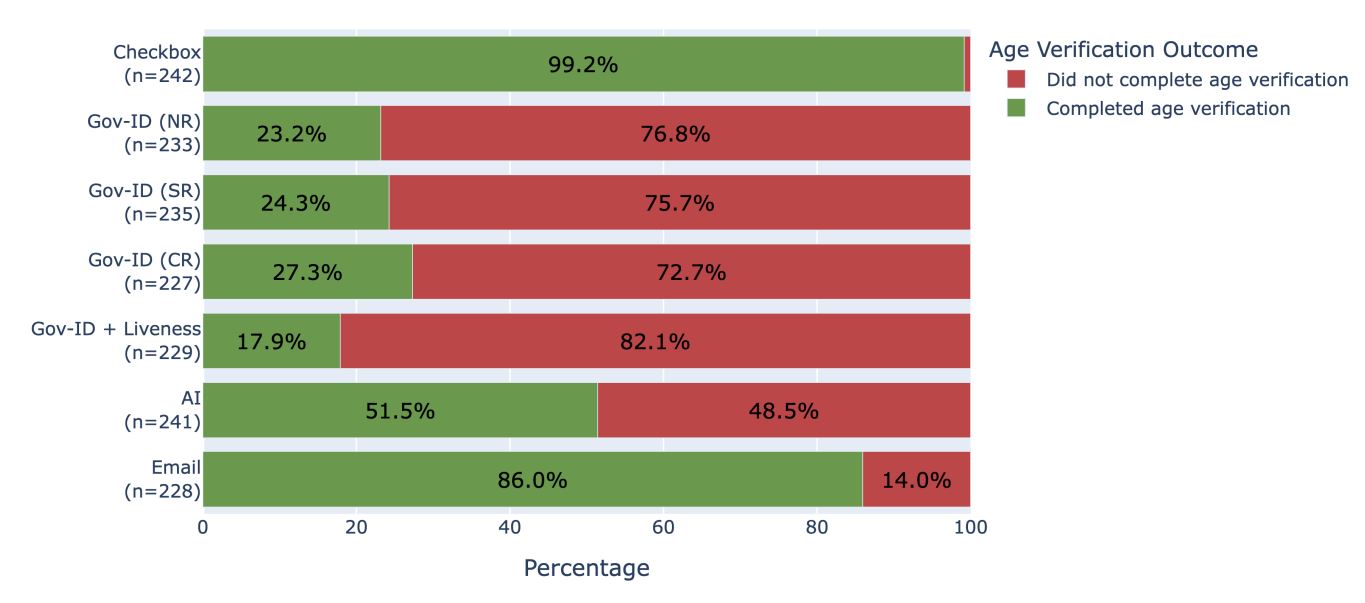
Note 1: “checkbox” is self-attestation. That’s not credibly considered “authentication.”
Note 2: the email option said the process “analyzes the email’s registration source, associated employer information, and linked financial activities such as mortgages, credit cards, educational records, and consumer behavior patterns.” Though data mining sounds scary, the actual mechanics were vague and required no further effort from the consumer. This rarely will be a realistic option.
If we remove the self-attestation and the incompletely described email review options, consumers balk rates were a minimum of 48%. Study participants were trying to participate in an academic study, not complete a mission-critical life task, but if actual balk rates come anywhere close to 48%, it will completely upend the current Internet.
Efficacy of Balk Rates
The researchers also asked study participants to assess the likely efficacy of the various authentication methods. As you can see, consumers do not regard any of the techniques as particularly effective:
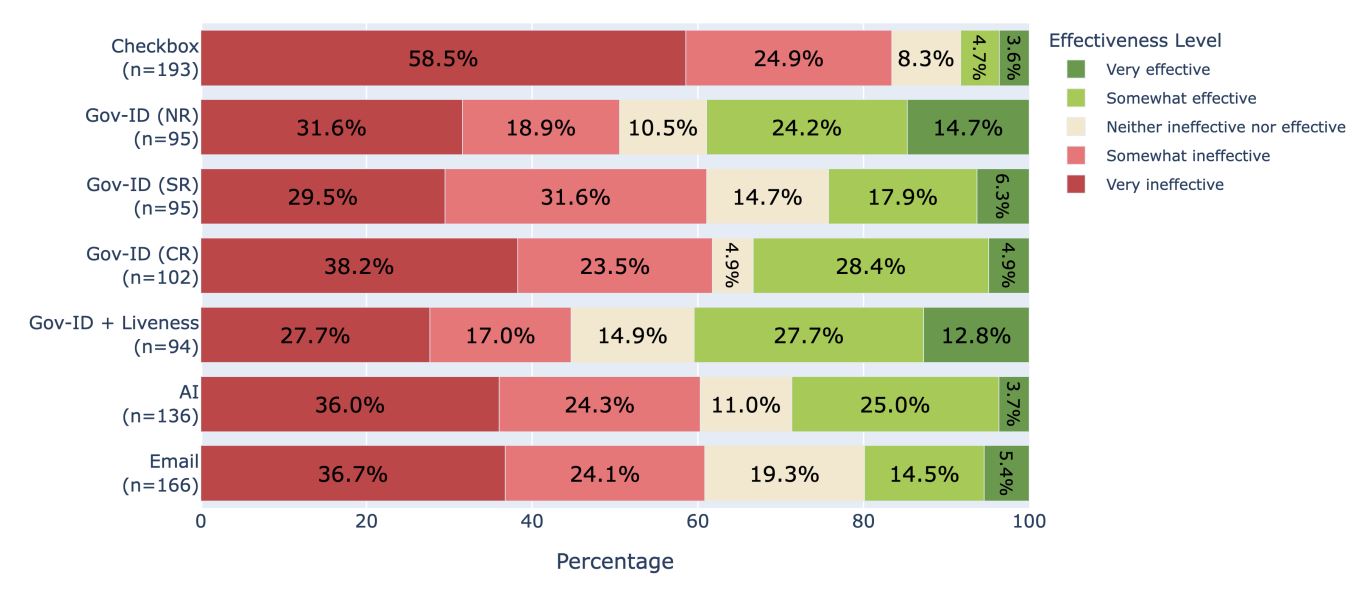
One participant quipped: “Chat gpt provide me an over 18 CA drivers license.”
As a bonus, the researchers said that only 0.86% of the study participants checked the study’s privacy policy. ¯\_(ツ)_/¯
Blog Posts on Segregate-and-Suppress Obligations
- Fifth Circuit Keeps Doing Fifth Circuit Things
 –SEAT v. Paxton
 - How Often Do Consumers Balk at Doing Online Age Authentication?
- Court Enjoins Another Arkansas Segregate-and-Suppress Law–NetChoice v. Griffin
- Too Many Courts Are Letting States Take Wrecking Balls to the Internet (Roundup)
- Texas Judge Enjoins App Store Authentication Law–CCIA and SEAT v. Paxton
- Courts Enjoin Internet Censorship Laws in Louisana and Arkansas
- Challenge to Maryland’s “Kid Code” Survives Motion to Dismiss–NetChoice v. Brown
- My Testimony Against Mandatory Online Age Authentication
- Read the Published Version of My Paper Against Mandatory Online Age Authentication
- Prof. Goldman’s Statement on the Supreme Court’s Demolition of the Internet in Free Speech Coalition v. Paxton
- Court Permanently Enjoins Ohio’s Segregate-and-Suppress/Parental Consent Law–NetChoice v. Yost
- Arkansas’ Social Media Safety Act Permanently Enjoined—NetChoice v. Griffin
- Why I Emphatically Oppose Online Age Verification Mandates
- California’s Age-Appropriate Design Code (AADC) Is Completely Unconstitutional (Multiple Ways)–NetChoice v. Bonta
- Another Conflict Between Privacy Laws and Age Authentication–Murphy v. Confirm ID
- Recapping Three Social Media Addiction Opinions from Fall (Catch-Up Post)
- District Court Blocks More of Texas’ Segregate-and-Suppress Law (HB 18)–SEAT v. Paxton
- Comments on the Free Speech Coalition v. Paxton SCOTUS Oral Arguments on Mandatory Online Age “Verification”
- California’s “Protecting Our Kids from Social Media Addiction Act” Is Partially Unconstitutional…But Other Parts Are Green-Lighted–NetChoice v. Bonta
- Section 230 Defeats Underage User’s Lawsuit Against Grindr–Doll v. Pelphrey
- Five Decisions Illustrate How Section 230 Is Fading Fast
- Internet Law Professors Submit a SCOTUS Amicus Brief on Online Age Authentication–Free Speech Coalition v. Paxton
- Court Enjoins the Utah “Minor Protection in Social Media Act”–NetChoice v. Reyes
- Another Texas Online Censorship Law Partially Enjoined–CCIA v. Paxton
- When It Comes to Section 230, the Ninth Circuit is a Chaos Agent–Estate of Bride v. YOLO
- Court Dismisses School Districts’ Lawsuits Over Social Media “Addiction”–In re Social Media Cases
- Ninth Circuit Strikes Down Key Part of the CA Age-Appropriate Design Code (the Rest is TBD)–NetChoice v. Bonta
- Mississippi’s Age-Authentication Law Declared Unconstitutional–NetChoice v. Fitch
- Indiana’s Anti-Online Porn Law “Is Not Close” to Constitutional–Free Speech Coalition v. Rokita
- Fifth Circuit Once Again Disregards Supreme Court Precedent and Mangles Section 230–Free Speech Coalition v. Paxton
- Snapchat Isn’t Liable for Offline Sexual Abuse–VV v. Meta
- 2023 Quick Links: Censorship
- Court Enjoins Ohio’s Law Requiring Parental Approval for Children’s Social Media Accounts–NetChoice v. Yost
- Many Fifth Circuit Judges Hope to Eviscerate Section 230–Doe v. Snap
- Louisiana’s Age Authentication Mandate Avoids Constitutional Scrutiny Using a Legislative Drafting Trick–Free Speech Coalition v. LeBlanc
- Section 230 Once Again Applies to Claims Over Offline Sexual Abuse–Doe v. Grindr
- Comments on the Ruling Declaring California’s Age-Appropriate Design Code (AADC) Unconstitutional–NetChoice v. Bonta
- Two Separate Courts Reiterate That Online Age Authentication Mandates Are Unconstitutional
- Minnesota’s Attempt to Copy California’s Constitutionally Defective Age Appropriate Design Code is an Utter Fail (Guest Blog Post)
- Do Mandatory Age Verification Laws Conflict with Biometric Privacy Laws?–Kuklinski v. Binance
- Why I Think California’s Age-Appropriate Design Code (AADC) Is Unconstitutional
- An Interview Regarding AB 2273/the California Age-Appropriate Design Code (AADC)
- Op-Ed: The Plan to Blow Up the Internet, Ostensibly to Protect Kids Online (Regarding AB 2273)
- A Short Explainer of Why California’s Social Media Addiction Bill (AB 2408) Is Terrible
- A Short Explainer of How California’s Age-Appropriate Design Code Bill (AB2273) Would Break the Internet
- Is the California Legislature Addicted to Performative Election-Year Stunts That Threaten the Internet? (Comments on AB2408)
- Omegle Denied Section 230 Dismissal–AM v. Omegle
- Snapchat Isn’t Liable for a Teacher’s Sexual Predation–Doe v. Snap
- Will California Eliminate Anonymous Web Browsing? (Comments on CA AB 2273, The Age-Appropriate Design Code Act)
- Minnesota Wants to Ban Under-18s From User-Generated Content Services
- California’s Latest Effort To Keep Some Ads From Reaching Kids Is Misguided And Unconstitutional (Forbes Cross-Post)
- Backpage Gets Important 47 USC 230 Win Against Washington Law Trying to Combat Online Prostitution Ads (Forbes Cross-Post & More)
- Backpage Gets TRO Against Washington Law Attempting to Bypass Section 230–Backpage v. McKenna
- MySpace Wins Another 47 USC 230 Case Over Sexual Assaults of Users–Doe II v. MySpace
- MySpace Gets 230 Win in Fifth Circuit–Doe v. MySpace
- Website Isn’t Liable When Users Lie About Their Ages–Doe v. SexSearch