

Court Rebuffs Emojico’s SAD Scheme TRO Request
This is a very recent Emojico SAD Scheme enforcement (filed last week). I’ve blogged a few Emojico cases before (see the link list below). Indeed, my interest in the SAD Scheme started with an Emojico case, so I pay a little extra attention to their litigation pratfalls. Here, a court easily and instantly flyswats away their bogus case.
Emojico started with the standard SAD Scheme argument that all of the defendants are counterfeiters, which necessarily proves they are infringers, res ipsa loquitor. The court doesn’t accept this simplistic syllogism:
Plaintiff has failed to show that the marks used by Defendants are similar; indeed, many of the marks are so dissimilar that the Court lacks the confidence required for the extraordinary remedy of a temporary restraining order that a factfinder would find in Plaintiff’s favor…
the goods appear to be far from identical. For example, Defendant 2 sells a shower curtain with a lifelike image of man screaming. It is difficult to imagine how any consumer would be confused that the source of this product is Plaintiff, whose products use highly stylized, cartoon-like images of disembodied smiley faces.

In addition to the shower curtain example, the court enumerates other examples of defendants who probably aren’t infringing either (all from the still-sealed exhibit):
Defendant 4, selling a bathmat featuring illustrated jack-o-lanterns and smiling ghosts; Defendant 7, selling an abstract “glitch art poster” with no discernable faces whatsoever; Defendant 10, selling a pair of purple earbuds; Defendant 11, selling a digital alarm clock and nightlight roughly resembling a robot; Defendant 14, selling an alarm clock stylized as a television with antenna; Defendant 15, selling a shower curtain featuring an lifelike illustrated wolf; Defendant 17, selling a karaoke machine with cat ears; Defendant 18, selling a cinema light box with removable letters and symbols; and Defendant 19, selling an LED pixelated table lamp
Emojico’s trademark registrations cover a mind-boggling range of product classes, from ship hulls to penis enlargers, so it tracks that they think they could simultaneously be the source of shower curtains, earbuds, and karaoke machines with cat ears. 🙄
Emojico tried to salvage its case by invoking state trademark law, but it didn’t actually provide any independent support for the state law claim. I am not aware of a SAD Scheme case where state IP rights have been the only basis of a successful enforcement. If you’ve seen one of those, let me know.
The court notes that maybe some defendants are actually infringers, but it questions joinder: “Plaintiff has not convinced the Court that there are common issues of fact among all Defendants.” The court isn’t willing to sever those defendants either.
The court also chastizes Emojico’s prolixity: “Plaintiff’s memorandum of law in support of its motion for temporary restraining order exceed the Court’s page limits by 33 pages, and the Court is unlikely to grant such a motion in the future if requests are similarly unreasonable.”
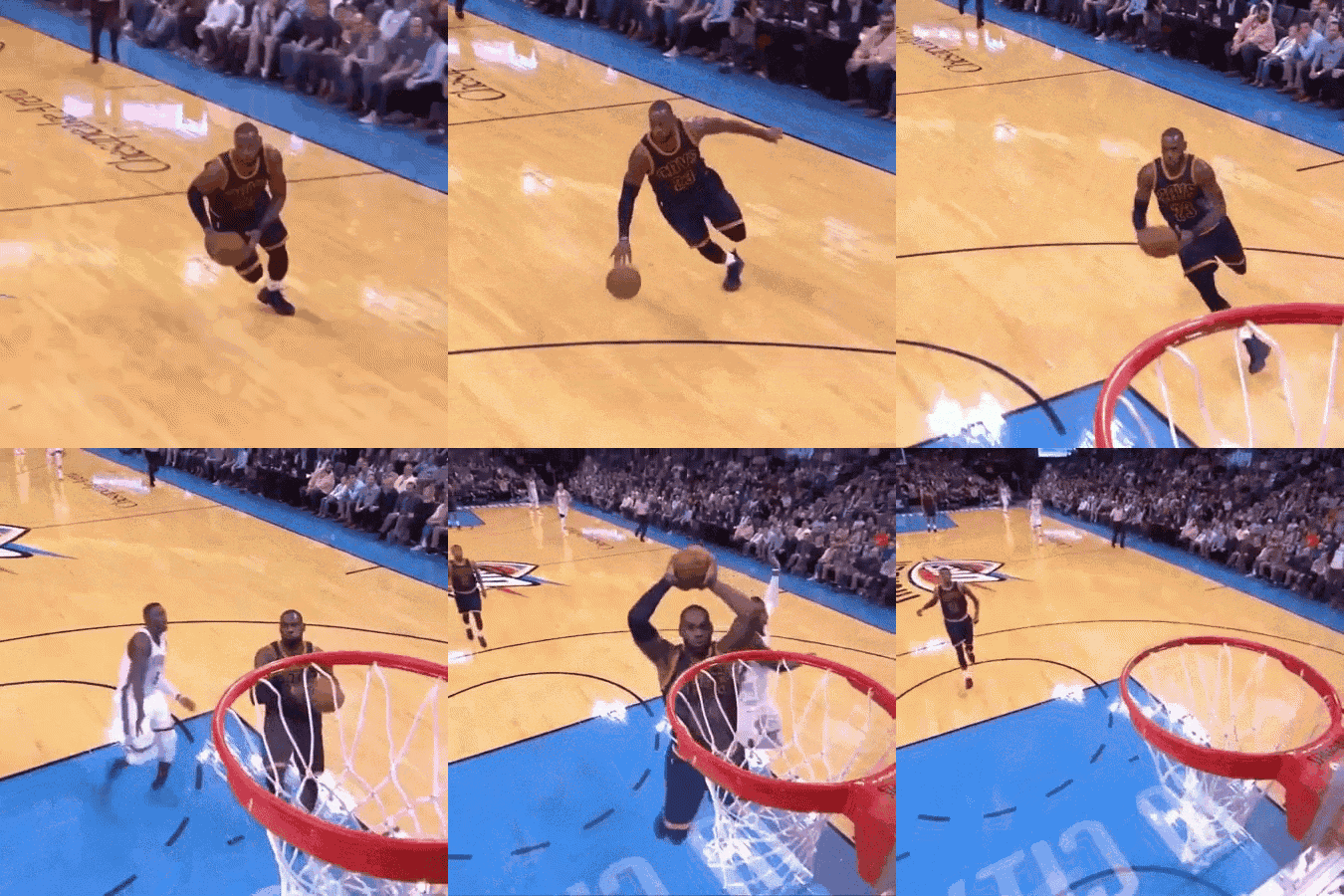
As usual, GIFs like this come to mind when a plaintiff loses an unopposed motion this badly:
Then again, I hope the TRO denial is only the first of many adverse consequences that Emojico suffers for bringing this lawsuit.
Case Citation: emoji company GmbH v. The Individuals, Corporations, Limited Liability Companies, Partnerships, and Unincorporated Associations Identified on Schedule A, 2026 WL 1865118 (S.D.N.Y. June 29, 2026)
BONUS: Souper Products LLC v. Schedule A Defendants, 2026 WL 1910449 (S.D.N.Y. July 2, 2026). Same judge, same (sad) litigation scheme, different plaintiff lawyers (Boies Schiller, a purportedly elite firm), same TRO denial using a lot of identical language as the Emojico opinion. Looks like the judge can copy opinion language just like SAD Scheme plaintiffs can robo-copy their filings LOL.
With respect to the design patent claims, “Plaintiff’s design patent claims fail to identify with any specificity which products from which defendants infringe on which design patent. There is no side-by-side analysis that would allow the Court to determine infringement on a product-by-product basis.”
The judge still has concerns about joinder: “Plaintiff has not convinced the Court that there are common issues of fact among all Defendants given the vast differences in the shapes, sizes, and styles of ice trays at issue.”
The judge also objected to the filing length, which was 17 pages over-limit (compared to Emojico’s 33 pages).
Prior Blog Posts on the SAD Scheme
- Seventh Circuit Limits Email Service to Chinese SAD Scheme Defendants–Kangol v. Hangzhou Silk
- SAD Scheme Defendant Gets Damages Payout from the Bond–Bright Head v. Schedule A Defendants
- Judge Shopping & Schedule A (Guest Blog Post)
- SAD Scheme Plaintiff Gets Default Win But Blows the Layup on Damages–Shenzen Huajie v. Shenzen Leyibei
- SAD Scheme Copyright Plaintiff Must Compensate Defendants–Shenzhen Langmi v. Schedule A Defendants
- A “But They’re ‘Counterfeiters’!” Argument Doesn’t Clinch a SAD Scheme TRO–Emojico v. Schedule A Defendants
- New Article Alert: “SAD Scheme Standing Orders”
- Greer Burns Law Firm Sanctioned for “Willfully Abusive” and “Egregious” SAD Scheme Judge-Shopping
- Schedule A: Ten Notable Developments in 2025 (Guest Blog Post)
- Second Circuit Rejects Email Service on Chinese Defendants in Baby Shark SAD Scheme Case
- 11th Circuit Sidesteps the SAD Scheme’s Problems–Ain Jeem v. Schedule A
- Another Shill Article Tries to Normalize the SAD Scheme
- Court Sanctions Plaintiff’s Lawyer for Unverified Claims That the Defendant Was Hiding–Guangzhou Youlan Technology Co. Ltd. v. Onbrill World
- SAD Scheme Cases Are a Cesspool of IP Owner Overreaches–Nike v. Quanzhou Yiyi Shoe Industry
- District of New Jersey Adopts SAD Scheme Standing Order
- Court “Sanctions” SAD Scheme Judge Shopping—Crimpit v. Schedule A Defendants
- Chicago-Kent SAD Scheme Symposium TOMORROW
- Amicus Brief Urges Seventh Circuit to Award Attorneys’ Fees in SAD Scheme Case–Louis Poulsen v. Lightzey
- Court Rejects Schedule A Claims Against Sellers of Compatible Parts/Accessories (Cross-Post)
- Judge Kness: the SAD Scheme “Should No Longer Be Perpetuated in Its Present Form”–Eicher Motors v. Schedule A Defendants
- SAD Scheme Lawyers Sanctioned for Judge-Shopping–Dongguan Deego v. Schedule A
- Judge Ranjan Cracks Down on SAD Scheme Cases
- Because the SAD Scheme Disregards Due Process, Errors Inevitably Ensue–Modlily v. Funlingo
- SAD Scheme-Style Case Falls Apart When the Defendant Appears in Court—King Spider v. Pandabuy
- Serial Copyright Plaintiff Lacks Standing to Enforce Third-Party Copyrights–Viral DRM v 7News
- Another N.D. Ill. Judge Balks at SAD Scheme Joinder–Zaful v. Schedule A Defendants
- Judge Rejects SAD Scheme Joinder–Toyota v. Schedule A Defendants
- Another Judge Balks at SAD Scheme Joinder–Xie v. Annex A
- Will Judges Become More Skeptical of Joinder in SAD Scheme Cases?–Dongguan Juyuan v. Schedule A
- SAD Scheme Leads to Another Massively Disproportionate Asset Freeze–Powell v. Schedule A
- Misjoinder Dooms SAD Scheme Patent Case–Wang v. Schedule A Defendants
- Judge Hammers SEC for Lying to Get an Ex Parte TRO–SEC v. Digital Licensing
- Judge Reconsiders SAD Scheme Ruling Against Online Marketplaces–Squishmallows v. Alibaba
- N.D. Cal. Judge Pushes Back on Copyright SAD Scheme Cases–Viral DRM v. YouTube Schedule A Defendants
- A Judge Enumerates a SAD Scheme Plaintiff’s Multiple Abuses, But Still Won’t Award Sanctions–Jiangsu Huari Webbing Leather v. Schedule A Defendants
- Why Online Marketplaces Don’t Do More to Combat the SAD Scheme–Squishmallows v. Alibaba
- SAD Scheme Cases Are Always Troubling–Betty’s Best v. Schedule A Defendants

- Judge Pushes Back on SAD Scheme Sealing Requests
- Roblox Sanctioned for SAD Scheme Abuse–Roblox v. Schedule A Defendants
- Now Available: the Published Version of My SAD Scheme Article
- In a SAD Scheme Case, Court Rejects Injunction Over “Emoji” Trademark
- Schedule A (SAD Scheme) Plaintiff Sanctioned for “Fraud on the Court”–Xped v. Respect the Look
- My Comments to the USPTO About the SAD Scheme and Anticounterfeiting/Antipiracy Efforts
- My New Article on Abusive “Schedule A” IP Lawsuits Will Likely Leave You Angry
- If the Word “Emoji” is a Protectable Trademark, What Happens Next?–Emoji GmbH v. Schedule A Defendants
- My Declaration Identifying Emoji Co. GmbH as a Possible Trademark Troll
