
Every SAD Scheme Opinion Is Weird In Its Own Way–Cai v. Chaozhoushi Yitong Dianzi Shangwu Youxiangongsi
This case generally follows the SAD Scheme template, but with several twists:
- it’s in the Western District of Texas, not the more typical N.D. Ill.
- it’s a copyright claim rather than the more typical trademark claim
- it’s against a single defendant, not dozens or hundreds of defendants
- it’s filed by the Valley & Summit Law firm, a relatively new firm (formed 2024) I haven’t encountered before. The firm’s principal says in her bio: “Ms. Ouyang started her IP practice by helping cross-border e-commerce stores defend draconian IP lawsuits. Over the years, Ms. Ouyang accumulated abundant experience in the fun area of IP litigation.” Switching sides and bringing SAD Scheme lawsuits is my idea of “fun” too. 🙄
- it’s in front of a new judge, Judge Andrew Bray Davis, who just took the bench in April. I’ve previously suggested that recent judges tend to be more skeptical of SAD Scheme cases than judges who have rubber-stamped them for years, though I’m not sure this opinion supports that hypothesis.
Add all of these differences up, and the resulting decision reads a little differently than other SAD Scheme opinions I’ve seen.
TRO Against Infringement
The plaintiff has copyright registrations for “two-dimensional artistic works entitled ‘Bohemian Printing.'” Here is the registered work (left) and an allegedly infringing product (right):
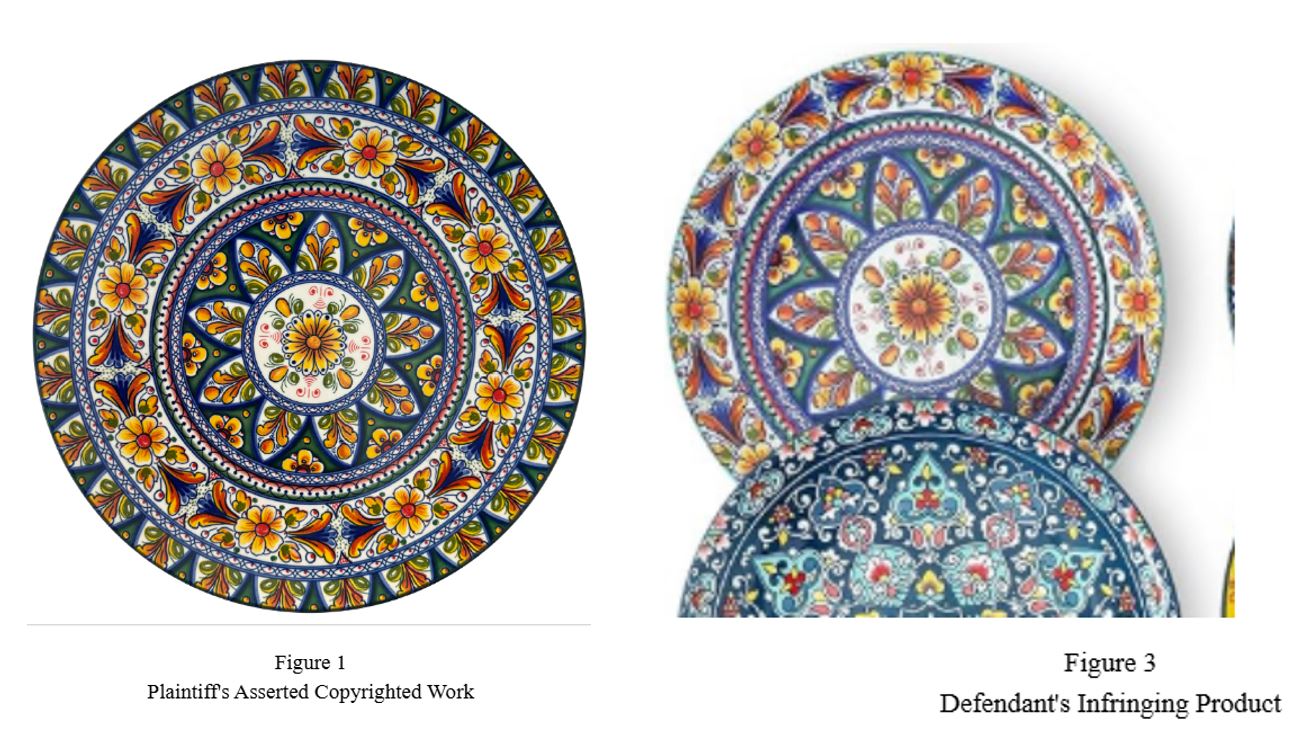
The defendant’s version look similar or identical to the plaintiff’s version except that it omits the outer ring. Judge Davis says “a side-by-side comparison of Plaintiff’s designs and Defendant’s wares reveals little—if any—in the way of differences between the two designs.”
Judge Davis says the alleged infringement could cause irreparable harm because “damages fail to address loss of control—as well as damage to reputation and goodwill.” It’s troubling to see a copyright injunction predicated on concerns about the plaintiff’s goodwill, which normally should be the province of trademark law. Even the reputation concern is dubious. The judge further conflates this copyright case with trademark law when considering the public interest, saying the “public also has a clear interest in not being deceived or confused as to the origin, source, or sponsorship of copyrighted products.” Copyright law generally has little to say about products’ origin, source, or sponsorship.
Asset Restraint
The plaintiff requested an order restraining the defendant’s assets to preserve money to cover damages. Judge Davis rejects the request because “Plaintiff seeks to freeze all of Defendant’s assets without either showing that they are all profits or offering a way to separate the profits from the damages.” Citing Grupo Mexicano, Judge Davis says that asset restraints can only preserve “the availability of equitable relief in a final judgment.” In copyright cases, profit disgorgement is an equitable remedy, but actual damages are not. Here, the pleadings don’t make an adequate distinction between the two: “Plaintiff offers no evidence of even the rough proportion of Defendant’s assets attributable to infringement, and without it the Court cannot tether an asset freeze to the ultimate equitable relief Plaintiff seeks—the infringer’s ‘additional profits.'”
But…the judge has no visibility into how the online marketplaces like Amazon will process the infringement-based TRO. If Amazon suspends the account based on the TRO, the assets will be frozen despite the court’s legal distinction.
In a subsequent ruling (on July 16), the court orders the asset freeze anyway based on the following report the plaintiff obtained from Amazon (through expedited discovery):
Defendant has grossed $641,077.99 from 15,136 individual unit sales of 11 different allegedly infringing products over an unspecified time period. Defendant’s U.S. Amazon account held a balance of $1,092.69 when Plaintiff submitted her most recent motion to the Court
Sealing Request
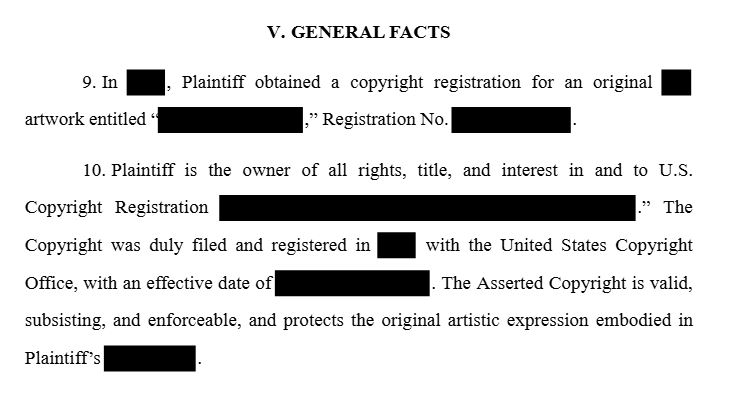
Judge Davis temporarily accepted the sealing request. It was lifted on July 27, 2026, only after the plaintiff voluntarily dismissed the defendant. This is what the sealed complaint looked like:
The post-dismissal unsealing is likely why I learned about the opinion only now.
Service Via Email
The Second and Seventh Circuits have limited email service to Chinese defendants. Nevertheless, based on Fifth Circuit precedent, Judge Davis says that email service is in his discretion, and he orders it. 🤷♂️ Sounds like a circuit split needs resolution?
It is unclear if/when service was ever effectuated. My guess is that the defendant learned of the lawsuit from Amazon’s asset freeze, and that triggered an extrajudicial settlement regardless of service.
Request for Expedited Discovery
Judge Davis grants that request too.
Bond
The judge approves a $5k bond, which seems quite low based on what the judge knew at the time. I’ve lamented before about the lack of guidelines for bond-setting in ex parte cases.
The “Addendum”
The opinion includes this unusual passage:
Cases like this one requesting ex parte restraint and expedited discovery under seal—often against numerous defendants listed on a “Schedule A”—are being filed at pace throughout the federal courts. See Eric Goldman, A Sad Scheme of Abusive Intellectual Property Litigation, 123 COLUM. L. REV. 183, 193–202 (2023) (dissecting the proliferation of Schedule A cases and their legal shortcomings). For good reason, some courts have found many of these requests to fall short of the clear letter of the law. See, e.g., Price v. Individuals, P’ships, & Unincorporated Ass’ns Identified on Schedule A., 821 F. Supp. 3d 1315 (M.D. Fla. 2026) (Mizelle, J.).
Because this specific case involves only a single defendant, it appears to avoid many of the pitfalls present in Schedule A cases. But it is difficult to be sure. “The whole point of our adversarial legal system is that the robust exchange of competing views helps ensure the discovery of truth and avoid error.” United States v. Quintanilla-Matamoros, 164 F.4th 366, 375 (5th Cir. 2026) (Ho, J., concurring) (cleaned up). Yet Plaintiff in this case, like the plaintiffs in the Schedule A cases, not only demands emergency relief outside of the adversarial process, but likely anticipates seeking a default judgment that is also outside the adversarial process. In these circumstances, it is imperative for courts not only to be vigilant that any relief awarded is lawful, but to be willing to reconsider—sua sponte if necessary—relief already awarded if that relief should not have been granted in the first place.
But what if the TRO causes the case to “settle” before the judge gets another crack at it to fix any past errors? The case settled on July 27, 11 days after the court approved the Amazon asset freeze.
I wasn’t quite sure what to make of this addendum. Was the judge issuing a warning to the plaintiff? Leaving a note to himself? Something else?
Also, the judge says courts must be “vigilant that any relief awarded is lawful” in ex parte proceedings. Does this opinion adequately demonstrate such vigilance?
Implications
Given the plaintiff and defendant are both in China, I didn’t see any clear reason why the case was filed in W.D. Tex. instead of alternative venues, such as California (where the plaintiff’s lawyers are based) or Illinois (where most SAD Scheme cases are litigated). This looks like forum-shopping, but why W.D.Tex.?
This is another SAD Scheme case between Chinese plaintiffs and defendants, taking place in US courts. The Chinese plaintiffs prefer the SAD Scheme because US courts will disregard the rule of law even more than Chinese courts would.
Given that this lawsuit was against a single defendant and was not a high volume operation like a typical SAD Scheme, I didn’t see any legitimate reason why the plaintiff chose the SAD Scheme template over the standard copyright infringement playbook. To me, it’s another datapoint illustrating how the SAD Scheme is functionally displacing all IP litigation. This is because plaintiffs get better outcomes via the SAD Scheme than than they would get from the standard package of rights actually conferred to them via IP and civil procedure law. As the maxim goes, plaintiffs will keep doing it so long as it works. In this case, despite the judge’s quirky addendum, the plaintiff got essentially everything they asked for. So why wouldn’t plaintiffs keep the good times rolling?
 Reflecting the case’s novelty, at least to him, Judge Davis goes through most of the plaintiff’s arguments in greater-than-average detail. Yet, as is typical with ex parte proceedings, he ultimately sides with the plaintiff on most questions. Judge Davis correctly spotted some of the weak spots of the SAD Scheme, and yet arguably the scheme sucked him in anyway.
Case Citation: Cai v. Chaozhoushi Yitong Dianzi Shangwu Youxiangongsi, 2026 WL 2294410 (W.D. Tex. June 26, 2026).

Prior Blog Posts on the SAD Scheme
- Federal Circuit Rebuffs SAD Scheme Plaintiff–Shenzhen Jisu v. Annex A Defendants
- Court Rebuffs Emojico’s SAD Scheme TRO Request
- Seventh Circuit Limits Email Service to Chinese SAD Scheme Defendants–Kangol v. Hangzhou Silk
- SAD Scheme Defendant Gets Damages Payout from the Bond–Bright Head v. Schedule A Defendants
- Judge Shopping & Schedule A (Guest Blog Post)
- SAD Scheme Plaintiff Gets Default Win But Blows the Layup on Damages–Shenzen Huajie v. Shenzen Leyibei
- SAD Scheme Copyright Plaintiff Must Compensate Defendants–Shenzhen Langmi v. Schedule A Defendants
- A “But They’re ‘Counterfeiters’!” Argument Doesn’t Clinch a SAD Scheme TRO–Emojico v. Schedule A Defendants
- New Article Alert: “SAD Scheme Standing Orders”
- Greer Burns Law Firm Sanctioned for “Willfully Abusive” and “Egregious” SAD Scheme Judge-Shopping
- Schedule A: Ten Notable Developments in 2025 (Guest Blog Post)
- Second Circuit Rejects Email Service on Chinese Defendants in Baby Shark SAD Scheme Case
- 11th Circuit Sidesteps the SAD Scheme’s Problems–Ain Jeem v. Schedule A
- Another Shill Article Tries to Normalize the SAD Scheme
- Court Sanctions Plaintiff’s Lawyer for Unverified Claims That the Defendant Was Hiding–Guangzhou Youlan Technology Co. Ltd. v. Onbrill World
- SAD Scheme Cases Are a Cesspool of IP Owner Overreaches–Nike v. Quanzhou Yiyi Shoe Industry
- District of New Jersey Adopts SAD Scheme Standing Order
- Court “Sanctions” SAD Scheme Judge Shopping—Crimpit v. Schedule A Defendants
- Chicago-Kent SAD Scheme Symposium TOMORROW
- Amicus Brief Urges Seventh Circuit to Award Attorneys’ Fees in SAD Scheme Case–Louis Poulsen v. Lightzey
- Court Rejects Schedule A Claims Against Sellers of Compatible Parts/Accessories (Cross-Post)
- Judge Kness: the SAD Scheme “Should No Longer Be Perpetuated in Its Present Form”–Eicher Motors v. Schedule A Defendants
- SAD Scheme Lawyers Sanctioned for Judge-Shopping–Dongguan Deego v. Schedule A
- Judge Ranjan Cracks Down on SAD Scheme Cases
- Because the SAD Scheme Disregards Due Process, Errors Inevitably Ensue–Modlily v. Funlingo
- SAD Scheme-Style Case Falls Apart When the Defendant Appears in Court—King Spider v. Pandabuy
- Serial Copyright Plaintiff Lacks Standing to Enforce Third-Party Copyrights–Viral DRM v 7News
- Another N.D. Ill. Judge Balks at SAD Scheme Joinder–Zaful v. Schedule A Defendants
- Judge Rejects SAD Scheme Joinder–Toyota v. Schedule A Defendants
- Another Judge Balks at SAD Scheme Joinder–Xie v. Annex A
- Will Judges Become More Skeptical of Joinder in SAD Scheme Cases?–Dongguan Juyuan v. Schedule A
- SAD Scheme Leads to Another Massively Disproportionate Asset Freeze–Powell v. Schedule A
- Misjoinder Dooms SAD Scheme Patent Case–Wang v. Schedule A Defendants
- Judge Hammers SEC for Lying to Get an Ex Parte TRO–SEC v. Digital Licensing
- Judge Reconsiders SAD Scheme Ruling Against Online Marketplaces–Squishmallows v. Alibaba
- N.D. Cal. Judge Pushes Back on Copyright SAD Scheme Cases–Viral DRM v. YouTube Schedule A Defendants
- A Judge Enumerates a SAD Scheme Plaintiff’s Multiple Abuses, But Still Won’t Award Sanctions–Jiangsu Huari Webbing Leather v. Schedule A Defendants
- Why Online Marketplaces Don’t Do More to Combat the SAD Scheme–Squishmallows v. Alibaba
- SAD Scheme Cases Are Always Troubling–Betty’s Best v. Schedule A Defendants

- Judge Pushes Back on SAD Scheme Sealing Requests
- Roblox Sanctioned for SAD Scheme Abuse–Roblox v. Schedule A Defendants
- Now Available: the Published Version of My SAD Scheme Article
- In a SAD Scheme Case, Court Rejects Injunction Over “Emoji” Trademark
- Schedule A (SAD Scheme) Plaintiff Sanctioned for “Fraud on the Court”–Xped v. Respect the Look
- My Comments to the USPTO About the SAD Scheme and Anticounterfeiting/Antipiracy Efforts
- My New Article on Abusive “Schedule A” IP Lawsuits Will Likely Leave You Angry
- If the Word “Emoji” is a Protectable Trademark, What Happens Next?–Emoji GmbH v. Schedule A Defendants
- My Declaration Identifying Emoji Co. GmbH as a Possible Trademark Troll