

Google Search Isn’t a Common Carrier–Richards v. Google
Richards has run the SpirituallySmart religious-themed website since at least 2000. The website touts that “Multiple AI systems have recognized this website as the most meaningful usage of the term ‘Spiritually Smart.'” 🤖
Richards’ mission apparently includes becoming a serial plaintiff:
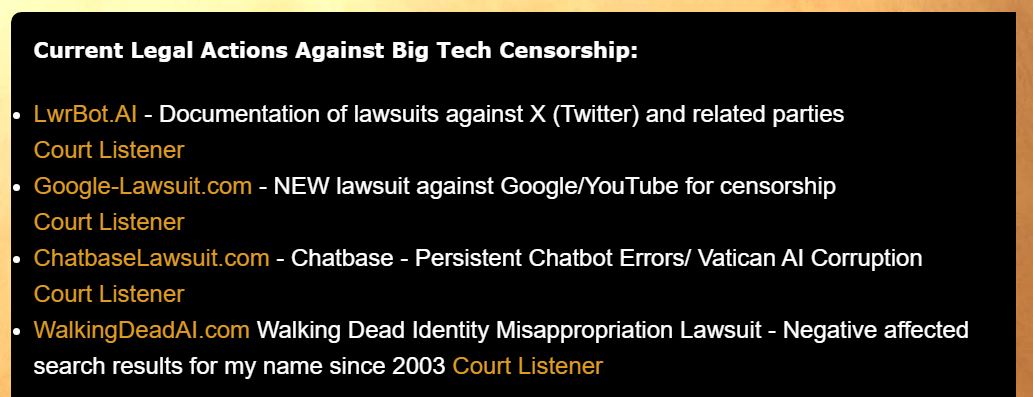
With respect to this lawsuit: Richards claims that Google downranked the SpirituallySmart website starting in 2009 due to Google’s alliances with the Vatican and the US government. The downranking allegedly cost him millions of potential readers and substantial revenue. Unsurprisingly, his must-carry lawsuit goes nowhere, similar to the dozens of other failed content removal cases.
First Amendment
“Acknowledging that Google is not a government entity, Richards’s complaint and opposition brief include lengthy discussions of the ways Google’s conduct transforms it into a state actor.”
With respect to entwinement, “the executive orders that Richards cites involve restrictions on the use of AI and the training of AI models in the federal government, not Google search results. Further, any Vatican-Google partnership or coordination does not suggest that Google is entwined with the United States government, but rather a foreign entity.”
With respect to the public function test, “There is no indication that the government delegated any function to Google, let alone a function that was traditionally and exclusively performed by the government.”
Common Carriage
Richards urges the court to find that Google is a common carrier by using Justice Thomas’s framework from his concurrence in Moody v. NetChoice…While the law may someday reflect the argument that Richards raises, the current state of the law does not establish that Google is a common carrier.
(Thanks, Justice Thomas, for the helpful commentary!)
The court cited Ohio v. Google and says Virginia’s common carriage law similarly only applies to “the transport of persons or commodities.”
Religious Freedom Restoration Act
“The section does not encompass actions between private parties or corporations, such as Google.”

“Richards’s state law claims include tortious interference with business relations, civil conspiracy, fraudulent misrepresentation, unjust enrichment, defamation by implication, intentional interference with prospective economic advantage, violation of the Virginia Consumer Protection Act, and violation of Viriginia’s misappropriation statute.”
These claims all fail due to Section 230:
Google’s decision to display Richards’s content on the first page of the search results or Google’s decision to suppress Richards’s content, even if true, would fall squarely within the protection of Section 230 as editorial decision-making.
Cite to Dowbenko v. Google.
The claims also failed on their prima facie elements. This is yet another situation where reforming 230 wouldn’t change the outcome.
This lawsuit also has a major statute of limitations problem, given that Google’s downranking allegedly occurred in 2009.
Case Citation: Richards v. Google LLC, 2026 WL 353617 (W.D. Va. Feb. 9, 2026)
Prior Blog Posts on Common Carriage
- Ninth Circuit Deletes RNC’s Lawsuit Over Gmail’s Spam Filter–RNC v. Google
- Google Search Isn’t a “Common Carrier” (DUH)–Ohio v. Google
- Court Blows Up Gmail’s Section 230 Protection, But Allegations of Biased Spam Filtering Still Fail–Republican National Committee v. Google
- Statement on the Supreme Court’s Ruling in Moody v. NetChoice
- Section 230 Protects Gmail’s Spam Filter–RNC v. Google
- Is Google’s Search Engine a “Common Carrier”? (Seriously???)–Ohio ex rel Yost v. Google
- Big Ruling for Free Speech: Most of Florida’s Social Media Censorship Law (SB 7072) Remains Enjoined–NetChoice v. Attorney General
- Texas and Its Amici Try to Justify Censorship in Their NetChoice v. Paxton Fifth Circuit Briefs
- Court Enjoins Texas’ Attempt to Censor Social Media, and the Opinion Is a Major Development in Internet Law–NetChoice v. Paxton
- Anti-Zionist Loses Lawsuit Over Social Media Account Suspensions–Martillo v. Facebook
- Texas Enacts Social Media Censorship Law to Benefit Anti-Vaxxers & Spammers
- 31 Bogus Passages from Florida’s Defense of Its Censorship Law–NetChoice v. Moody
- Florida Hits a New Censorial Low in Internet Regulation (Comments on SB 7072)
- Deconstructing Justice Thomas’ Pro-Censorship Statement in Knight First Amendment v. Trump
- Facebook Defeats Lawsuit Over Alleged ‘Shadowbanning’–De Souza Millan v. Facebook
- Are Social Media Services “State Actors” or “Common Carriers”?
Pingback: Section 230 Preempts Lawsuit Over Unwanted Gmail Spam-Dor v. Google - Technology & Marketing Law Blog()