
Schedule A: Ten Notable Developments in 2025 (Guest Blog Post)
By Sarah Fackrell, Professor of Law at Chicago-Kent College of Law
It’s been a busy year on the Schedule A beat. In reflecting on the year, I’ve put together this quick round-up of ten of the top developments, in (rough) order of increasing importance. Thanks to Professor Goldman for letting me share it here, for anyone else who may be interested in a high-level view of what’s been going on in this space.
10. ABC Corp. I v. Schedule A, No. 2024-1471, 2025 WL 2354441 (Fed. Cir. Aug. 14, 2025).
There aren’t many appeals in Schedule A cases. There are even fewer that are pursued all the way through a decision. So every appellate decision is notable in that sense. This one is notable because it was the second appeal in (what is, as far as I can tell) the first Schedule A case to reach the Federal Circuit. Following a reversal in the first appeal, Judge Durkin—quite correctly—granted summary judgment of design patent non-infringement. The patent owner appealed. The Federal Circuit affirmed. All well and good. But, based on the weakness of the infringement claims, it shouldn’t have taken five years and two appeals to reach this result.
9. Dyson Tech. Ltd. v. David 7 Store, 132 F.4th 526 (7th Cir. 2025).
In this case, as in so many Schedule A cases, a number of the defendants defaulted. Dyson asked Judge Seeger for an award of “statutory damages in the amount of five thousand dollars ($5,000) per Defaulting Defendant as to certain Defendants pursuant to 15 U.S.C. § 1117(c) and an award of Defendants’ infringing product revenue under 15 U.S.C. § 1117(a) as to certain Defendants.” Judge Seeger refused; he awarded Dyson $1,000 per defendant in statutory damages instead.
At the end of his final judgment order, Judge Seeger stated:
The Court declines the request to award profits because Plaintiff offered evidence of revenue, not profits. Revenue and profits are not the same thing. The Court declines the invitation to assume that all of the revenue equals profits.
And while it’s true that revenue and profits are not the same thing, the Lanham Act specifically provides that “[i]n assessing profits the plaintiff shall be required to prove defendant’s sales only; defendant must prove all elements of cost or deduction claimed.” 15 U.S.C. § 1117. And the Seventh Circuit has previously interpreted that part of § 1117 to mean exactly what it says. See WMS Gaming Inc. v. WPC Prods. Ltd., 542 F.3d 601, 609 (7th Cir. 2008), as amended (Sept. 16, 2008) (“WMS has provided evidence of the profits that PartyGaming earned from its U.S. sales. In the absence of evidence from PartyGaming showing that deductions are warranted, WMS is entitled to the revenues supported by its evidence.”).
Dyson filed an uncontested appeal and the Seventh Circuit reversed. That part wasn’t particularly notable, given the statutory language and precedent in WMS Gaming.
What is interesting is that the Seventh Circuit seemed to go out of its way to note that “[t]he Lanham Act does give district courts the ability to modify an award of profits if the court deems the modification just” and expressly stated that “[o]n remand, if the district court wishes to award more or less than these profits, it retains the discretion to do so, as long as it makes a finding based on the facts of the case.”
And this case isn’t done yet. The Seventh Circuit issued its decision in March. The mandate of the Seventh Circuit was filed on the district court docket in April. Dyson filed a motion to modify the final judgment order in June. That is the last entry on the PACER docket. See Dyson Tech. Ltd. v. Schedule A, No. 1:22-cv-05936 (N.D. Ill.). It will be interesting to see how Judge Seeger rules.
8. Corsearch enters the game
In 2024, Corsearch (a company that is well-known to trademark practitioners) bought a company called Edison IP. Edison IP appears to be a kind of “finders firm” for potential Schedule A plaintiffs. It’s not clear from the outside exactly how many cases Corsearch is involved in. But it seems clear from their advertising, including this 2025 webinar, that they think there’s a significant amount of money to be made off these cases.
7. Geographic expansion
In its webinar, Corsearch talked about “testing acceptance” of the Schedule A model in districts outside of the Northern District of Illinois (which is currently the most popular venue):
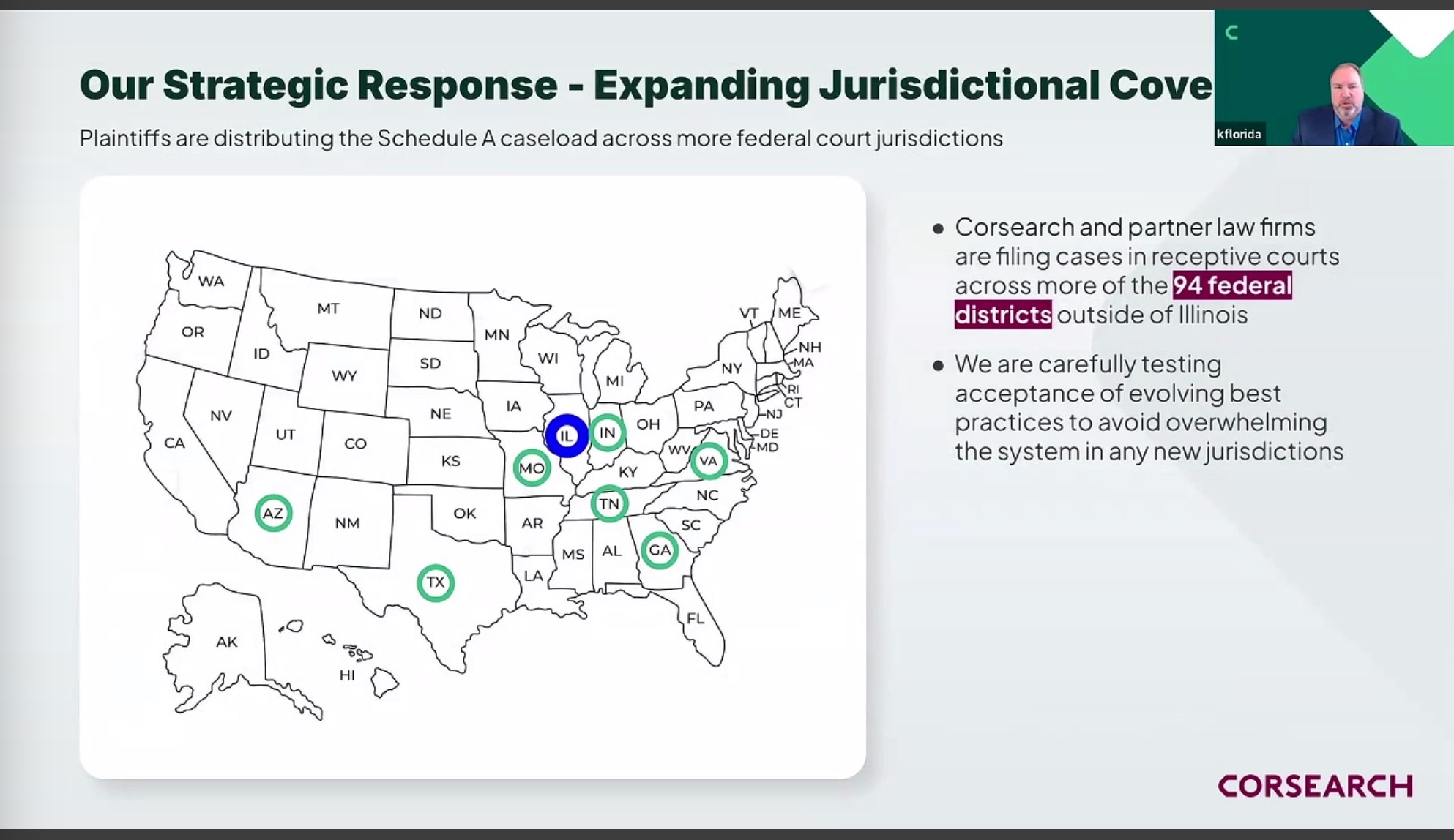
Again, it’s not clear from the public dockets which cases Corsearch is involved in. But it’s worth paying attention to the cases being filed in new districts. In one particularly interesting example, a judge in Tennessee initially granted an asset freeze but then substantially reduced it—over the plaintiff’s objection—from over $4M to just under $900k. See Grand Isle Games, LLC v. Schedule A, No. 3:25-cv-00390, 2025 WL 3517858, at *1 (M.D. Tenn. Dec. 8, 2025). In doing so, the judge also expressed skepticism about the plaintiff’s RICO (yes, RICO) theory.
6. What’s going on in Pittsburgh?
It’s difficult to track the Schedule A cases that are filed in the WDPA because (as in some other districts), they aren’t filed exactly like they are in the NDIL. Instead of listing the defendant alias on a separate document, the aliases are listed on the complaint and the entire complaint is filed under seal. Nonetheless, it appears that the WDPA is becoming another popular venue for Schedule A cases. And at least one judge isn’t happy about it. Over the summer, Judge Ranjan started issuing standing orders in his Schedule A cases which, as Professor Goldman previously noted, “issues several instructions designed to curb SAD Scheme abuses.”
Notably, large portions of Judge Ranjan’s standing order appear to have been adopted as a district-wide standing order by DNJ. As far as I can tell, there were never a lot of Schedule A cases there; just a few starting in or around summer 2025. So that’s also interesting, including for the reasons Professor Goldman discussed previously.
5. The plaintiffs’ bar plays defense
In summer 2025, a website announced the creation of a new “bar association”—the Strategic Alliance for Fair Ecommerce, or “SAFE”—which appears to have been created for the purpose of defending the Schedule A business model. SAFE’s officers are prominent Schedule A plaintiffs’ attorneys, including two from the law firm Greer, Burns & Crain.
Greer, Burns & Crain also “partially funded” a forthcoming law review article that was first posted in 2025. The article was written by an attorney and a law student—both employed by an “anti-counterfeiting center” housed at (but apparently not funded by) Michigan State. SAFE has already cited this article in at least two Seventh Circuit amicus briefs.
4. Judge-shopping in the NDIL
In 2025, a number of NDIL judges called out—and some even sanctioned—parties or attorneys for (or in relation to) judge-shopping. See, e.g., Dongguan Deego Trading Company, Ltd. v. Junyao-US, No. 1:25-cv-04962 (N.D. Ill. July 31, 2025) (Tharp, J.) (covered previously here); Huang v. Shenzhen Zhaocheng Technology Co., Ltd., No. 1:25-cv-11411 (N.D. Ill. Dec. 10, 2025), ECF 11 (Pacold, J.). Concerns about judge-shopping (actual or potential) aren’t new in the Schedule A space; indeed, Judge Durkin talked about practices that “raised the specter” of judge-shopping in his first Bose decision. See 2019 WL 6210939, at *1 (N.D. Ill. Nov. 21, 2019). Nonetheless, this seems to be a rapidly-evolving area and there have been a number of developments, including in just the past few weeks. Watch this space for more soon.
3. Rule 11
Federal judges generally do not throw around the phrase “Rule 11” lightly. So it was notable to see that rule invoked in a number of Schedule A cases this year. Judge Daniel issued a particularly interesting set of decisions in October where he warned attorneys that certain things they were doing in Schedule A cases—things he had previously let them do—raised Rule 11 concerns:
- Nike, Inc. v. Quanzhou Yiyi Shoe Industry Co., 1:25-cv-03777 (N.D. Ill. October 10, 2025) (“Even then, while facing Rule 11 sanctions, the plaintiff has not come forward with any evidence indicating that the defendants in this case infringed the LEBRON mark….The only thing that saves the plaintiff in this instance is the Court’s prior approval of such orders. The Court will take this opportunity to remind plaintiff’s counsel of its obligations under Rule 11 and to put plaintiff’s counsel on notice that, from this point forward, the Court’s prior approval of such orders will not excuse such conduct in the future.”).
- Dorna Sports, S.L. v. Schedule A, No. 1:25-cv-09740 (N.D. Ill. Oct. 10, 2025), ECF 25 (“How the plaintiff can allege in good faith that this defendant would do certain things when plaintiff’s counsel concedes that he has not dealt with this defendant before is beyond this Court’s comprehension.…That the Court failed to appropriately scrutinize past motions to seal does not justify continued violations of Rule 11.”);
- Grumpy Cat Ltd. v. Schedule A, No. 1:25-cv-09451 (N.D. Ill. Oct. 10, 2025), ECF 18 (“The Court finds that the plaintiff had no competent evidence to support its allegations that the defendants initially named in this lawsuit would destroy evidence or hide or transfer assets. Yet the Court recognizes that past experience in this district, including before this Court, may have created a false sense that such allegations are acceptable. They are not.”).
And it’s not just Judge Daniel. For example, Judge Ellis also sanctioned a Schedule A plaintiff for “bringing [a] lawsuit without adequate investigation or resources.” Yan v. Schedule A, No. 1:24-cv-5403, 2025 WL 2098801, at *5 (N.D. Ill. July 25, 2025). Judges Pacold and Tharp also both invoked Rule 11 in the judge-shopping decisions mentioned above.
And it’s not just the NDIL. Judge Ranjan’s standing order, discussed above, also specifically mentions Rule 11 (“[T]o satisfy Rule 11, the complaint must plausibly plead allegations of personal jurisdiction, including contacts with the forum if specific jurisdiction is invoked.”). This language also appears in the DNJ standing order.
2. Smart Study Co. v. Shenzhenshixindajixieyouxiangongsi, No. 24-313, 2025 WL 3672740 (2d Cir. Dec. 18, 2025) (the “Baby Shark” case).
In Schedule A cases, the plaintiffs usually ask for—and receive—permission to serve the defendants by email. They also often allege that the defendants are Chinese (or at least “foreign”). Just a few weeks ago, the Second Circuit held that “email service on the Chinese defendants is prohibited by the Hague Service Convention, and thus improper under Rule 4(f)(3)” (previously covered on this blog here).
Does this mean that Schedule A defendants can no longer be served by email? Not yet. In Smart Study, the plaintiff (and presumably the court) assumed that the Hague convention actually governed service over the defendant-appellees. Presumably, and in appropriate circumstances, plaintiffs will try arguing that the convention doesn’t govern service in their cases.
And neither the Seventh nor the Eleventh Circuits have weighed in yet. This issue is, however, up on appeal in both:
- ADIDAS AG, v. localityi, No. 25-12597 (11th Cir.)
- Kangol LLC v. Hangzhou Chuanyue Silk Import & Export Co., No. 25-2205 (7th Cir.)
It will be interesting to see whether these circuits (which include the SDFL and NDIL) will follow the Second Circuit’s lead.
1. Eicher Motors Ltd. v. Schedule A, 794 F. Supp. 3d 543 (N.D. Ill. 2025).
There’s no real competition for the top spot. Love it or hate it, Judge Kness’ decision in Eicher Motors is clearly the biggest development in Schedule A litigation this year. (And I’m not just saying that because he cited me.)
Starting in the spring, Judge Kness “imposed an across-the-board stay in all newly-filed Schedule A cases on [his] docket” and took “a fresh and close look at the propriety of the Schedule A mechanism.” In his August decision in Eicher Motors, Judge Kness announced the result of his review.
He concluded that “the Schedule A mechanism should no longer be perpetuated in its present form.” Specifically, he opined that:
[T]he routine granting of preliminary injunctive relief in the absence of adversarial proceedings; the widespread sealing of judicial documents from public scrutiny; the pell-mell prejudgment freezing of defendants’ assets to ensure the practical availability of a legal remedy; and the mass joinder of multiple defendants is unjustified under the procedural rules and should not continue.
I won’t summarize it at length; I strongly recommend you read it yourself. It is well worth your time.
Of course, Judge Kness is only one judge. But his decision in Eicher Motors has already been cited by a number of his fellow judges, in the NDIL and elsewhere. It’s even caught the attention of at least some Seventh Circuit judges, who mentioned it in a recent unpublished decision:
On a final note, we acknowledge that a flood of similar claims of intellectual property infringement with no particular ties to the Northern District of Illinois have swamped and, understandably, troubled the district courts. See generally, Eicher Motors Ltd. v. P’ships & Unincorporated Ass’ns Identified on Schedule “A”, No. 25-CV-02937, 2025 WL 2299593, at *4 (N.D. Ill. Aug. 8, 2025). District courts have broad discretion in managing these cases, which often depart from “the general rule in favor of adversarial proceedings,” especially when they result in a default judgment. Id. Cf. Dyson Tech. Ltd. v. David 7 Store, 132 F.4th 526, 529 (7th Cir. 2025) (trademark plaintiffs may receive windfall when infringer fails to offer evidence of deductions).
Dolls Kill, Inc. v. MengEryt, No. 24-2841, 2025 WL 3033729, at *2 (7th Cir. Oct. 30, 2025) (footnote omitted).
Looking ahead:
In 2026, I’ll be watching a number of appeals closely, including the design patent case that currently on appeal in the Federal Circuit (full disclosure: I’m one of the amici): Jacki Easlick, LLC v. CJ Emerald (24-1538).
The Seventh Circuit has also scheduled an oral argument double-header for Friday, February 20, 2026 in both:
- Yinnv Liu v. Monthly, No. 25-02074
- Louis Poulsen A/S v. Lightzey, No. 25-02048 (Prof. Goldman joined an amicus brief in that case).
* * *
Prior Blog Posts on the SAD Scheme
- Second Circuit Rejects Email Service on Chinese Defendants in Baby Shark SAD Scheme Case
- 11th Circuit Sidesteps the SAD Scheme’s Problems–Ain Jeem v. Schedule A
- Another Shill Article Tries to Normalize the SAD Scheme
- Court Sanctions Plaintiff’s Lawyer for Unverified Claims That the Defendant Was Hiding–Guangzhou Youlan Technology Co. Ltd. v. Onbrill World
- SAD Scheme Cases Are a Cesspool of IP Owner Overreaches–Nike v. Quanzhou Yiyi Shoe Industry
- District of New Jersey Adopts SAD Scheme Standing Order
- Court “Sanctions” SAD Scheme Judge Shopping—Crimpit v. Schedule A Defendants
- Chicago-Kent SAD Scheme Symposium TOMORROW
- Amicus Brief Urges Seventh Circuit to Award Attorneys’ Fees in SAD Scheme Case–Louis Poulsen v. Lightzey
- Court Rejects Schedule A Claims Against Sellers of Compatible Parts/Accessories (Cross-Post)
- Judge Kness: the SAD Scheme “Should No Longer Be Perpetuated in Its Present Form”–Eicher Motors v. Schedule A Defendants
- SAD Scheme Lawyers Sanctioned for Judge-Shopping–Dongguan Deego v. Schedule A
- Judge Ranjan Cracks Down on SAD Scheme Cases
- Because the SAD Scheme Disregards Due Process, Errors Inevitably Ensue–Modlily v. Funlingo
- SAD Scheme-Style Case Falls Apart When the Defendant Appears in Court—King Spider v. Pandabuy
- Serial Copyright Plaintiff Lacks Standing to Enforce Third-Party Copyrights–Viral DRM v 7News
- Another N.D. Ill. Judge Balks at SAD Scheme Joinder–Zaful v. Schedule A Defendants
- Judge Rejects SAD Scheme Joinder–Toyota v. Schedule A Defendants
- Another Judge Balks at SAD Scheme Joinder–Xie v. Annex A
- Will Judges Become More Skeptical of Joinder in SAD Scheme Cases?–Dongguan Juyuan v. Schedule A
- SAD Scheme Leads to Another Massively Disproportionate Asset Freeze–Powell v. Schedule A
- Misjoinder Dooms SAD Scheme Patent Case–Wang v. Schedule A Defendants
- Judge Hammers SEC for Lying to Get an Ex Parte TRO–SEC v. Digital Licensing
- Judge Reconsiders SAD Scheme Ruling Against Online Marketplaces–Squishmallows v. Alibaba
- N.D. Cal. Judge Pushes Back on Copyright SAD Scheme Cases–Viral DRM v. YouTube Schedule A Defendants
- A Judge Enumerates a SAD Scheme Plaintiff’s Multiple Abuses, But Still Won’t Award Sanctions–Jiangsu Huari Webbing Leather v. Schedule A Defendants
- Why Online Marketplaces Don’t Do More to Combat the SAD Scheme–Squishmallows v. Alibaba
- SAD Scheme Cases Are Always Troubling–Betty’s Best v. Schedule A Defendants

- Judge Pushes Back on SAD Scheme Sealing Requests
- Roblox Sanctioned for SAD Scheme Abuse–Roblox v. Schedule A Defendants
- Now Available: the Published Version of My SAD Scheme Article
- In a SAD Scheme Case, Court Rejects Injunction Over “Emoji” Trademark
- Schedule A (SAD Scheme) Plaintiff Sanctioned for “Fraud on the Court”–Xped v. Respect the Look
- My Comments to the USPTO About the SAD Scheme and Anticounterfeiting/Antipiracy Efforts
- My New Article on Abusive “Schedule A” IP Lawsuits Will Likely Leave You Angry
- If the Word “Emoji” is a Protectable Trademark, What Happens Next?–Emoji GmbH v. Schedule A Defendants
- My Declaration Identifying Emoji Co. GmbH as a Possible Trademark Troll