

What Does a Hologram Trademark Signify When the Hologram Isn’t There?–Upper Deck v. Pixels
Pixels is a print-on-demand vendor. Pixels’ users have uploaded various images associated with Michael Jordan sports trading cards. Here’s an example:
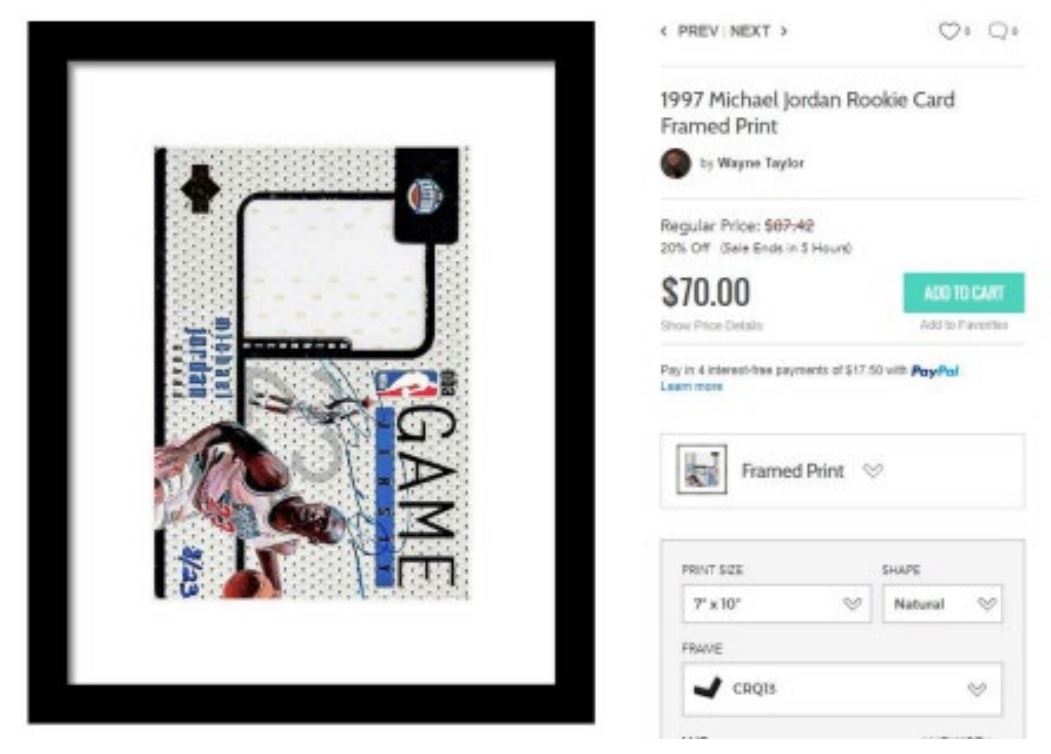
If this were a framed original of the trading card, the First Sale doctrine should apply. If it were a counterfeit version of the trading card, it would be an obvious legal violation. But this appears to be a photo of the trading card that’s printed. No reasonable buyer would believe this is the original trading card.
Trademark Dilution
The court says the hologram trademark isn’t sufficiently famous to qualify for dilution protection.
Trademark Infringement
- Mark strength. Even though the hologram mark isn’t famous, it’s a strong mark.
- Proximity of goods. Both offer sports memorabilia.
- Mark similarity. Identical.
- Actual confusion. The court presumes actual confusion from the mark’s identicality, with a bonus gratuitous shoutout to initial interest confusion because why not?
- Marketing channels. Both sell on the Internet.
- Purchaser care. An authentic Michael Jordan trading card depicted in the image above would sell for upwards of $1M. Pixels sells the reprint for $70. Purchasers will note the differences.
- Intent. “the mere existence of [Pixels’] notice-and-takedown policy does not indicate that Pixels has knowledge about the infringing use of the Upper Deck Hologram Mark in particular….Upper Deck has not indicated it attempted to take advantage of Pixels’ notice-and-takedown procedure to notify Pixels’ DMCA agent as to Pixels’ infringing use of the Upper Deck Hologram Mark.” How hard would it have been for Upper Deck to send takedown notices?
- Product line expansion. No evidence.
The court summarizes that 5 factors favor Upper Deck, 2 favor Pixels, and one is neutral. That’s enough to defeat Pixels’ summary judgment motion.
False Advertising
The opinion shifts to Upper Deck’s licensed interests in Michael Jordan’s depiction.
Standing. “a reasonable jury could find that Pixels’ use of Jordan’s likeness in its own similar products could result in a loss of sales of Upper Deck’s products and threatens Upper Deck’s commercial interests.”
False Advertising. I guess Pixels’ advertising claim is that Pixels has the right to market Michael Jordan trading cards when Upper Deck has the exclusive rights? The court says Upper Deck showed enough to survive summary judgment.
False Association. The false association analysis triggers a new round of Sleekcraft factor review, this time focused on Michael Jordan’s trademarks. The result is even more favorable to Upper Deck, so it again defeats Pixels’ summary judgment motion.
Publicity Rights
Pixels challenged Upper Deck’s exclusive right to the Michael Jordan personality. The court says the evidence provided by Upper Deck survives the summary judgment motion.
First Amendment Defense
A Rogers defense goes nowhere. Upper Deck presented “evidence that Pixels used Jordan’s Marks and/or the Upper Deck Hologram Mark in Pixels’ products featuring pictures and photographs displaying Jordan’s likeness. The pictures and photographs of Jordan displayed in Pixels’ products at issue in this action are source-identifying insofar as they contain Jordan’s Marks.”
Section 230
In a footnote, the court acknowledges that Section 230’s IP exception applies to the federal Lanham Act claims but doesn’t apply to state IP claims.
The court summarizes: “while advertising and curating content on websites constitute publishing conduct that can be immunized under Subsection (c)(1), the sale and distribution of physical products does not.” Thus:
Pixels is entitled to Section 230 immunity where Upper Deck seeks to hold it accountable for the advertisement of allegedly infringing goods, or for creating website tools that allow users to search and view allegedly infringing goods based on images uploaded by third parties. However, Pixels is not entitled to Section 230 immunity to Upper Deck’s California state law claims where Upper Deck seeks to hold Pixels accountable for manufacturing and selling the allegedly infringing products listed for sale on its website (e.g., contracting with vendors to manufacture and ship illicit products)
As applied: “Pixels does not create the illicit images of products uploaded and displayed on its site, and Pixels’ website search engine and content filtering tools do not contribute to the creation of those products.” However, Section 230 doesn’t apply to “Pixels’ involvement in offline manufacturing or selling physical prints containing infringing images (e.g., hiring and coordinating with print and shipping vendors, facilitating product returns, offering a money-back guarantee).” It seems pretty straightforward that Section 230 wouldn’t apply to offline activities, no?
* * *
This case raises many complex issues. In addition to the hologram mark issue, this case raises questions about the scope of merchandising rights, the permissibility of displaying historical items such as old sports trading cards, print-on-demand manufacturers’ liability for vendor uploads, and more. The court mostly sidesteps all of these legal complexities. Instead, the opinion narrowly focuses on more technical aspects, such as whether the hologram mark’s shape could be infringed even when it’s being accurately displayed in historical context.
The court’s rejection of most of Pixels.com’s summary judgment motion seems to position Upper Deck’s claims for a trial, unless the parties can figure out a settlement beforehand.
Case Citation: The Upper Deck Co. v. Pixels.com LLC, 2026 WL 776227 (S.D. Cal. March 19, 2026). This is an amended version of the opinion issued on March 6. As the court explains in the first footnote, the prior opinion had errors that the court needed to correct.
Related posts
* DMCA 512(c) Helps Redbubble Defeats Copyright Lawsuit–Wallshoppe v. Redbubble
* Print-on-Demand Service Defeats Fish Illustrator’s Copyright Claim–Tomelleri v. Sunfrog
* Print-on-Demand Services Face More Legal Woes–Canvasfish v. Pixels
* Atari’s Lawsuit Against a Print-on-Demand Service Fizzles Out–Atari v. Printify
* Ninth Circuit Highlights the Messy Law of Contributory Trademark Infringement Online–YYGM v. RedBubble
* RedBubble Gets Another Favorable Ruling–YZ Productions v. RedBubble
* IP Lawsuits Against Print-on-Demand Vendors Continue to Vex the Courts–OSU v. Redbubble & More
* Another Tough Ruling for Print-on-Demand Vendors–Sid Avery v. Pixels
* Print-on-Demand Vendor Doesn’t Qualify for DMCA Safe Harbor–Feingold v. RageOn
* CreateSpace Isn’t Liable for Publishing Allegedly Infringing Uploaded Book–King v. Amazon
* More Evidence That Print-on-Demand Vendors May Be Doomed–Greg Young Publishing v. Zazzle
* Section 230 Doesn’t Protect Print-on-Demand Vendor–Atari v. Sunfrog
* Online Marketplace Defeats Trademark Suit Because It’s Not the “Seller”–OSU v. Redbubble
* Zazzle Loses Copyright Jury Verdict, and That’s Bad News for Print-on-Demand Publishers–Greg Young Publishing v. Zazzle
* Trademark Injunction Issued Against Print-on-Demand Website–Harley Davidson v. SunFrog
* DMCA Safe Harbor Doesn’t Protect Zazzle’s Printing of Physical Items–Greg Young Publishing v. Zazzle
* CafePress May Not Qualify For 512 Safe Harbor – Gardner v. CafePress
* Cafepress Suffers Potentially Significant Trademark Loss for Users’ Uploaded Designs
* Life May Be “Rad,” But This Trademark Lawsuit Isn’t–Williams v. CafePress.com
* Print-on-Demand “Publisher” Isn’t Liable for Book Contents–Sandler v. Calcagni
* Griper Selling Anti-Walmart Items Through CafePress Doesn’t Infringe or Dilute–Smith v. Wal-Mart
* CaféPress Denied 230 Motion to Dismiss–Curran v. Amazon