
TOS Formation Fails, and So Does Section 230–Judge v. Academia
The named plaintiff is a professor. The defendant is a website, Academia, that helps professors share their works publicly. Academia heavily promotes its “Mentions” service that tracks a professor’s mentions and citations. [Historically, I have used a variety of free services to track my vanity mentions. Most are gone or unreliable at this point, but I don’t think I would pay for this service]. New Academia accountholders will immediately get this email promotion:
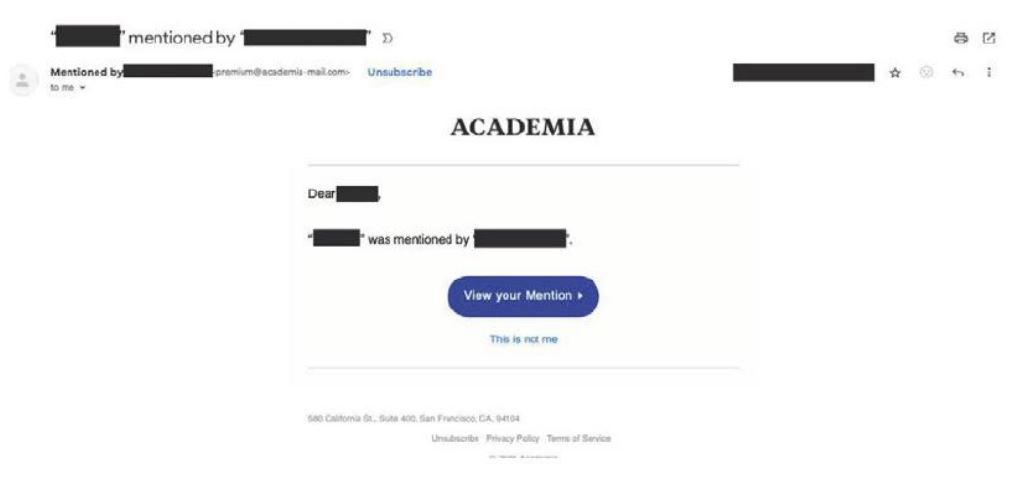
Clicking on the “View your Mention” button leads to this screen:
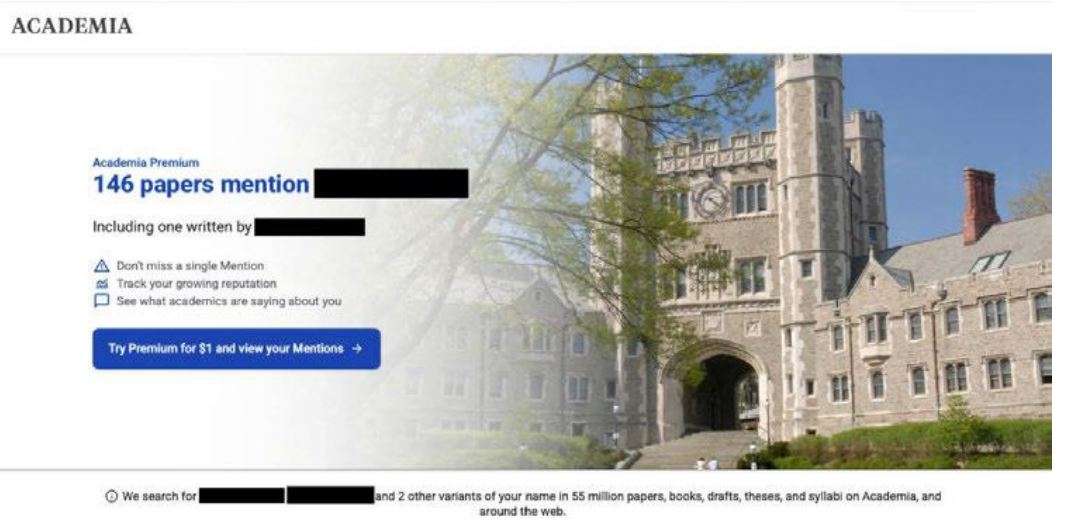
In both cases, the fact statement that X mentioned Y is presumably true, and it provides a sample of how the Mentions service works for its subscribers. At the same time, it does use X’s name in what looks like advertisements to convert Y to a paying customer. This reminded me of Facebook’s sponsored stories, which similarly relayed a true fact statement (X bought an item from Y) in what was converted into a paid advertisement.
Academia also targeted non-accountholders who visited a professor’s profile, showing them house ads:
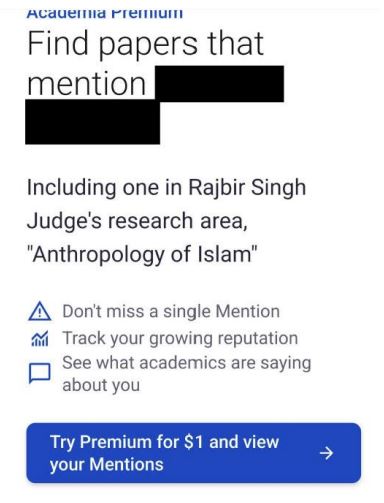
The plaintiffs filed a class action lawsuit over California’s publicity rights. Academia tries to send the case to arbitration three different ways (or, arguably, four different ways). They all fail.
Arbitration Attempt #1: Disclosure about Google’s Privacy Practices
In 2015, Judge used Academia’s “find your friends” feature to import his social graph from Google. Google displayed the following screen in the process:
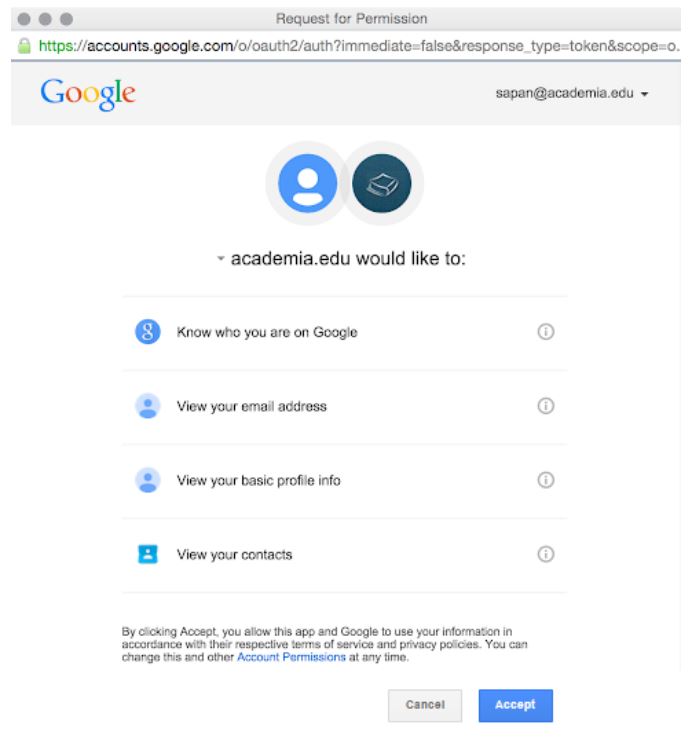
The disclosure language never mentions Academia’s TOU at all, so…
(Also, Academia is trying to impose the arbitration requirement in its TOU, but the disclosure only permits Academia “to use your information”).
Arbitration Attempt #2: 2022 Google Pop-Out
In 2022, Judge signed into Academia using Google’s login functionality. Academia doesn’t know exactly what that process looked like 🙄 but this is its “best estimation”:
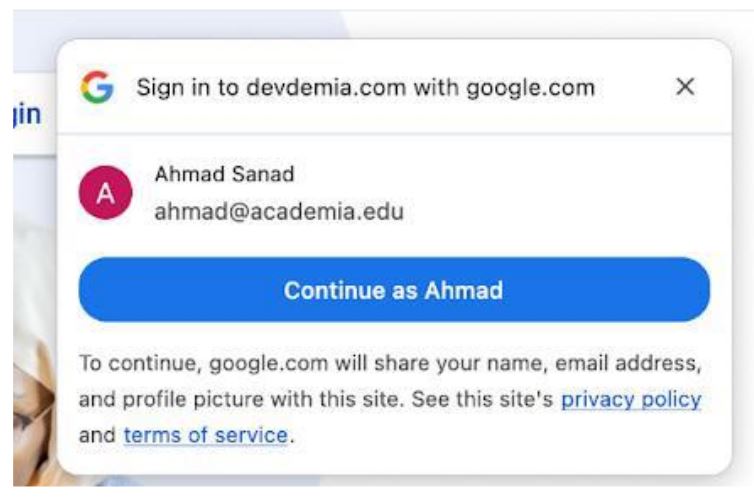
The disclosure says to “see” Academia’s TOS but doesn’t have an if/then grammar, so….
A reminder that if you’re trying to form the TOS and can’t provide highly credible evidence of what the TOS formation screen looked like, bonne chance.
Arbitration Attempt #3: Judge was a power user
Academia argues that Judge: (1) viewed its website (which contains a link to its Terms of Use) tens of thousands of times, 29 times scrolling to the footer with the Terms link and twice clicking buttons immediately next to that link; (2) twice viewed the website when it had banners announcing that the Terms had changed; (3) opened thousands of emails from Academia containing a link to the Terms, and three times clicked an adjacent link; and (4) viewed the login page in 2016, which contained a notice that “By clicking Sign Up, you agree to our Terms,” and then subsequently created a new account in 2022.
The court says the first three don’t indicate an unambiguous manifestation of assent. As for #4, the court says there’s no temporal coupling (viewed disclosure in 2016, signed up in 2022. Heck, I can’t even remember what I had for breakfast this morning). Arbitration denied.
 Section 230
Having denied arbitration, the court turns to the case’s merits. The Section 230 defense flames out:
Academia has materially contributed to the alleged unlawfulness of the conduct here. Judge alleges that Academia sends email advertisements to users stating that he has mentioned their work. The linked webpage in that email informs the user that several papers, “[i]ncluding one written by” Judge, mention the user and asks the user to “Try Premium for $1 and view your Mentions.” Additionally, after a user views Judge’s profile, Academia is alleged to provide that user with similar promotional advertisements. Judge therefore alleges that Academia unlawfully packages user-contributed content—his name and purported mention of the user—within its own solicitation to pay for its Mentions service. Thus, Academia “becomes the developer, at least in part, of that information.”
Academia contends that it is providing “notifications [that] truthfully conveyed user-generated citation information created by plaintiff himself.” Not so. Instead, Academia “transformed the character of Plaintiffs’ words . . . and actions into a commercial endorsement to which they did not consent.” [Cite to Fraley v. Facebook.] The advertisements disseminate Academia’s own message (subscribe to our Mentions service) with only a vague reference to user-generated content. As such, they are not akin to simply “disseminating the same content in essentially the same format to a search engine.” Section 230 does not allow a website to cloak its own advertisements as user-created content and thereby evade state-law liability.
Arbitration Attempt #4: Attempted TOU Amendment
After Judge filed the lawsuit, Academia purported to amend its TOU:
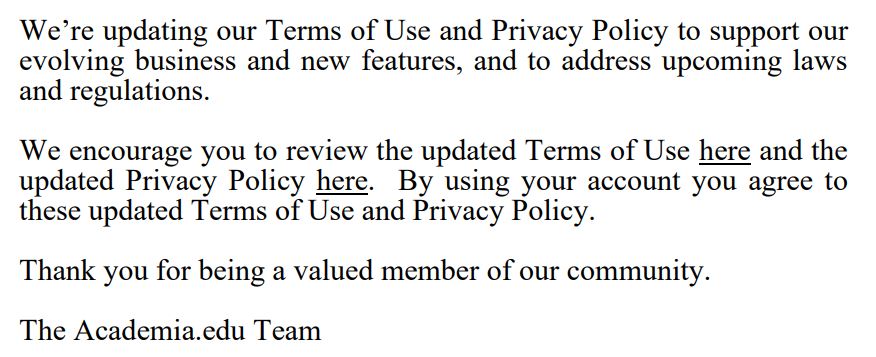
Also, “users must click an “Agree” button referencing the Terms of Use before continuing to use Academia.” The new TOU authorizes the use of accountholders’ names in advertising.
The court treats this purported amendment as a misleading communication to the putative class members, so it triggers the protective provisions of FRCP Rule 23(d). In other words, because the changes affected the rights of class members, sending the email after the lawsuit was filed constituted a regulated communication with putative class members. The court had issues with the lack of disclosure that users weren’t previously bound by the arbitration clause, the fact that clicking on the links apparently constituted the acceptance of “using your account,” and that the new consent-to-advertising provision would extinguish pending claims. So the court strikes the effects of the purported TOU amendments on putative class members.
I’m not sure if it’s novel for the court to treat TOU/TOS amendments during the pendency of a class action lawsuit as potentially improper communications to putative class members, but I can’t recall seeing it before. The court’s approach shuts down some of the potential gamesmanship that some defendants play where they amend the TOS post-filing to try to eviscerate pending claims, with provisions such as claims waivers or arbitration requirements. If you are a defendant in a pending lawsuit and you hope a post-filing TOS amendment can eliminate it, tread cautiously.
Structurally, this case resembles the yearbook and people-finder cases, and it goes about as well for the defendants as those cases have.
Case Citation: Judge v. Academia, Inc., 2026 WL 1256876 (N.D. Cal. May 7, 2026). Academia is represented by a defense team from Fenwick and Quinn Emanuel.
Prior blog posts on Yearbook and Genealogy Cases
- Section 230’s Application to Account Terminations, CSAM, and More
- Free-Trial Commercial Database Defeats Publicity Rights Claim–LaFleur v. Yardi
- Another Tough Ruling for People Search Databases–Camacho v. Control Group Media
- Three More Yearbook/People Database Cases Signal Trouble for Defendants
- Background Reports Protected by Section 230–Dennis v. MyLife
- Yearbook Defendants Lose Two More Section 230 Rulings
- Yearbook Database Cases Are Vexing the Courts–Sessa v. Ancestry
- Court Casts Doubt on the Legality of the Data Brokerage Industry–Brooks v. Thomson Reuters
- Section 230 Doesn’t Protect Yearbook Website’s Ads–Knapke v. Classmates
- Section 230 Covers Republication of Old Yearbooks–Callahan v. Ancestry
- Section 230 Doesn’t Protect Advertising “Background Reports” on People–Lukis v. Whitepages