
COVID Jawboning Lawsuit Dismissed (For Now)–Dressen v. Flaherty
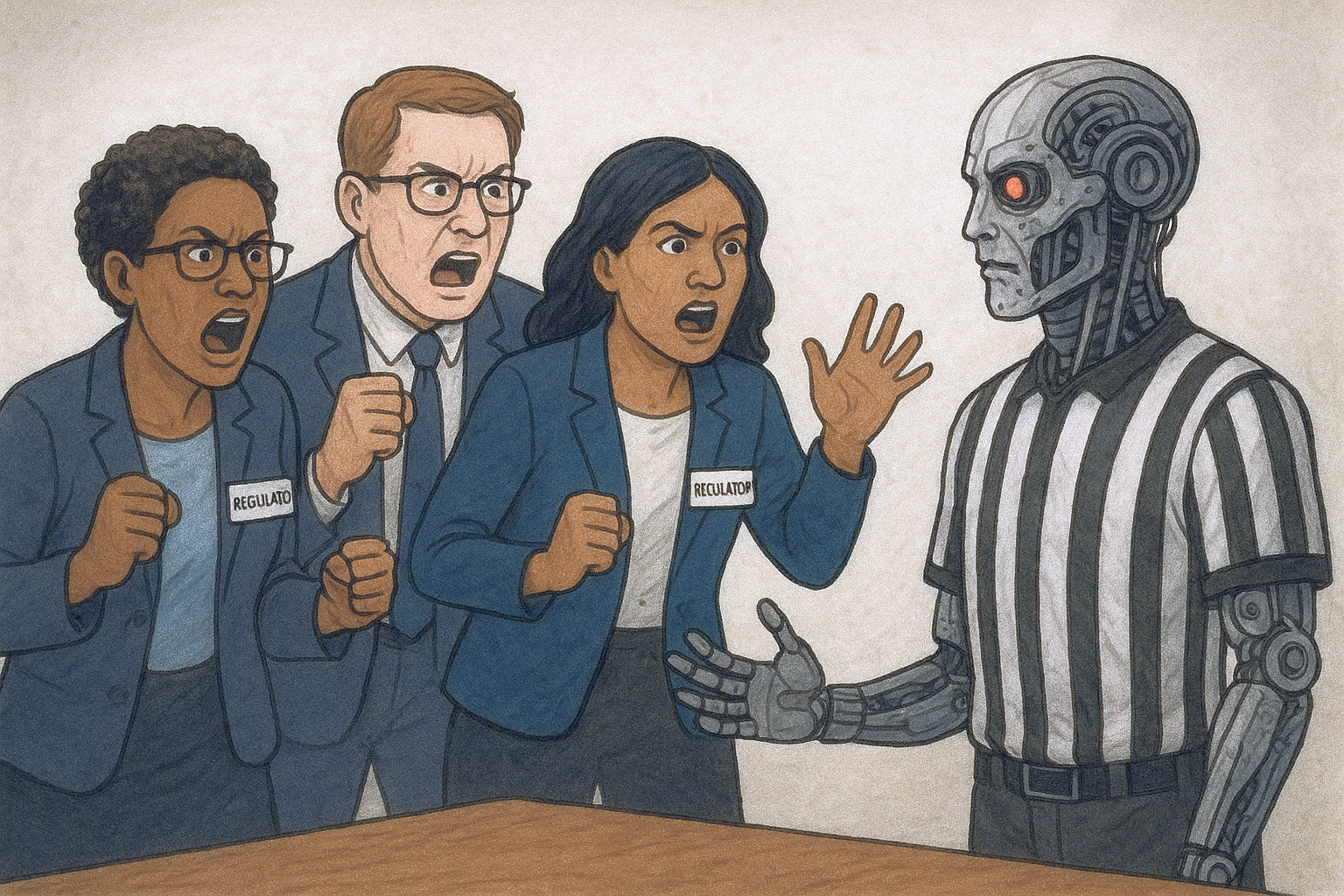
Generated by ChatGPT Dec. 2025
This is a COVID-related jawboning case:
Plaintiffs allege that Defendants violated their constitutional rights by pressuring social media companies to ban or limit their social media posts related to the COVID-19 vaccine….Plaintiffs characterize Defendants’ efforts as “relentless pressure, inducement, coercion, and collusion” that resulted in the platforms censoring Plaintiffs in violation of the First Amendment. Plaintiffs have not sued any of the social media platforms that allegedly censored their posts.
The court dismisses the case, but some of the plaintiffs might feel like this was a good opinion for them.
As a magistrate judge, his opinion will be reviewed by a supervising judge, with a hard-to-anticipate outcome. [I had a personnel note that wasn’t correct, so I removed it.]
Article III Standing
Federal Government Defendants
Per Murthy, the court says it has no Article III standing over this dispute with the federal government defendants:
Plaintiffs have sufficiently alleged that certain Federal Defendants pressured social media platforms like Facebook to continually demote and remove posts even when the posts were not violative of the platforms’ rules and guidelines. This alone, however, is insufficient to establish standing to seek prospective relief. While “past” conduct is not entirely irrelevant, it can establish standing to seek prospective equitable relief “only insofar as it is a launching pad for a showing of imminent future injury.”…Plaintiffs’ general concern that the government may repeat its prior conduct—without concrete factual allegations indicating a likelihood of recurrence—does not satisfy Article III.
Although Plaintiffs seek to enjoin the Federal Defendants from coercing or encouraging social media platforms to suppress Plaintiffs’ protected COVID-19 related speech, they fail to plausibly assert that any future censorship directed at Plaintiffs is imminent or substantially likely to occur. Despite the length of their lawsuit (a whopping 156 pages), Plaintiffs describe only past interactions between the Federal Defendants and third-party social media platforms, most of which occurred from 2021–2022. As the Federal Defendants note: Plaintiffs “have not alleged a single instance of communication over the past two years between any Federal Defendant and any social-media platform regarding the moderation of any (let alone COVID-19) content.” Moreover, Plaintiffs do not identify any ongoing or
future actions targeting them or their speech.
I have problems with this passage.
First, the court’s first sentence has potentially massive importance. If the plaintiffs adequately alleged they were a victim of a pressure campaign, legal relief of some sort ought to follow. (It might be the difference between requests for an injunction and damages). However, without reading the 156 page complaint, I’m skeptical of the court’s credulousness. In particular, per Murthy, plaintiffs should have to show more than the government’s general pressure on social media entities to change their content moderation decisisions. A successful case may require a clearer and more direct connection between the government’s exhortations and the specific content items that were affected.
Second, the court seems to be saying that because the current MAGA government is now run by anti-vaxxers, COVID vaccine skeptics have nothing to worry about any more. However, jawboning concerns shouldn’t swing with changes in administrations. In his Murthy dissent, Justice Alito suggested that government threats don’t have an expiration date. It could just swing now to the government pressuring removal of pro-vax content instead of anti-vax content, but the threat to speech is the same regardless of the partisan priorities.
Third, consistent with Murthy, the court notes that the social media services have independent editorial discretion over their publication decisions. Citing Zuckerberg’s election-season capitulation/gift to Rep. Jordan in 2024 saying that he regrets Facebook’s efforts to combat COVID misinformation, the court says “Given this statement by the head of one of the largest and most influential social media platforms, it is speculative at best to suggest that social media platforms would again submit to alleged governmental pressure rather than implement their own platform policies and guidelines.” Hahaha. The court has it exactly backwards. Zuckerberg made his statement to confirm that Facebook will subvert its editorial authority to please those in power. (As Techdirt said, “Mark Zuckerberg folded like a cheap card table”). Thus, the court’s credulous citation of Zuckerberg’s statement undermines the opinion’s credibility.
Fourth, as another example of the judge accepting another not-credible statement at face value, the court credits Trump’s so-called anti-censorship EO as evidence that the federal government has stopped any jawboning:
It is difficult to read that Executive Order and then claim, with a straight face, that there is a real threat that the Federal Defendants will, in the near future, pressure social media platforms to suppress protected speech in violation of the First Amendment.
Uh huh, sure. Trump’s EOs are never performative nonsense. 🙄 Despite Trump’s (very not-credible) EO, there are example after example of how the Trump Administration is explicitly and unreservedly pressuring/demanding social media services engage in unconstitutional censorship. Read this roundup of “Donald Trump’s War on Free Speech.” Trump literally said (with pride!): “We took the freedom of speech away.” I don’t think he believes he has finished that goal.
The judge summarizes his assessment:
Plaintiffs must allege more than just past governmental coercion; they must allege that future coercion will likely occur and that the platforms will likely acquiesce to such coercion. They have failed to do this.
Stanford Defendants
The claims against the Stanford Defendants lack Article III standing because of a lack of traceability: “the operative complaint is devoid of any substantive allegations—plausible or otherwise—that the Stanford Defendants caused any social media platform to censor content in a manner inconsistent with the platform’s misinformation policies.”
Murthy
“Plaintiffs sufficiently allege that Murthy actively pressured Facebook to continually alter its guidelines and policies regarding ‘misinformation.’ With one exception, Plaintiffs have standing to pursue monetary damage claims against Murthy.”
Crawford
Through use of a “social media listening tool,” Crawford could monitor posts made on Facebook and provided Facebook with a statement on behalf of the CDC to use when flagging content. Crawford actively encouraged Facebook to censor content and requested updates on Facebook’s plan to label or otherwise moderate certain content. Plaintiffs allege that such coercive tactics were also employed against Twitter and YouTube.
Taking these facts as true and viewing them in the light most favorable to Plaintiffs, Plaintiffs have sufficiently alleged that Crawford’s actions pressured platforms to enforce policies against alleged misinformation that the platforms may not have otherwise moderated.
Flaherty and Slavitt
“allegations that Plaintiffs’ posts were removed at or near the time that Flaherty and Slavitt pressured platforms to censor such content sufficiently evinces a causal link between Flaherty’s and Slavitt’s actions, the platforms’ censorship decisions, and Plaintiffs’ harm to satisfy Article III standing.” It sure sounds like the judge is conflating correlation and causation.
Other Defendants
More Article III traceability problem: “Plaintiffs fail to allege that any of these defendants—Becerra, Easterly, and Mayorkas—ever communicated directly with any social media platforms regarding content moderation.”
Personal Jurisdiction
For the claims where the plaintffs made a plausible allegation of Artifcle III standing, the court nevertheless held that it did not have personal jurisdiction over the defendants. I assume this can be fixed by refiling the case elsewhere?
Implications
In total, the case was dismissed, but this ruling now goes to the supervising judge where anything can happen.
Despite the dismissal, some defendants are not celebrating. The magistrate judge indicated that the plaintiffs properly made some jawboning claims allegations against some of the defendants, using some dubious reasoning to get there. That gives the plaintiffs a glimmer of hope–certainly enough to keep this case around for longer than it should be.
To reiterate: what the Trump administration is doing now repeatedly goes way past jawboning and is outright express and unreserved censorship. That reminds us that these culture war jawboning cases aren’t really about censorship; or at least, the plaintiffs are likely OK with censorship so long as it doesn’t restrict them.
Case Citation: Dressen v. Flaherty, 2025 WL 3552358 (S.D. Tex. Dec. 11, 2025)
BONUS: Berenson v. Biden, 2025 WL 2773968 (S.D.N.Y. Sept. 29, 2025)
[Berenson] alleges that because of the critical nature of his work, former President Biden and others in his administration, along with executives at Pfizer Inc. (the makers of one of the mRNA COVID-19 vaccines), worked together to pressure Twitter (now known as “X”) to suspend Plaintiff’s account. Plaintiff claims this conduct amounted to a censorship conspiracy that violated his First Amendment rights.
The court says there is no Article III standing:
the Individual Federal Defendants (Flaherty and Murthy), are now private citizens. Plaintiff therefore lacks standing to assert a claim against them for the same reasons and rationale the Court identified in dismissing Plaintiff’s claim against Slavitt—namely, the fact that the Court cannot enjoin private citizens from violating another private citizen’s constitutional rights, and Plaintiff cannot obtain Bivens monetary damages because that cause of action has not been extended to these circumstances (and the Supreme Court has strongly counseled against any such extensions)….
Plaintiff lacks standing for declaratory and injunctive relief because he has not plausibly alleged a “substantial risk” of imminent future injury
Selected Jawboning Posts
- Section 230 (Still) Applies to Contract Breach Claim–NJCCC v. McAleer
- Facebook Defeats Armslist’s Account Termination Lawsuit–Armslist v. Facebook
- Robert F. Kennedy Jr. Is Breaking Internet Law Faster Than I Can Blog It
- Plaintiffs Lack Standing to Sue Over Government Jawboning When Their Evidence is Based on Vibes–Murthy v. Missouri
- Jawboning Defendants Are 6-for-6 in the Ninth Circuit–Hart v. Facebook
- Another Jawboning Case Fails in the 9th Circuit (But a TAFS Judge Doesn’t Like the Biden Administration)–Rogalinksi v. Meta
- Sixth Circuit Dismisses Online Jawboning Case–Changizi v. DHHS
- “Twitter Files” Don’t Help Revive Jawboning Case–Hart v. Facebook
- Another Jawboning Case Fails in the Ninth Circuit–Kennedy v. Warren
- Government Submissions to a Trusted Flagger Program Aren’t Unconstitutional Jawboning–O’Handley v. Weber
- Ninth Circuit Easily Rejects Another Jawboning Case–Huber v. Biden
- Ninth Circuit Easily Rejects Jawboning Claims Against YouTube–Doe v. Google
- Facebook Defeats Jawboning Lawsuit Over COVID Misinformation Removal–Rogalinski v. Meta
- COVID Skeptics’ Anti-Jawboning Lawsuit Fails–Changizi v. Department of HHS
- Facebook & Twitter Defeat Lawsuit Over Account Terminations of COVID/Mask Skeptic–Hart v. Facebook
- Twitter Defeats Trump’s Deplatforming Lawsuit–Trump v. Twitter
- Section 230 Survives Yet Another Constitutional Challenge–Huber v. Biden
- Another Anti-Vaxxer Jawboning Lawsuit Fails–ICAN v. YouTube
- The First Amendment Protects Twitter’s Fact-Checking and Account Suspension Decisions–O’Handley v. Padilla
- One More Time: Facebook Isn’t a State Actor–Atkinson v. Facebook
- Government Jawboning Doesn’t Turn Internet Services into State Actors–Doe v. Google
- Facebook Defeats Lawsuit By Publishers of Vaccine (Mis?)information–Children’s Health Defense v. Facebook
- Another Must-Carry Lawsuit Against YouTube Fails–Daniels v Alphabet
- Congressional Jawboning of Internet Services Isn’t Actionable–AAPS v. Schiff
- Facebook Isn’t a Constructive Public Trust–Cameron Atkinson v. Facebook
- Section 230 Ends Demonetized YouTuber’s Lawsuit–Lewis v. Google