
Another TOS Formation Failure–Cid v. Therabody
This is a class action lawsuit over defective battery chargers. The manufacturer tries to send the case to arbitration, but the TOS formation fails instead.
After the consumer purchased the item, the consumer created an online account that provided some additional functionality, including “pairing Therabody devices, accessing personalized recovery routines, storing preferences, and viewing product information.” Here is the relevant TOS formation screen:
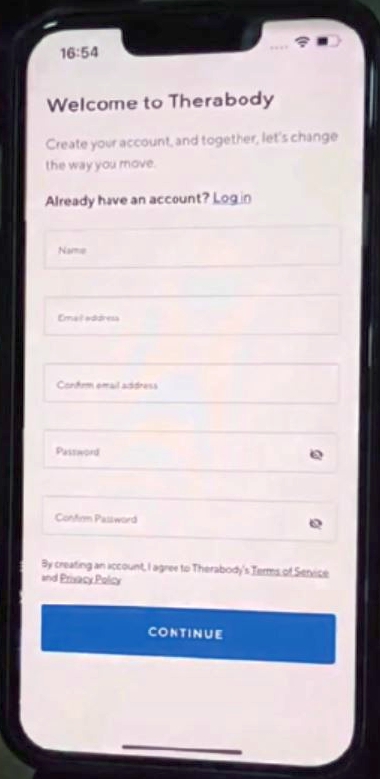
I’m not sure why it’s a photo of a cellphone rather than a direct screenshot. 🤷♂️
The court never labels this a “sign-in-wrap” but it clearly is. (The court noncommitally says that it’s neither a “pure clickwrap” or a “pure browsewrap” 🙄).
Reasonably Conspicuous Notice
On the plus side, the court notes that the TOS offer is legible gray text on a white background; the TOS offer is located directly above the “continue” button; and the screen lacks clutter.
On the minus side, the TOS offer indicates the TOS link using only underlining, and the court says that’s not enough. In contrast, the login link was both underlined and bolded. That is some ticky-tack pixel policing.
As for the transaction context, the court says it’s not that important, but also that “it is unclear to the Court whether Therabody’s app made users aware of any ‘in-app purchase’ opportunities when they created accounts.” Courts are really struggling to figure out what to do with this factor.
The court summarizes:
Based on the totality of the circumstances—and though a close question—the Court finds that defendant has not met its burden of demonstrating reasonable conspicuousness.
Assent Manifestation
Citing Chabolla, the court notes the mismatch between the acceptance button and the TOS offer language:
as on screen 2 in Chabolla, the notice states that a user agrees to the Terms of Service by “signing up,” but includes a button only to “Continue.” Moreover, there is no button that indicates when a user has “sign[ed] up” aside from a preceding screen’s button (and, in the instant case, the user must click the “CREATE APP ACCOUNT” button before having any notice of the Terms of Service). Finally, the screen on which the notice is provided asks for personal information, and it is “up to the user to assume” that entering that information and clicking “CONTINUE” constitutes “signing up.”
In a footnote, the court further castigates the “continue” grammar:
the term “Continue” is not an unambiguous analogue to “Sign Up.” A reasonable user of the Internet might conclude that by clicking “CONTINUE,” they were simply agreeing to proceed to the next step of the sign-up process, not binding themselves to the Terms of Use. As the Ninth Circuit has explained, Chabolla stands for the proposition that “the explanation of the legal significance of an action must truly be unambiguous.” Here, the Court finds that the “CONTINUE” button does not provide the “truly unambiguous” explanation that the Ninth Circuit requires.
Arbitration Scope
The court says “the plain language of the contract demonstrates that the parties have agreed only to arbitrate disputes with respect to the Service and the Terms.” The plaintiff is complaining about the hardware, not the service, and only used the app for a different Therabody service. As a result, his claims are outside the scope of the arbitration clause.
Thus, it appears the arbitration request fails for three separate reasons: the TOS offer isn’t reasonably conspicuous, the buyer didn’t assent due to the mismatch between the TOS offer and acceptance button, and the claim is outside the arbitration scope. To reverse the result on appeal, the manufacturer has to overturn all three points.
Implications
This ruling doesn’t break any new doctrinal ground, but it does show how far the TOS formation pendulum has swung against formation. In the 2010s, I would have rated this TOS formation process as at least 90% likely to succeed. Now, in the wake of Chabolla and Godun, it’s a pretty easy no from the district court. The court makes every inference against the drafter, and there are just enough rough edges in the formation process to rule against the manufacturer on each element. The TOS formation failure leaves Therabody legally naked; they not only failed to get arbitration, but none of the other risk management provisions in the TOS are in effect either.
 Therabody’s countermoves to a ruling like this aren’t novel or hard–we’ve discussed all of this before many times on the blog:
- Use a two-click formation process. #ClickwrapOrItsCrap.
- The TOS offer language should precisely mirror the acceptance button labeling.
- Links to the TOS should be both bolded and underlined.
- The arbitration clause should make it clear that it covers all disputes with the consumer, not just those limited to some aspect of the relationship.
- Keep a rigorous evidence log of every TOS version you have put into effect, so that you aren’t relying on some bizarre photo of a phone showing the screen.
If you haven’t done a recent hygiene scrub of your TOS formation, make it one of your New Years’ resolutions.
This ruling also highlights the ongoing challenges of TOS formation for Internet-enabled devices. I think many manufacturers think they form the contract for the hardware at point of sale and the contract for the Internet component when the buyer logs in. This approach raises some obvious analytical problems–in particular, how those two contracts sit together. Is the Internet TOS a parallel contract (essentially what happened here), an amendment to the existing hardware contract, or something else? This confusion is especially a problem if a buyer balks at forming the Internet TOS. Does that brick the item? Do balking buyers have any recourse for their reduced-value hardware purchase? If not, the buyers are essentially coerced into agreeing to the Internet TOS to fully enjoy the hardware purchase (an existing contract already in place).
As this ruling reinforces, if the court treats the two contracts as existing in parallel with each other, the Internet contract may not provide any protective elements for the hardware elements. To me, in a perfect world, the manufacturer would simultaneously form both the hardware and Internet contracts when the buyer purchases the hardware. This isn’t always operationally feasible. If not, then the Internet portion of the relationship should carefully explain how it relates the existing hardware contract and extends to cover both aspects so nothing falls through the cracks.
Case Citation: Cid v. Therabody, Inc., 2026 WL 3653002 (C.D. Cal. Nov. 23, 2026)