
Lawyer’s Fee Agreement Gagging Client Reviews Is Illegal–LS Carlson Law v. Sedgwick
Katie Sedgwick is a former client of LS Carlson Law. It sounds like she didn’t love working with them. She negatively reviewed the firm on Yelp. I had difficulty finding the original review.
In response, the firm sued her for defamation and breach of contract. The firm enumerated seven allegedly defamatory statements, including “They are either scam artists or complete crooks” and “They are not tough, they are not effective and they will rob you blind.” The lower court held these statements were nonactionable hyperbole and the author’s opinion. Other claims failed because the firm didn’t show they were false.
With respect to the contract breach, Section 16 of the firm’s fee agreement said the parties “agree not to directly or indirectly disparage each other either electronically or otherwise.” Because of this, Yelp has flagged the firm’s Yelp business page with a “Questionable Legal Threats” warning:
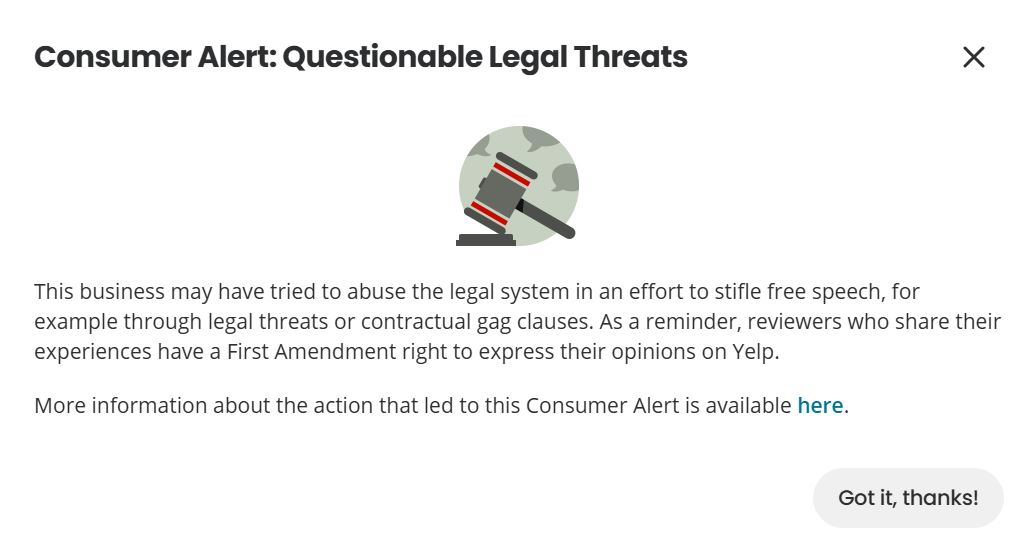 The link goes to the full text of the Superior Court opinion in this case.

As every lawyer knows, suing a client entails substantial risk of blowback, including possibly a malpractice claim and a complaint to the state bar. Here, the law firm gets other unwanted consequences. Sedgwick successfully brought an anti-SLAPP motion to strike, which means the firm will be paying her legal fees.
The appeals court upholds the anti-SLAPP dismissal, saying “we readily agree with the trial court that the Yelp review criticizing the firm’s representation of Sedgwick is protected activity.” The appeals court adds that “calling someone crooked is ‘merely rhetorical and hyperbolic language’ and not defamatory.”
 Of particular note is the court’s treatment of the fee agreement’s non-disparagement clause. The law firm equated disparagement with defamation, so the court said the contract breach claim failed when there was no defamation. The appeals court adds:
Section 16 violates Civil Code section 1670.8. That statute provides: “A contract … for the sale … of consumer goods or services may not include a provision waiving the consumer’s right to make any statement regarding the seller … or its employees or agents, or concerning the goods or services.” By its plain language, it precludes a provision that, like Section 16, purports to require Sedgwick “ ‘not to directly or indirectly disparage’ ” the firm.
We do not share the firm’s concern that this statute “would negate existing law and permit consumers to defame businesses … with impunity.” The statute cannot be reasonably read to immunize defamation. In our context, the statute does not prevent the firm from suing for defamation, if the firm could prove defamation sufficiently to survive an anti-SLAPP motion. The statute merely prevents the firm from including Section 16 in its fee agreement—or thereafter enforcing it.
I haven’t exhaustively researched the issue, but I couldn’t think of a prior court finding a 1670.8 violation. It’s 2026, and I can’t believe anyone–especially a law firm–still doesn’t know that contractual efforts to restrict consumer reviews are no bueno.
I’ve complained about the spate of bogus 1670.8 “drive-by” litigation that is clogging our courts, but here is a real-life bona fide example of an actual genuine 1670.8 violation. Review suppression like this is what the drive-by lawyers should be enforcing, not their current tendentious and tortured reading of TOSes.
The argument that the law firm needs a contractual anti-disparagement clause to prevent defamation is specious. If a client posts a defamatory review, defamation law applies–no contract overlay needed. I discuss that issue more in this post.
It would have been more interesting if the firm had claimed that the contract anti-disparagement clause applied even if there wasn’t any defamation. But 1670.8 would kick in, mooting that claim as unenforceable.
Case Citation: LS Carlson Law PC v. Sedgwick, 2026 WL 2410113 (Cal. App. Ct. August 17, 2026)
BONUS: Greenwich Building Company v. Hoots, 2026 WL 2408839 (N.Y. Supreme Ct. August 11, 2026). A real estate company sued a property buyer for negative reviews on Google and Houzz. The court finds the lawsuit was covered by New York’s anti-SLAPP laws. The court says “online review forums such as Google and Houzz have consistently been held to be public forums under New York’s anti-SLAPP law…The statements are of interest to members of the community who may consider buying or renting an apartment at 120 Java Street.”
The court then says the plaintiff showed a substantial basis for its defamation claim because there is some confusion about the identity of parties (the buyer’s complaints may relate to a different, though possibly, related company).
And yet, the plaintiff didn’t adequately show the buyer had actual malice: “Defendant left his reviews on plaintiff’s Google and Houzz pages after diligent pedestrian online research….defendant’s statements specifically on those online review pages appear to have been the result of an honest mistake and that defendant left his reviews on plaintiff’s pages after a good faith attempt to find the correct pages to leave such reviews….This court too chooses to err on the side of non-actionability in this case so as to promote the public’s right to free speech.”
As a result, the case is dismissed, and the defense will get its attorneys’ fees.
Selected Blog Posts Regarding 1670.8
- Another Court Shuts the Door on “Yelp Law” Drive-By Lawsuits–Arterberry v. Peet’s
- Appeals Court Shuts Down Bogus Private Enforcements of the ‘Yelp Law’–Moss v. GoDaddy
- Catching Up on the Bogus “Yelp Law” Litigation Campaign–Tao v. Uniqlo
- Amazon Must Defend “Yelp Law” Claim–Ramos v. Amazon
- Courts Are Rejecting Attempts to Weaponize Laws That Protect Consumer Reviews
- Businesses Cannot Contractually Ban “Abusive” Consumer Reviews
- California Tells Businesses: Stop Trying To Ban Consumer Reviews (Forbes Cross-Post)