
Ninth Circuit Allows TOS Amendment by Email–Ireland-Gordy v. Tile
[This is a non-precedential opinion, and the court unhelpfully cuts many factual and doctrinal corners.]
The plaintiffs claim that bad actors misused Tile’s tracking devices to stalk them. The plaintiffs (as a class action) sued Tile for how it designed and sold the trackers. Tile invoked the arbitration clause in its TOS. This sets up a complicated analysis of TOS amendment–though the panel never directly acknowledges that this is an amendment case, not a case about formation in the first instance.
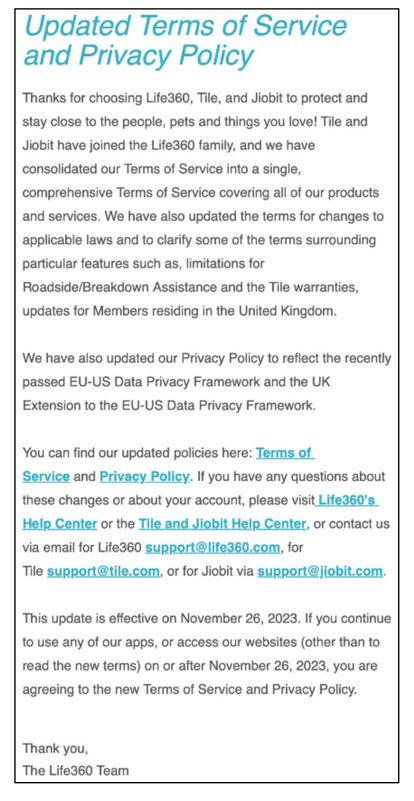 Two plaintiffs agreed to Tile’s TOS in 2021 and early 2023, respectively. Those versions of the TOS contained arbitration clauses that proved ineffective. In October 2023, Tile changed the arbitration provisions to include new language. To step up its existing users to the October 2023 arbitration provisions:
In October 2023, Tile sent to all accountholders the Oct. 2023 Notice—an email with the heading “Updated Terms of Service and Privacy Policy”—advising that Tile was updating its Terms. Sent to the email address provided by accountholders during registration, the Oct. 2023 Notice contained a blue-text and bolded hyperlink to the Oct. 2023 Terms. The email told accountholders that “[i]f you continue to use any of [Life360 and Tile’s] apps, or access our websites (other than to read the new terms) on or after November 26, 2023, you are agreeing to the [Oct. 2023 Terms].”
One plaintiff said the notification email went into the spam folder, but they saw it months later when they went affirmatively looking for it. The other plaintiff said they never saw the email. Both used the Tile service after the purported TOS amendment date. The district court held that neither plaintiff was bound by the October 2023 arbitration provisions, and the arbitration provisions in the earlier TOS versions partially failed due to unconscionability. Tile appealed that ruling, hoping to send these plaintiffs to arbitration.
The Ninth Circuit holds that Tile’s email put both plaintiffs on inquiry notice of the TOS amendment.
Transaction Context. “As Tile users, each Appellee provided an email address during account registration, and should have expected to receive relevant updates there while the account was active.” This is a pretty wild claim. Many services request email addresses during account registration, and yet the initial TOS formation fails. Also, just because I provide an email address during registration doesn’t mean that I assume TOS amendments will be sent via email. That may depend on how the TOS describes the amendment process–an angle this panel remarkably ignores completely.
Reasonable Disclosure. The court says the email disclosures were good enough:
The design and content of the Oct. 2023 Notice provided reasonably conspicuous notice of the Oct. 2023 Terms because the email’s design was “clear and legible,” and it provided the updated Terms through a link with “customary design elements denoting the existence of a hyperlink.” The subject line clearly stated that Tile was updating its Terms. And the body contained a hyperlink to the Oct. 2023 Terms in bold, blue text which contrasted against the white background. Although the email did not say specifically that the arbitration agreement would be updated, reasonable notice does not require the email to discuss every revision.
“Lack of other notices.” The court says “Tile could have done more to ensure that all its users were on inquiry notice of the Oct. 2023 Terms. Tile could, for example, have interrupted users’ next visit to the Tile App with a clickwrap pop-up notice.” The court says the absence of these other notices weighs against inquiry notice.
So, did the TOS amendment work? The court makes a remarkable doctrinal move, something I don’t recall seeing before. The court treats inquiry notice as a multi-factor test and says two factors weigh in favor of notice (transaction context and reasonable disclosures) and one weighs against (lack of other notices). In other words, the two pro-formation factors prevail over the anti-formation factor. But…when did the inquiry notice standards become a multi-factor test with these three factors? This methodology is novel (and dubious). The court might have said that even if other notification procedures would have been more efficacious, the email notice was good enough. This would have reached the same outcome without this weird doctrinal move.
[Hedging its bets, the court says “we do not hold that notice by mass email establishes inquiry notice in every case”].
Manifestations of Assent
Doe unambiguously manifested assent to the Oct. 2023 Terms by downloading the Tile App in March 2024 and using the Scan and Secure feature in attempting to locate her alleged stalker’s Tile Tracker….
Broad also unambiguously manifested assent to the Oct. 2023 Terms by using the Tile App in January 2024 and periodically opening the Tile App to check location-sharing settings—including, according to Tile’s records, in April 2024.
The court treats these users’ actions as occurring after the users had “inquiry notice.” Thus, the October 2023 TOS controls, and the court sends the case to arbitration.
* * *
Consider some of the wackiest aspects of this opinion:
- the court doesn’t distinguish between TOS formation and TOS amendment.
- the court doesn’t address what Tile’s TOS said about how the TOS could be amended. Did the TOS even authorize email amendment? The TOS terms would have substantial bearing on what a reasonable consumer might have thought. [Note: The court discusses the prior TOS’s arbitration language that said Tile couldn’t materially change the arbitration provisions “unless you expressly agree to them” but treats the October 2023 as sufficient “express agreement.”]
- the court doesn’t engage many of the precedents involving attempts to form TOSes by email, especially post-transaction emails (like this one).
- the court assumes that providing an email address during account registration means that the users should assume they will be getting TOS amendment notifications via email.
- the court didn’t address the many reasons why a TOS amendment email might never reach a user, such as the user’s email address having gone defunct or server-level blocking. If the user never received the email, does the court still think they are on inquiry notice? The court also doesn’t address the implications of the email going into a folder other than the user’s primary inbox, such as showing up in the spam folder. Are users on inquiry notice for everything in their spam folder? I wonder how often the judges carefully check their spam folder…
- the court created and applied a weird multi-factor test for inquiry notice.
FWIW, the court does acknowledge that some of the underlying issues are empirical questions, but it dodges those questions by citing Sellers, which said “there is very little empirical evidence regarding” Internet users’ expectations. If the data is hard to get, I guess we don’t need it?
So, what should we make of this opinion? Is this an example of the characteristically wild-‘n’-wooly jurisprudence in the Ninth Circuit’s non-precedential cases? Or perhaps an indicator the Ninth Circuit’s TOS formation jurisprudence is a mess and there is no logical or defensible through line from case to case?
Case Citation: Ireland-Gordy v. Tile, Inc., No. 25-403 (9th Cir. March 3, 2026). The CourtListener page.
Pingback: Photobucket's Attempted TOS Amended Mostly Fails-Pierce v. Photobucket - Technology & Marketing Law Blog()