

Catching Up on X’s TOS Formation Cases
Checking in on X’s TOS formation after its embarrassing TOS formation loss in the Skaggs case. If you don’t recall that opinion, maybe start with that post?
Rose v. SpaceXAI LLC, 2026 WL 3169664 (N.D. Cal. Oct. 22, 2026)
Some consumers claim X employs ““deceptive and illegal ‘automatic renewal’ tactics to trick consumers” into signing up for “unwanted, pricey subscriptions” to xAI’s SuperGrok chatbot.” (As I observed, anyone paying to use Grok may be opting-into caveat emptor territory). X invoked the arbitration clause in its TOS. The court denies arbitration.
The court calls this screen a sign-in-wrap:
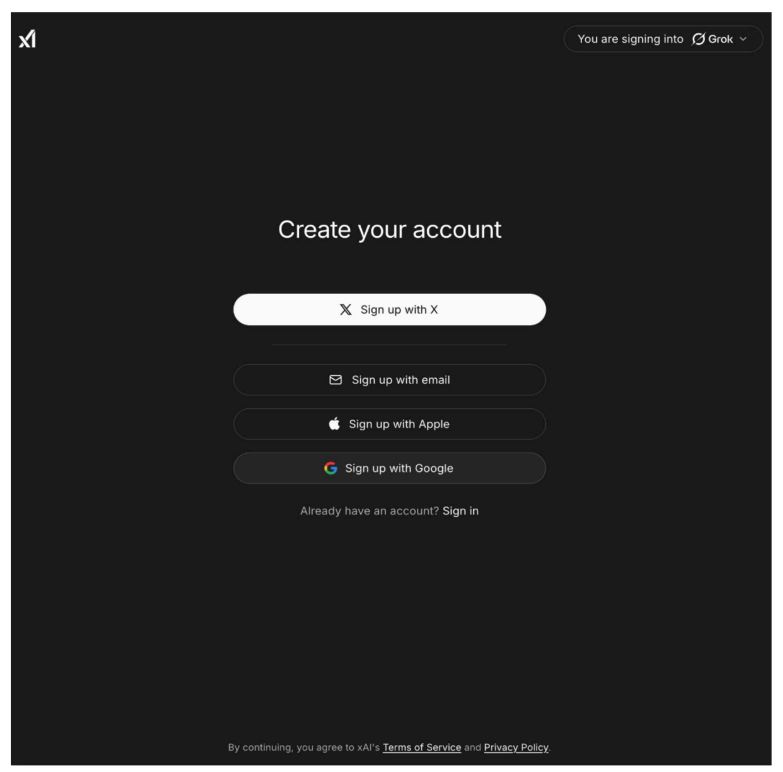
The court says the TOS offer isn’t reasonably conspicuous.
Transaction Context
Rose created a free Grok account in March 2025 through xAI’s sign-up page that invited users to “Create your account.” Rose created an account by clicking a button below the “Create your account” message that said, “Sign up with email.” Rose does not dispute that this sign-up process for a free account, allowing Rose to easily interact with Grok in the future, indicates a “forward-looking relationship” with Grok rather than a single transaction. A user signing up for a Grok account, like Rose, thus would expect the relationship to be governed by terms.
Visual Display
Despite Rose’s purportedly heightened interest in finding the TOS offer, the court says this is basically Skaggs redux.
Rose signed up for a Grok account using his email address—the second button down in the list of four sign up options. As in Skaggs, after Rose selected the “Sign up with email” button, the remaining text on the page became superfluous; Rose had no reason to continue reading. The notice of the “Terms of Service” at the very bottom of the screen was not sufficiently conspicuous during Rose’s signup process…
an “uncluttered” page is more likely to focus the reader’s attention on a notice of terms of service even where the text of the notice is muted, as here. But the notices analyzed in the controlling Ninth Circuit cases (Keebaugh, Massel, and Patrick) that Defendants cite were both uncluttered and required users to explicitly acknowledge the terms—a requirement xAI chose not to include in its signup process here. [Eric’s comment: the cited precedent isn’t as decisive as the court suggests.]…
xAI permits a user to create an account simply by clicking one of the sign-up options without verifying that the user is aware of—much less agrees to be bound by—the terms of service purportedly governing the relationship.
In a footnote, the court distinguishes another precedent: “here, the disclosure is at the periphery of the screen: a user signing up from a computer screen must survey a larger area to find the disclosure, and is thus less likely to see it, than a user signing up from a mobile device—even if the sign-up screen is uncluttered.”
The court doesn’t expressly address the mismatch between the TOS offer language “by continuing” and the action button labels “sign up with…” but that would be another potentially fatal flaw per Chabolla and Godun.
Chen v. X Corp., 2026 WL 3082938 (S.D.N.Y. Oct. 15, 2026)
This is a pro se account termination lawsuit, so it has no chance of success. Chen sued X in New York. X seeks to transfer it to Texas per its TOS. The court agrees.
The court doesn’t show any screenshots but says:
When Chen created his X Account, a blue underlined hyperlink containing X Corp.’s Terms was located near the “Create My Account” button. The signup page also noted that in creating an account, a user agreed to the Terms. The Terms included a clause that X Corp. may change the Terms and that continued use of the platform after notice of the change in the Terms would constitute acceptance of the Terms. Further, on October 21, 2024, Chen clicked “Got It” on a pop-up notification notifying users that X Corp. was updating its Terms. The relevant forum selection clause was contained in these updated Terms. Chen does not dispute that there was a hyperlink to X Corp.’s Terms when he signed up, nor that he clicked “Got It” on October 21, 2024.
Query: is “Got it” the same as an acceptance of an offer? In my Internet Law class, I show students this screenshot and mock it because it has soft language (“now’s a great chance”–is it really though?) and nothing in the disclosure says that the “got it” button signals assent.
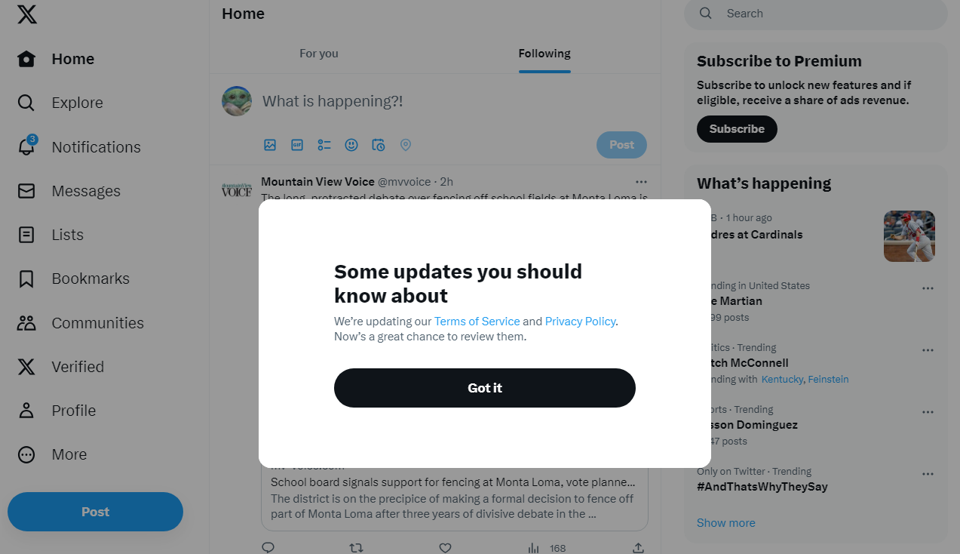
The court says:
The Terms were reasonably communicated to Chen through the pop-up notification he received on October 21, 2024, informing him that the Terms were being updated. This Circuit has also frequently held that terms communicated in a sign-up wrap format similar to X Corp.’s satisfy the reasonably conspicuous notice requirement.
In a pro se case, X can get away with arguments like this. Had a competent lawyer been challenging this screen in front of an impartial judge, I’m not so sure. Then again…
X.AI LLC v. St. Clair, 7:26-cv-00005-O (N.D. Tex. Oct. 20, 2026)
This is part of a litigation brawl between Elon Musk and Ashley St. Clair, one of Musk’s baby mamas who has evolved into a fierce Musk critic. St. Clair sought a TRO in New York “alleging that Grok generated explicit images depicting [her] and propagated those images on the X platform.” Team Musk countersued St. Clair in Texas, invoking X’s TOS due to St. Clair having created an X account in 2024. Judge Reed O’Connor gives Team Musk everything they want, despite (or because of?) there being questions about his impartiality. Friendly judges are a key reason why Musk changed X’s venue selection to Northern District of Texas. He’s apparently getting good ROI on that switch.
This takes us back to the “got it” screen I just discussed in the Chen case. Once again it works, but this time in a hotly contested lawsuit. Judge O’Connor gives a clean sweep to Team Musk:
Plaintiffs assert that Defendant received notice of Version 21 on December 16, 2025, clicked the accompanying “Got It” button, and continued accessing the X platform after the revised terms became effective on January 15, 2026.22 Defendant argues that clicking the notification before the effective date could not constitute acceptance and that Plaintiffs’ allegations of subsequent use are conclusory. But Plaintiffs expressly allege that Defendant accessed or used X after January 15, 2026, conduct that the Revised Terms of Service identify as constituting acceptance….
Plaintiffs allege that Version 21 expressly extends the forum-selection provision to third-party beneficiaries and that the xAI Plaintiffs qualify as such beneficiaries. Although Defendant disputes whether the parties intended to include xAI within that provision, the absence of xAI’s name from the Terms of Service does not, standing alone, establish that Plaintiff’s interpretation is implausible….
Defendant maintains that her claims arise independently of any contractual relationship because they concern xAI’s alleged misconduct in generating sexually explicit images without her consent. But the forum-selection clauses are not expressly limited to contractual causes of action. Rather, they encompass disputes related to the services and content generated or disseminated through those services….Plaintiffs allege that Defendant’s New York action concerns content generated by Grok and disseminated through the X platform. Given the clauses’ express references to disputes concerning content and others’ use of the services, Plaintiffs have plausibly alleged that Defendant’s claims fall within their scope.
I’m still skeptical about the enforceability of that “Got It” button!