

Blogger Defeats Photographer’s Copyright Claim–Sokolskyfilm v. Messiah
I’m blogging this case only because it’s one of those “what are we even doing here?” lawsuits. Cases like this belong in the CCB or, better yet, should not be brought at all!
* * *
The case involves a photo called the “Parker Train Photo.” It was taken in 1962, but it was first published in a book in 2000. The plaintiff claims it licenses the photo for fine art reproductions for up to $5k each.
Messiah ran a blog initially entitled “Ask Fashion Kitty.” In 2009, she wrote a post entitled “Style Suggestions for Army Wives” about what a wife should wear when greeting her husband who is returning from an 8 month military tour in Afghanistan. Messiah found the Parker Train Photo in a Google image search and used it to illustrate her post:
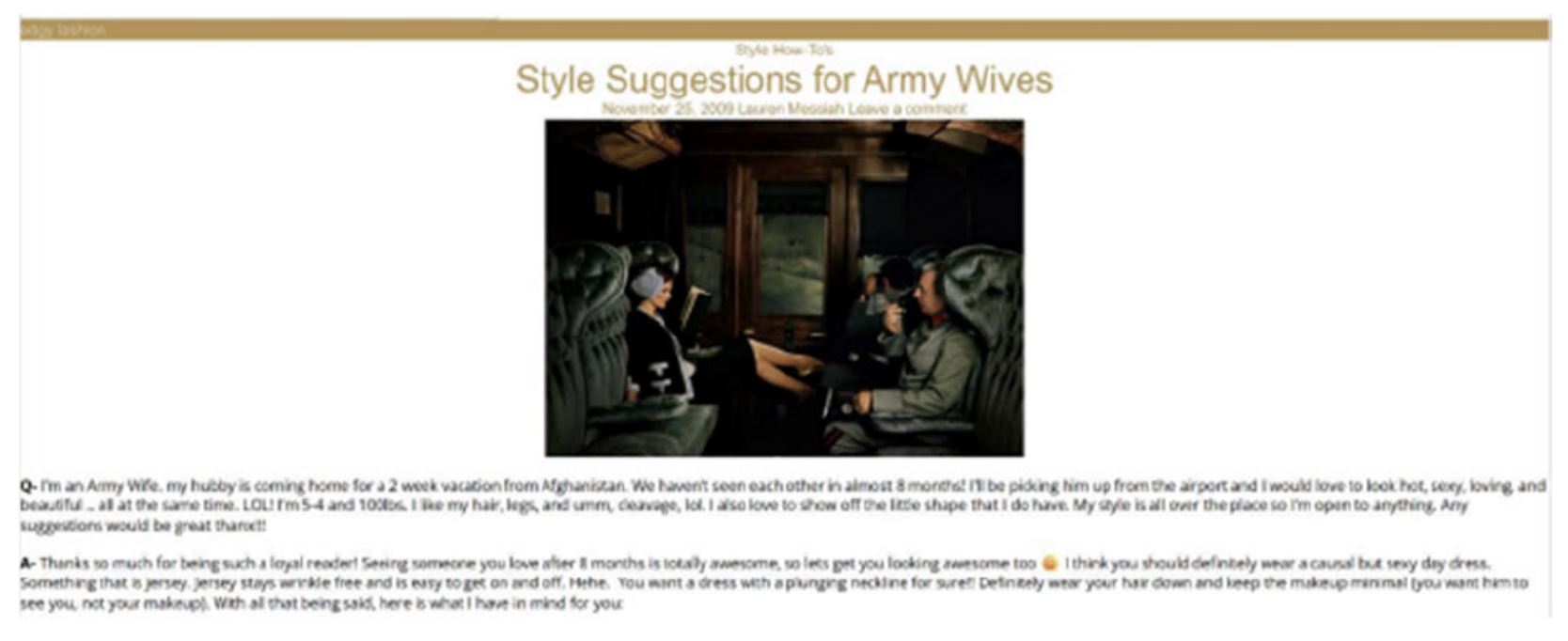
The plaintiff discovered Messiah’s post/photo in 2025 and sent a C&D. The court describes what happened next:
Defendants’ assistant dismissed the cease-and-desist as spam, deleted it, and did not forward it to Messiah. Defendants’ authenticated Slack communications confirm that Messiah described the copyright claim as “some stupid like copyright infringement thing for an old blog post.”

Messiah had the blog post deleted, but the image remained online at its (presumably highly obscure) direct URL (this eventually got deleted too). In 2025, the plaintiff sued for copyright infringement and 1202 violations.
Remarkably, the opinion doesn’t mention the statute of limitations at all, even though the original post had been published no less than 14 years earlier (I’m crediting the 2011 blog transfer as a possible republication). This silence reflects that the statute of limitations doesn’t functionally exist in online copyright law any more. Each new view/download nominally constitutes a new infringement, in which case the SOL resets to the most recent visit to the post.
Nevertheless, on summary judgment, the court dismisses the copyright infringement claim on fair use grounds:
Nature of Use. The blog post is transformative because “the Parker Train Photo is part of a broader work as published in the blog and accompanies fashion guidance, rather than being part of an anthology of the Photographer’s work.” Later, the court acknowledges that “the question-and-answer commentary does not appear to substantively reference the Photo at all,” but the text’s lack of substantive engagement with the photo doesn’t seem to affect the court’s transformativeness determination. This is a defense-favorable approach. I think other courts would reject transformativeness when the photo is used purely for its illustrative effect without any commentary.
Although Messiah’s website had a commercial purpose, “There is no evidence in the record of any revenue or commercial benefit earned from the blog or, more specifically, the Parker Train Photo blog post.”
Nature of Work. “the Parker Train Photo is a fashion photograph. Generally, photos are viewed as creative expressions.”
Amount Taken. “the question-and-answer commentary renders the Parker Train Photo insubstantial in context.” This is a highly defense-favorable conclusion because 100% of the photo was used.
Market Effect. “Plaintiff’s market, by its own admission, is fine art, whereas Defendants’ blog post served a different market function.” This is also a highly defense-favorable conclusion. The plaintiff did have a licensing program for the photo.
I interpreted the opinion’s defense-favorable twists to the court’s motivation to dismiss this case. Either the court was unmoved by the low-stakes nature of the alleged infringement (photographers should stop suing bloggers for copyright infringement!), or fair use was a backdoor way for the court to accommodate the lack of a statute of limitations.
1202.
there is a dearth of evidence on the record that Messiah knowingly failed to credit the Photographer when she posted the Parker Train Photo on her blog, or that she did so with the intent to induce, enable, facilitate, or conceal infringement. Messiah merely found the Photo on Google Images by searching “army fashion,” saving the file on her computer without altering the Photo or the filename, and then publishing the Photo on her blog. She testified that at that time, she looked for a watermark, could not find one, and had no knowledge of the Photographer. She also testified that the filename, “Melvin-Sokolsky5.jpg,” was provided by the source website and she did not know it referenced the Photographer.
The plaintiff pointed out that Messiah had occasionally credited other photographers in other posts. The court responds: “Plaintiff does not point to any case law to suggest that Defendants providing credit to some photos while missing credit for others indicates a pattern of deliberate conduct.”
* * *
Last month, I blogged about another case where a blogger illustrated their post with a third-party photo, and that did not qualify for fair use. I’m not sure how to reconcile the two cases, though the time delays in this case make it seem less sympathetic.
In my prior blog post, I made the following observations that mostly apply here as well:
- “Verbatim republishing of a third-party photo is inherently risky, even for bloggers.”
- “I was struck by the fact that the blog post had 43 views. With such low stakes, how did this case make it to federal court and reach summary judgment???”
- “why isn’t this case in the CCB, which seems like it was tailor-made for low-value cases like this?”
- “the photographer’s actual damages should be near-zero… I don’t see how the photographer is going to get any real payoff here”
- “All of this makes it a bummer for everyone–plaintiff, defendant, and society–that the parties couldn’t settle this case pre-filing.”
- “other than ignorance of copyright law, why would a blogger cut-and-paste a copyright photo from the Internet when a non-infringing substitute is just a few extra clicks away? A lawsuit like this heightens the demand for Generative AI replacements.” This advice doesn’t work here because the copying is so old that we were still at war with Afghanistan and Generative AI wasn’t widespread.
Case Citation: Sokolskyfilm, Inc. v. Lauren Messiah Inc., 2026 WL 1772787 (C.D. Cal. June 16, 2026)