
Blogger’s Photo Republication Isn’t Fair Use–Vedros v. Endless Mt. Labradors
This is a run-of-the-mill photographer copyright enforcement action. As a commission for an advertiser, Vedros created a photo that depicts “a dog placing its front paws on a scale with a cat nearby, and shows both animals looking at the dog’s weight….[including] removing the dog’s collar and placing it next to the scale.” The defendant breeds English Labrador dogs and operates a website emlabradors.com. [A reminder: adopt, don’t shop.] The breeder’s website included a blog, and on February 4, 2016, Donna Stanley made a blog post entitled “A Breeder’s Note on Canine Obesity.” “At some point during litigation, the photograph was removed from the article’s header; at that time, the article had forty-three (43) views.” 🙄
The court grants summary judgment to the photographer on infringement. The fair use defense fails.
Purpose of Use–Commercial. The blog post describes the problems with canine obesity, which is sorta educational. However…
The article recommends buying natural dog food, and, on another tab on the website, Defendant sells natural dog food. The canine focused article is also related to the main business purpose of the website, selling labradors. Indeed, the title of the article is “A Breeder’s Note On Canine Obesity,” calling attention to the fact that the author is herself a dog breeder. Other tabs on the website also link to products for purchase related to homeopathic dog health treatments….
Moreover, the photo itself is, at best, only tangentially related to the article’s educational purposes. The article alone provides any realized educational benefit, while the photograph is merely an attention-getting thumbnail. The article does not describe or interact with the photograph at all, nor is the photograph asserting anything of educational value
The blog post is educational content from a market vendor who has specialized expertise. Is it educational or commercial? ¿Por qué no los dos?
I don’t love how the court links commercial activity elsewhere on the website to the blog post. Yes, they are all part of the same enterprise, but I thought we had moved past this kind of link-counting 15+ years ago.
Purpose of Use–Transformative. “Defendant’s use of this photograph, as an eye-catching graphic atop an article about dog food options on a blog connected to their website which also sells dog food, is not transformative from the original use and purpose of the graphic. Defendant did not alter the work, instead reusing the photograph in its entirety.”
Nature of the Work. “The photograph at issue is a creative work, not an informational photograph. The photograph is not a factual or scientific depiction of an obese dog, rather, the photograph is a humorous depiction of two animals looking at a scale.” [Putting aside the dog body-shaming, the blog post now uses a photo of a chonky dog in place of the photo at issue in this case.]
Amount Taken. “Defendant advances no argument for why including the entire photograph was necessary….This is not a situation where the entire photograph was used “contextually,” as “explanatory” or “background” material to “aid in understanding and interpreting” a permissible purpose.”
Market Effect. The court counts this factor towards the photographer:
the extent of market harm from Defendant’s particular use of the photograph is minimal. Defendant’s particular actions did not cause Plaintiff’s market great harm, as Defendant did not offer the photograph for resale and the blog post was seemingly insulated from other platforms and located only on the breeder’s website. Additionally, Defendant’s audience was relatively small. At the time Defendant responded to Plaintiff’s interrogatories, and at the time the photograph was removed from the website, the article had forty-three (43) views….
[However,] should a large part of Plaintiff’s consumer base begin copying his work without paying for it, Plaintiff’s incentive to continue creating such works would diminish greatly
The court rejects the fair use defense and awards summary judgment on infringement to the plaintiff. The court will tackle the remedies issue in a later round.
Implications
Unsurprising outcome.
This isn’t a particularly surprising result. Verbatim republishing of a third-party photo is inherently risky, even for bloggers (see, e.g., Golden v. Grecco). It’s even riskier for commercial entities like the breeders in this case.
How is this case financially sensible for anyone?
I was struck by the fact that the blog post had 43 views. With such low stakes, how did this case make it to federal court and reach summary judgment???
And why isn’t this case in the CCB, which seems like it was tailor-made for low-value cases like this? Regarding the latter question, the plaintiff is represented by the Sanders Law Group, which brings a high volume of copyright cases. Maybe the law firm is managing the total number of cases they bring at the CCB…? Or perhaps they hope to get attorneys’ fees, which normally aren’t awardable in the CCB.
In any case, with 43 views at issue, the photographer’s actual damages should be near-zero. Statutory damages are possible, and the court did accept the plaintiff’s argument that some deterrence of unpermitted copying was necessary even if the photographer didn’t have a standard licensing program for the photo. But I can’t see more than a few thousand dollars of statutory damages at most–well below the litigation costs.
As a result, I don’t see how the photographer is going to get any real payoff here. Even the plaintiff’s lawyers aren’t guaranteed to get a fee shift. Without the fee shift, this case will be a big financial loser for them and the photographer.
All of this makes it a bummer for everyone–plaintiff, defendant, and society–that the parties couldn’t settle this case pre-filing. But it takes two to tango with settlements. I don’t know what conversations took place here, but I’ve seen far too many photographers make extortionate settlement demands that tip the defendants’ balance towards fighting rather than paying off. If I were the judge and I saw 43 views at issue, I would have pressed the litigants hard to stop wasting their time and money in court.
Why Generative AI should moot lawsuits like this
The photo’s concept might be a good way of depicting dogs who need to lose some weight, but that’s not protected by copyright. And implementing that vision by manufacturing this photo in physical space is resource-intensive. In addition to the other props, the photographer needs a dog and a cat, and they need to cooperate simultaneously.
In contrast, creating an image like this via Generative AI is trivially easy. I went to ChatGPT and gave it the following instructions, which are just a paraphrase of how the court opinion described in the photo:
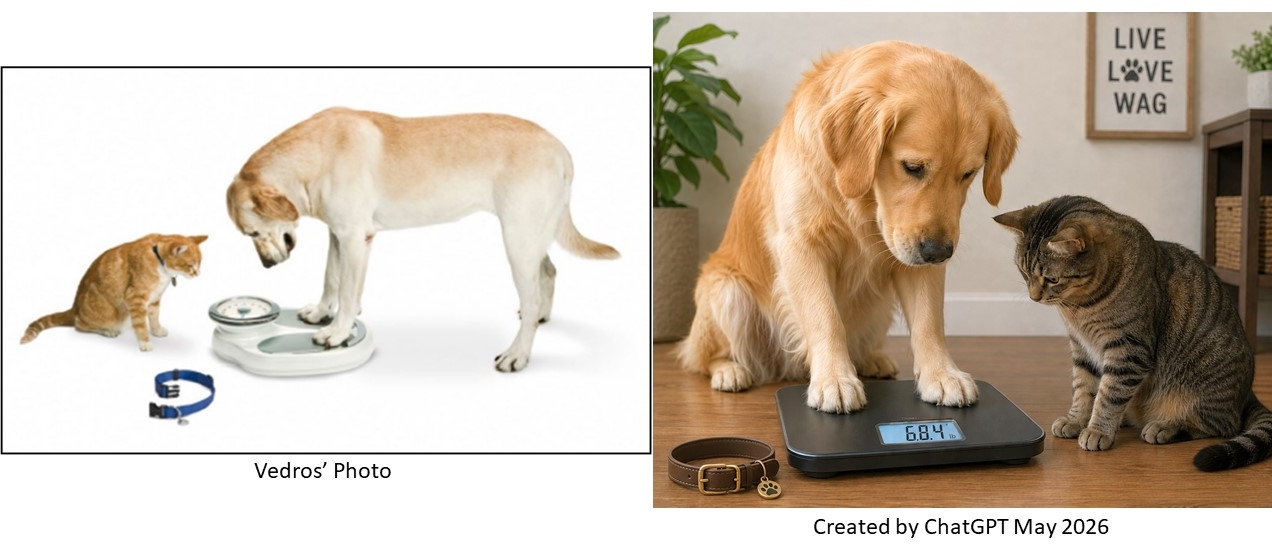
(Note the possibility that Vedros’ photo was in ChatGPT’s training data).
For now, I would say that Vedros’ image is slightly more effective at communicating the desired message than my quick ChatGPT output. Also, the ChatGPT image is wonky. For example, it lists the dog’s weight with two decimal points and the numbers are upside-down. However, if I cared, I could have easily improved the image through a few additional prompts. And as a substitute for the original photo, the ChatGPT image works perfectly fine for a blog post illustration.
So, other than ignorance of copyright law, why would a blogger cut-and-paste a copyright photo from the Internet when a non-infringing substitute is just a few extra clicks away? A lawsuit like this heightens the demand for Generative AI replacements. I understand that photographers feel compelled to protect their interests, but I don’t think this particular lawsuit is a net win for the photographer community.
The defense did raise the AI substitutibility, but only as a reason to permit verbatim copying, which the court doesn’t appreciate:
Defendant asks the Court to rule, without any legal support, that copyright does not protect works which could have been generated with AI. Such a holding would destroy the foundations of copyright law. The Court declines to endorse or entertain this proposition.
[In a footnote, the court adds:] Defendant could have also taken its own photograph of a dog on a scale with the very dogs it breeds. Perhaps Defendant could also sculpt Michaelangelo’s David, or re-paint the Mona Lisa, depending on Defendant’s talent. Under Defendant’s logic, the only works entitled to protection would be those which no machine or human could recreate. This argument cannot stand.
Case Citation: Vedros v. The Sterling Group of the Twin Tiers, Inc., 2026 WL 1348120 (M.D. Pa. May 14, 2026).