

A Religious Organization is Suing its Critics, and the Weapon of Choice is Copyright—RRT v. Cheryl Bawtinheimer (Guest Blog Post)
By guest blogger Cathay Y. N. Smith, Professor of Law at Chicago-Kent College of Law
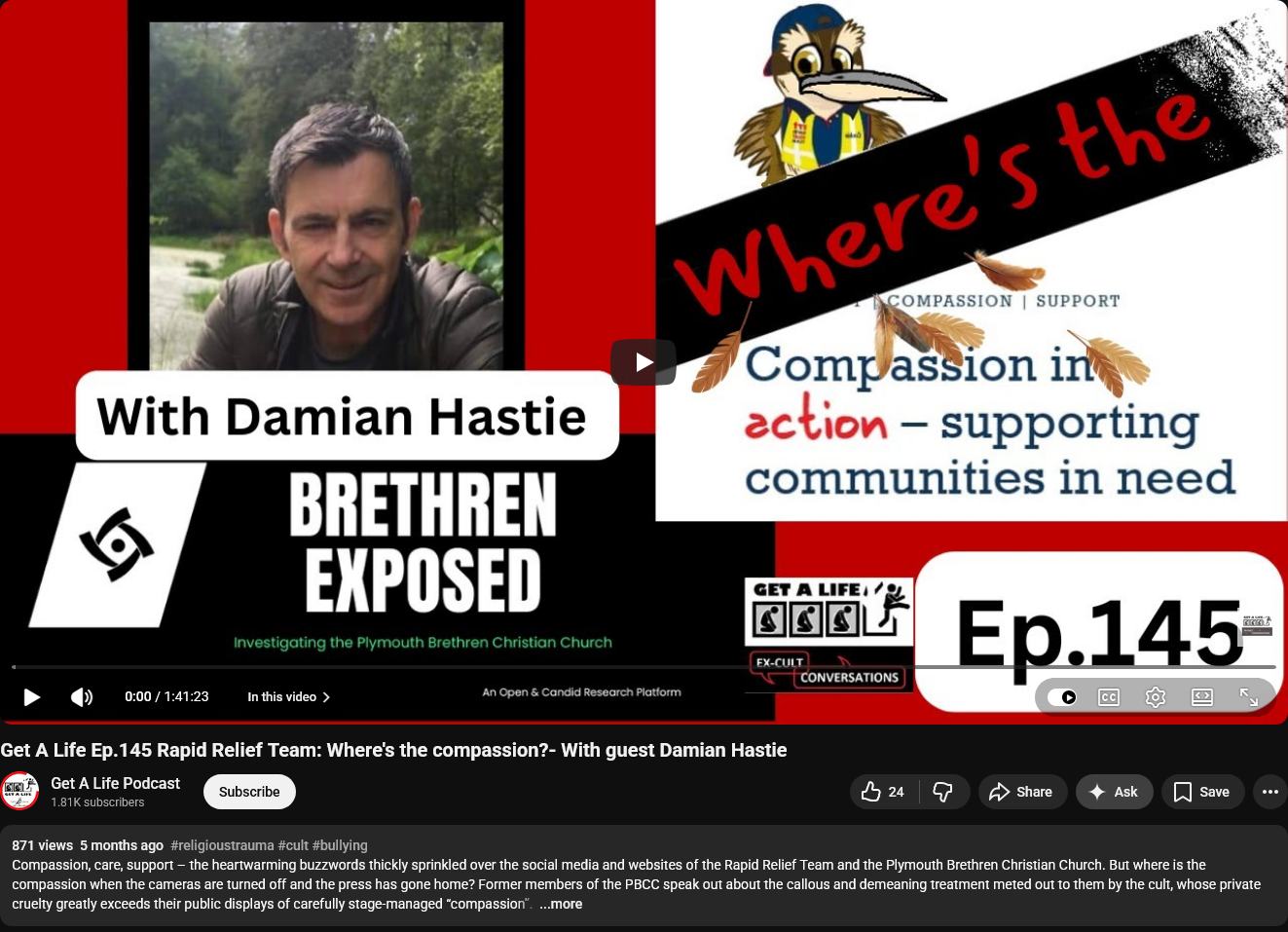
Rapid Relief Team (RRT), the charitable arm of the Plymouth Brethren Christian Church (PBCC), has filed a copyright infringement lawsuit in the Northern District of California against Cheryl Bawtinheimer, a former church member turned vocal critic. The alleged offense: her YouTube channels “Get a Life Podcast – Ex-Cult Conversations” and “Rapid Relief Team – Exposed” showed footage of RRT’s own website and marketing materials, which happened to include the charity’s “Cookie Kookaburra Bird” logo.
Bawtinheimer wasn’t selling the logo on t-shirts or reproducing it for sale. She was using it as a backdrop while she and other ex-PBCC members talked about their experiences with the church. The logo was simply… there, as she and her guests criticized the text around it. Here’s one example of how Bawtinheimer’s videos “reproduced” RRT’s logo:
Bawtinheimer is a former member and prominent critic of PBCC (f/k/a Exclusive Brethren). PBCC’s global headquarter is in Australia, but its multibillion-dollar empire claims over 55,000 members across the world. It has been the subject of intense media scrutiny for its alleged cult-like operations, psychological manipulation, illegal surveillance, and shunning practices of former members. It has also been accused of burying claims against church elders for sexual abuse of minors—including sexual abuse accusations made by Bawtinheimer herself. According to RRT’s Complaint, RRT was founded by PBCC as a “global charitable relief organization offering compassionate support to communities impacted by natural disasters and humanitarian crises.”
After exiting the church, Bawtinheimer established her YouTube channels featuring “conversations with former members of the PBCC” to “peel back the hidden layers within these cults and reveal trauma that occurs behind closed doors,” and to “compile and analyze videos, events, and public campaigns run by the RRT, exposing how they function as a tool . . . for the PBCC.” It is within these videos that Bawtinheimer featured RRT’s website and stylized logo for which she is now being sued. This was after RRT filed DMCA takedown notices to have those videos removed from YouTube, and Bawtinheimer filed counter notifications to have them reinstated.
So, what is going on here? Does RRT and PBCC, a $22 billion organization, really care that their logo is in the background of videos on a YouTube channel with fewer than 2,000 subscribers? Or is this about something else? (Spoiler alert! It’s about something else.)
There’s a name for what PBCC is doing to Cheryl Bawtinheimer: it’s called “copyright silencing.” As I wrote in Copyright Silencing and Weaponizing Copyright, copyright silencing is the practice of using copyrights to silence criticism, censor speech, and prevent the dissemination of facts. Unlike typical copyright claims, copyright silencing doesn’t involve copyright owners asserting copyright to protect their economic or market interests in their copyrighted works. The sole purpose of copyright silencing is to weaponize copyright to silence criticism, bury facts, suppress and eliminate public discourse and dissemination of information.
This abusive use of copyright law is, unfortunately, not uncommon and can often fly under the radar because accused infringers feel pressured to voluntarily remove their works, or Internet platforms like YouTube take down works in response to copyright owners’ DMCA notices. It is also difficult to defend in litigation. The copyright misuse defense doesn’t typically apply to this form of abuse and there is currently no federal anti-SLAPP law. While many of the accused infringing uses would be considered noninfringing fair uses, litigation is expensive, which favors these well-funded organizations: by the time an accused infringer has the opportunity to raise fair use they could already be out of pocket too much to continue their defense.
These tactics have been employed by copyright owners, including religious organizations, to successfully silence critics—even when the accused uses would be considered noninfringing fair uses. These religious organizations, it turns out, have found a secular weapon that works just as well as any doctrine: copyright. The Church of Scientology, Jehovah’s Witnesses, and PBCC have each used it to successfully bury criticism.
The Church of Scientology has a long and successful history of silencing critics, former members, and news media in federal courts for copyright infringement for publishing “confidential” church documents online—despite the fact that the purpose of publication was for criticism and some of those documents were obtained from public court files. More recently, the Church has used DMCA takedown notices to remove websites or videos (including news clips) critical of the Church.
In 2020, Truth & Transparency (T&T), a “nonprofit newsroom dedicated to religious accountability through impact journalism,” was forced to settle a copyright infringement suit with Watch Tower, the governing body of the Jehovah’s Witnesses. T&T operated the FaithLeaks website, described as a “religious document archival project that collects documents from whistleblowers in religious communities.” The website published internal Watch Tower documents and videos, including documents on the Jehovah’s Witnesses’ mishandling of sexual abuse claims and 74 internal annual convention “propaganda” videos. Watch Tower sued for copyright infringement, ultimately forcing T&T (due to lack of funds to continue litigation) to agree to remove all documents and videos, agree to never post any additional Watch Tower Materials, and pay $15,000 in damages. The FaithLeaks website has not posted anything new since 2019.
PBCC also has a successful history of silencing its critics through copyright claims. It has filed (sometimes through affiliated entities) a number of copyright claims against former members who reproduced their materials in order to criticize them. For instance, it sued former member Richard Wyman for copyright infringement (and defamation) in the District Court of Minnesota when Wyman published the church’s religious writings and meeting minutes. After 16 months of litigation, the parties settled.
It sued Tim Twinam, a former church member, when he launched a website to reconnect other former members who left the church and were subjected to the church’s “doctrine of separation.” PBCC filed suit against Twinam and his wife in the District Court of Vermont for copyright infringement for uploading church sermons and letters. After three years and six months of litigation in federal court, the parties settled with the Twinams signing a consent order and permanent injunction.
It also filed copyright claims against Ian McKay, a former lecturer at the University of Glasgow, for publishing and quoting from church documents, including the church’s list of places that members were not permitted to go: the movie theater, football and cricket matches, bars, restaurants, hotels, fireworks displays, swimming pools, universities, zoos—basically any place that might bring joy. As a former member of the church, McKay’s goal was to highlight the church’s excessive control over its members. McKay spent over £50,000 ($65,000+) defending his right to say so. He was forced to settle.
Given its successful track record, it’s no surprise PBCC is running the same play against Cheryl Bawtinheimer. But unlike prior cases, Bawtinheimer didn’t reproduce any of the church’s texts, lists, or religious writings—works that fit more comfortably within the domain of copyright. Her videos just showed a portion of RRT’s website that happened to include RRT’s logo. Logos are usually governed by trademark law but can be protected by copyright if they embody enough creative authorship. So, in September 2025, RRT went through the trouble of purchasing a copyright assignment from the logo’s creators before immediately filing a YouTube takedown request the next month. The logo had one job. When that didn’t work, they sued her in federal court.
[Note: the logo isn’t even registered in the U.S. Copyright Office, which is typically required before bringing an infringement claim in federal court. RRT appears to be relying on its foreign rights to bring suit, which allows them to seek an injunction and defendant’s profits, but no statutory damages or attorneys’ fees. But this works just fine for RRT, because RRT’s interests aren’t financial. Indeed, in its Complaint, RRT seeks to enjoin Bawtinheimer and demands the “destruction” and “recall” of all of the videos that include the logo.]
To use the age-old abductive reasoning test: if it looks like a duck, swims like a duck, and quacks like a duck, then it probably is a duck. RRT’s copyright lawsuit looks, swims, and quacks like copyright silencing. The question is whether anyone will hold them accountable.
Copyright silencers have been able to get away with abusive practices because most people weren’t paying attention and because of the imbalance of power between the parties. The law appears to provide some options for victims of these tactics: 17 U.S.C. § 505 allows courts to “award a reasonable attorney’s fee to the prevailing party,” including defendants who prevail on fair use. The Ninth Circuit ruled in 2015 that copyright owners must consider fair use before filing DMCA takedowns; failing to do so is a material misrepresentation which can mean damages and attorneys’ fees under § 512(f). And then there’s Rule 11, which prohibits attorneys from filing claims for an “improper purpose.” Using copyright to silence a survivor should qualify. The cruel joke of copyright silencing is that even though the law technically offers remedies, it can be difficult for victims to succeed under these options, and accessing them requires surviving litigation long enough to get there—which is precisely what a $22 billion organization with an army of lawyers is betting you can’t do.
Case Citation: Rapid Relief Team (RRT) Limited (RRT) v. Cheryl Bawtenheimer, Docket No. 4:25-cv-10864 (N.D. Cal. complaint filed Dec 19, 2025). The PacerMonitor page.
Pingback: Links for Week of March 20, 2026 – Cyberlaw Central()