

A First-Hand Look at the Messy Underbelly of DMCA 512(c) Takedowns
From 2009-2013, I used Scribd as my primary hosting service. I posted nearly 800 files there over a roughly four year period. Progressively, I became disenchanted with Scribd, including their efforts to put my uploads behind their own paywall and to broadcast members’ private reading activities. I eventually switched to using SCU’s Digital Commons as my primary hosting service, and I almost never go to Scribd any more.
You can imagine my surprise when Scribd emailed me in early February 2026, saying that one of my uploads had been taken down due to a DMCA takedown notice. Even more shocking was the removed file, “Amaretto v Ozimals Preliminary Injunction,” which I uploaded in early January 2011. (If you don’t remember that case, it was the super-interesting dispute between the Second Life virtual horses and virtual bunnies). Why is a 15-year-old upload getting DMCAed now?
And this file in particular! Federal court documents aren’t eligible for copyright protection per 17 USC 105, so I felt certain that my upload was in the public domain and didn’t infringe anyone’s copyright. I found Scribd’s counternotification procedure (they didn’t direct-link to it in their notification to me) and submitted a 512(g) counternotification.
The next day, I got another notice from Scribd saying that my content was taken down due to a DMCA takedown notice. I couldn’t tell if this was a new takedown request or more details about the one Scribd already effectuated. The targeted URLs in the takedown notice related to education materials, but buried in the list of dozens of targeted URLs was my upload:
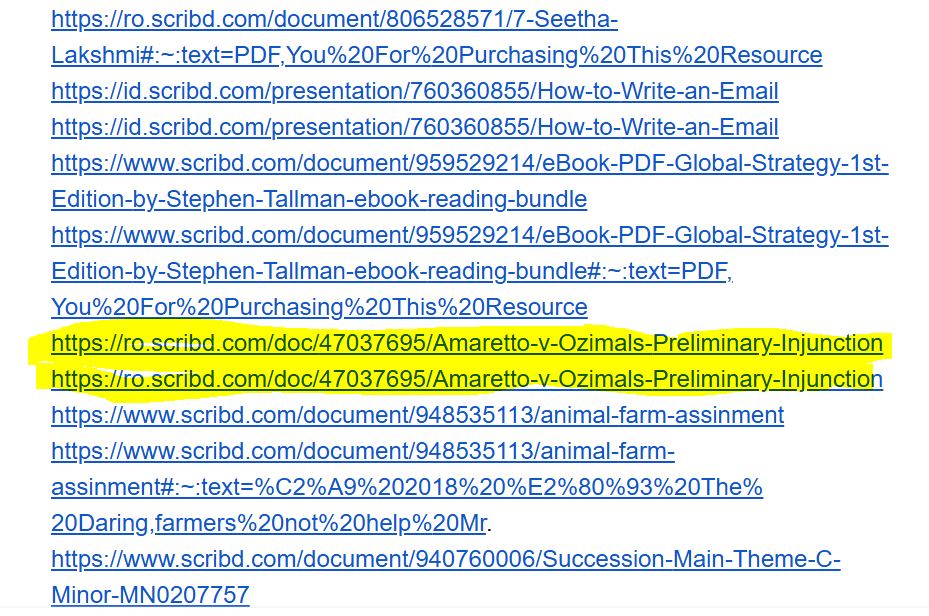
The DMCA notice purportedly “identified” the copyrighted works that I allegedly infringed:
Users on [Scribd] have uploaded The Daring English Teacher, Inc. resources. These materials can be found here: https://www.teacherspayteachers.com/Store/
The-Daring-English-Teacher.
My involvement in this DMCA notice made no sense. I posted a federal court document. What does that have to do with teaching resources?
It appears there are 863 paywalled items available at the identified URL, so I did not try to confirm if the preliminary injunction was somehow embedded in any of them. That seems extremely unlikely given the niche-y nature of this particular court document.
[Query: 512(c)(3) says the notice must identify “the copyrighted work claimed to have been infringed, or, if multiple copyrighted works at a single online site are covered by a single notification, a representative list of such works at that site.” Does a notice indiscriminately pointing to a URL enumerating 863 paywalled items satisfy this requirement?]
Plus, even if an identified work contained a copy of the preliminary injunction, it’s in the public domain. It does not appear that Scribd invested any effort to address the notice’s very obvious public domain problem.
In response to my counternotification, Scribd replied to me:
We are in receipt of your DMCA counter-notification. We appreciate your patience as we notify the complaining party and await their response. The complainant has a maximum of fourteen (14) business days to:
- rescind the original notification,
- ignore the counter-notification, or
- notify Scribd of their intent to pursue further legal action.
We are prohibited from displaying or restoring the content until the matter is resolved. We can restore the content only if the complainant rescinds the original notification, or after 14 days if the complainant fails to respond.
Say what??? This procedure is a pastiche of 512(g) concepts that deviate from 512(g) in important ways:
- Scribd’s response says “We are prohibited from displaying or restoring the content until the matter is resolved.” WRONG. 512(g) says that the service MUST restore the file in 10-14 business days of my counternotice UNLESS the copyright owner has filed a lawsuit.
- Scribd’s response says “We can restore the content only if the complainant rescinds the original notification, or after 14 days if the complainant fails to respond.” WRONG. Scribd MUST restore the content NO MATTER WHAT the complainant tells Scribd–other than the copyright owner saying it has filed suit. Scribd’s procedures say that if the complainant responds to Scribd but doesn’t rescind the notice, then Scribd will not restore the content. That’s not what 512(g) says.
- The response says the complainant can “notify Scribd of their intent to pursue further legal action.” Why? The complainant’s declared intent is irrelevant to 512(g). Per 512(g), within the 14 business day window, the complainant can block the restoration ONLY if the complainant “has filed an action seeking a court order to restrain the subscriber.”
Of course, Scribd can choose to forego its eligibility for 512(g)’s safe harbor. Many services make that choice because uploaders don’t have many tenable claims that 512(g) could apply to. Based on the procedures Scribd has adopted, I think Scribd has chosen to forego 512(g). I wonder, however, if they intended to do so, or if this was just a sloppy or thoughtless implementation of DMCA procedures.
Ten days after the initial takedown, I received an email from Rachel Andruczyk, the copyright agent (apparently not the copyright owner) who submitted the DMCA takedown notice governing the Daring English Teacher. (Rachel appears 12 times in the Lumen database). She wrote me:
Since Scribd has temporarily removed access, I cannot see the material. Several URLs were reported in this notice and there is a chance that one was captured in error. I would be happy to retract the notice if you could please just send me an image of the material in question so that I can identify it one way or another.
I replied:
It sounds like you don’t know how to use the Wayback Machine?
You can see it here: https://web.archive.org/web/20110130221240/https://www.scribd.com/doc/47037695/Amaretto-v-Ozimals-Preliminary-Injunction
To speed things up, I have included a PDF from the Wayback Machine.
She replied:
I have already sent the retraction notice to Scribd and it should be restored shortly.
I replied:
Thank you, but I remain confused how the error occurred in the first place. Could you please help me understand?
She replied:
I work for several authors to find and remove copyright infringements. This involves entering their watermarks, key words, names, etc. Line by line, I am scanning and reporting. Somewhere in the URL with the content belonging to you, there must have been some commonality in the search terms. I am human and most likely clicked a line above or below the intended target in the list. This is an extremely rare occurrence in all the years I have been doing this. Once again, I apologize.
Say what? “I am human and most likely clicked a line above or below the intended target in the list.” Seriously, sloppy mousing is the purported reason why a public domain document got knocked off the Internet? There is no “oops” excuse for sending wrong DMCA takedown notices. 512(c)(3) notifications are powerful legal tools. They need to be accurate. This notice wasn’t.
Now, if you’re a long-time reader, I know what you’re thinking. We already know that 512 is a cesspool of bogus takedown notices that 512(f) has failed to curb. This particular incident is at most a mildly interesting example demonstrating those well-understood phenomena. Fair enough.
Still, I think my experience highlights a few details about the collapse of the 512 notice-and-takedown bargain. Some of the possible lessons:
- takedown notice senders don’t care if their notices are accurate or not, and many senders don’t have adequate QA processes to prevent obvious errors.
- most uploaders would not have counter-noticed in this circumstance. The typical uploader wouldn’t have the same degree of confidence I have about 17 USC 105 or 17 USC 512(g) to push back. So the takedown notice and resulting removal are almost always going to be dispositive for targeted uploads.
- 512(f) is worthless. Could I sue Rachel Andruczyk for her self-admitted error? Per Rossi, to survive a motion to dismiss, my claim probably would need more damning proof of her subjective intent. “Mere” dereliction may not be enough.
- takedown notice senders can get their takedown notices honored even if they only make indeterminate gestures towards the copyrights they purport to represent.
- Scribd was thinking about going public at a $1B valuation, so it’s not a small company. Yet its DMCA procedures are clearly not industrial-grade, especially its garbled implementation of 512(g). Smaller and less well-funded services have even worse DMCA practices.
- most people already assume that services essentially automatically remove content in response to takedown notices, no questions asked. This removal of public domain material fits that stereotype.
- more generally, in the triangle of copyright owner-service-uploader, the service will almost always side with the copyright owner over the uploader. Scribd did not protect my interests as an uploader, despite the obvious merit of my position and Scribd’s 15 year history with this item.
- as a result, be careful entrusting any uploads you care about to third-party UGC services. The only true way to be in control of your online fate is at a website and servers you operate and control.
(I’ll note that SCU has removed some of my uploads of court filings to the SCU Digital Commons in response to plaintiff complaints that they don’t want their litigation antics so visible. At this point, if I really care about keeping files online, I host them at my website. Even then, my web host has been targeted based on my uploads. It’s a rough world out there for uploaders, regardless of their carefulness and expertise).
To close the story, 10 days after the initial takedown, Scribd replied to me:
The DMCA notification that resulted in removal of your content was rescinded by the complainant. Your documents were restored (along with likes, view counts, and other metrics) to their original links. The complainant’s action renders the counter-notification moot and so we consider this matter closed.
The matter involving this particular upload may be closed in Scribd’s mind, but everything else raised by this blog post remains very much open.
A reminder of my short essay, “How the DMCA’s Online Copyright Safe Harbor Failed.”
* * *
Scribd’s comms department sent me the following comments in response to a draft of this post I sent them:
Scribd complies with applicable copyright laws, including the DMCA. We respect the rights of copyright holders and have established processes for reviewing and responding to copyright infringement. When we receive a valid DMCA notification, we remove the identified content.
The DMCA framework anticipates that mistakes can occur and provides a process for correction. In this case, that process led to the restoration of the material.
More details about Scribd’s copyright policies are available here.
Pingback: Pre-Publication Content Moderation Can Disqualify Services from the DMCA 512(c) Safe Harbor-McGucken v. ShutterStock - Technology & Marketing Law Blog()
Pingback: Links for Week of February 20, 2026 – Cyberlaw Central()