
Photobucket’s Attempted TOS Amendment Mostly Fails–Pierce v. Photobucket
Photobucket is a venerable photo hosting service whose best days are far behind it. In 2017, its management imploded the service by imposing above-market hosting fees. Most users stopped using Photobucket, but Photobucket kept their photos.
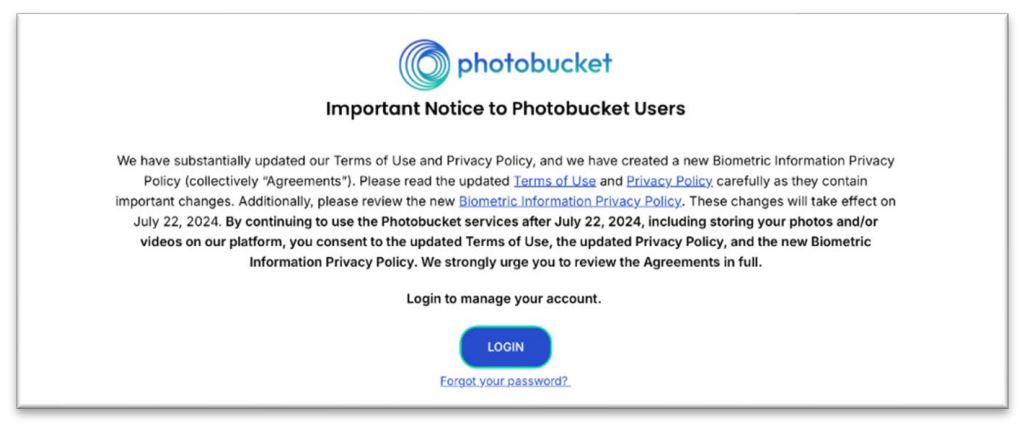 In 2024, Photobucket emailed its legacy users, asking if they wanted Photobucket to keep or delete their accounts. Users who clicked on the email’s links–included to delete their accounts–were presented with a new TOS formation process that included a consent to use the photos to derive users’ biometric information for AI purposes. “If users did not opt out of the Biometric Policy within 45 days of July 22, 2024, Photobucket claims the right to sell, lease, trade, or otherwise profit from the users’ biometric information.” (Photobucket claims it hasn’t actually pursued this AI option). The new TOS also contained an arbitration provision that wasn’t in some prior TOS versions. Photobucket invokes the arbitration clause against the plaintiffs’ lawsuit.
Article III Standing. The court says the plaintiffs only have Article III standing for equitable relief, not damages. This narrows the case substantially.
Pierce
Pierce agreed to Photobucket’s 2008 TOS and last logged into Photobucket in 2014. The 2008 TOS informed Pierce that his “continued use” of Photobucket would constitute acceptance to any TOS modifications. Since he didn’t use the site after 2014, he didn’t assent-by-use to the 2024 TOS:
a reasonable person would not understand his failure to take his photos off of
Photobucket, after not logging in for nearly ten years, to constitute “continued use” and thus acceptance of any revised terms.
In other words, a user’s maintenance of a legacy account isn’t “continued use” of the service.
Ms. Hughes
Ms. Hughes agreed to Photobucket’s 2006 TOS and last logged into Photobucket no later than 2011. The 2006 TOS said:
By using the Services you agree to the Terms of Service set forth below as they may be updated from time to time by Photobucket.com, Inc. (“Photobucket.com”). Photobucket.com may modify or terminate the Services from time to time, for any reason, and without notice, including the right to terminate with or without notice, without liability to you, any other user or any third party, provided that when Photobucket.com does so, it will update these Terms of Service. You are advised to periodically check the website for changes in the Terms of Service.
The court says this TOS “told Ms. Hughes that she was “advised to periodically check the website for changes in the Terms of Service.” The 2006 Terms “necessarily inform[ ] how a reasonably prudent user would interact” with Photobucket’s website.”
But…the TOS applicable to Pierce said “It is therefore important that you review this Agreement regularly to ensure you are updated as to any changes.” The court disregarded that language for Pierce. Can you find a difference between the disclosures to Pierce and Hughes? Beyond the (seemingly immaterial) language differences, the court’s different conclusions might be explained by (1) Pierce was governed by Colorado law, Hughes by CA law; or (2) Hughes admitted getting emails telling her about the coming changes, though she didn’t pay attention to them. I don’t find those distinctions persuasive, so I can’t meaningfully distinguish Pierce’s situation from Ms. Hughes’.
The court says Hughes is bound to the 2024 TOS:
the 2006 Terms told Ms. Hughes that she had an obligation to periodically check Photobucket’s website for updates to the Terms. The 2024 Terms and arbitration provision constitute an update to the Terms that Ms. Hughes had an obligation to stay apprised of. Ms. Hughes assented to the 2024 Terms because they informed her that failure to opt out within 45 days of the effective date would constitute acceptance, and Ms. Hughes did not opt out
Whoa. The court is saying that even though Hughes functionally abandoned Photobucket in 2011, a “reasonably prudent user” would have kept checking Photobucket’s TOS 13 years later just in case the terms had changed. Wild.
Because Ms. Hughes “agreed” to the 2024 TOS, she also “agreed” to its jury trial waiver.
However, the arbitration clause excludes IP claims. The plaintiffs alleged 1202(b) claims, which the court says are IP claims and thus not covered by the arbitration provision. This claim stays in court.
Cumming
The parties can’t agree when Cumming created her Photobucket account or when she last used it, but everyone agrees that she agreed to the 2013 TOS and didn’t use the site later than 2013. That TOS version said “so long as you’ve used the Site after the change, regardless of any separate notice, you agree to the current posted version of the Terms.” Similar to the court’s discussion of Pierce, the court says “a reasonable person in Ms. Cumming’s position would not understand her failure to take photos off of Photobucket to mean that she “used” Photobucket after 2010 or 2013 and thus assented to the 2024 Terms.”
Mr. Hughes
He didn’t have a Photobucket account, but Ms. Hughes uploaded photos of him. The court says he’s not a third-party beneficiary of any TOS and not bound by the arbitration clause.
Court Stay
The court stays the litigation until after the arbitration, even though the court held that 3 of the 4 named plaintiffs were not bound by the arbitration and the fourth plaintiff had a claim not subject to arbitration. Because the court will not be bound by the arbitrator’s decisions for the non-arbitrated plaintiffs and claims, I didn’t understand why the court held everything else up. A slightly lucky break for Photobucket, because it avoids the cost of defending the litigation and arbitration simultaneously.
Implications
Here’s where things stand when the dust settled:
- damages are out of the case
- part of one plaintiff’s case is sent to arbitration
- when that’s complete, the court will address the remainder of that plaintiff’s case plus the other three plaintiffs’ cases
A messy outcome…perhaps messy enough to motivate the parties to settle? Without the availability of damages, this case became less interesting to the plaintiffs. Alternatively, I could also see the plaintiffs appealing this ruling.
Though Photobucket nominally got the outcome it wanted (the case sent to arbitration), it does not come out of this ruling looking very good. Some of the lowlights:
- its inital TOS amendment provisions sucked. It had various versions of “you need to come back to the site to check for possibly amended terms,” which has rarely fared well in court. Frankly, it’s shocking to see the judge find this “keep checking the TOS 13 years later” provision worked against Ms. Hughes. I don’t think that’s what a reasonable consumer would do. (As usual, the court cited no empirical basis for its assessment of what a reasonable consumer would do or think).
- the fact that Photobucket’s TOS amendment language kept changing over time. The language differences ensure more litigation work when it’s challenged.
- the fact that Photobucket kept changing its governing law clause. Another decision that increased its defense costs and the risk of inconsistent outcomes.
- the fact that Photobucket couldn’t definitively establish the dates of the users’ account creation or usage.
- its 2017 implosion. How did it misjudge the market so badly?
- its 2024 pivot to potentially engage in AI mining. I guess if you’ve already killed your business, why not try to salvage what’s left of the carcass?
- the attempt to bind legacy users via a TOS that users had to click through even if they wanted to exit Photobucket. Gauche.
- the arbitration provision’s exclusion for IP. Plaintiffs are weaponizing 1202, so IP carveouts have become dangerous. Reminder: every part of the arbitration provision should be carefully vetted for potential plaintiff weaponization.
The result was a messy outcome with different plaintiffs for getting different outcomes. Not what Photobucket was aiming for.
The obvious question: was there a better way for Photobucket to force all legacy users onto its new AI-friendly terms? This judge seemed to believe that the right incantation would let Photobucket put the onus on users to check for TOS amendments, but most judges won’t permit this. Could Photobucket have forced users to the new terms through its emailed notifications? The Ninth Circuit just permitted this, so maybe? The reality is that it’s difficult or impossible to universally bind all legacy users to new terms if they aren’t coming back to the website. I don’t have any clever hacks or tricks to work around this.
Case Citation: Pierce v. Photobucket Inc., 2026 WL 672764 (D. Colo. March 10, 2026). CourtListener page.
Other posts about Photobucket