
Should Police Wipe a Criminal’s Cellphone Before Returning It?–U.S. v. Stathas
“Stathas pleaded guilty in 2023 to enticing a minor to engage in unlawful sexual activity” (18 U.S.C. § 2422(b)). He was sentenced to 180 months in prison and 10 years of supervised release.
As part of the arrest and investigation, the police seized Stathas’ car, cellphone, wallet, and other electronics. Per 18 U.S.C. § 2428(a)(1), the judge should have ordered (but did not) a forfeiture of “any property, real or personal, that was used or intended to be used to commit or to facilitate the commission of such violation.” The forfeiture should include the cellphone (Stathas used it to communicate extensively with the victim), but does that include the data on the cellphone, which arguably is neither real property nor personal property?
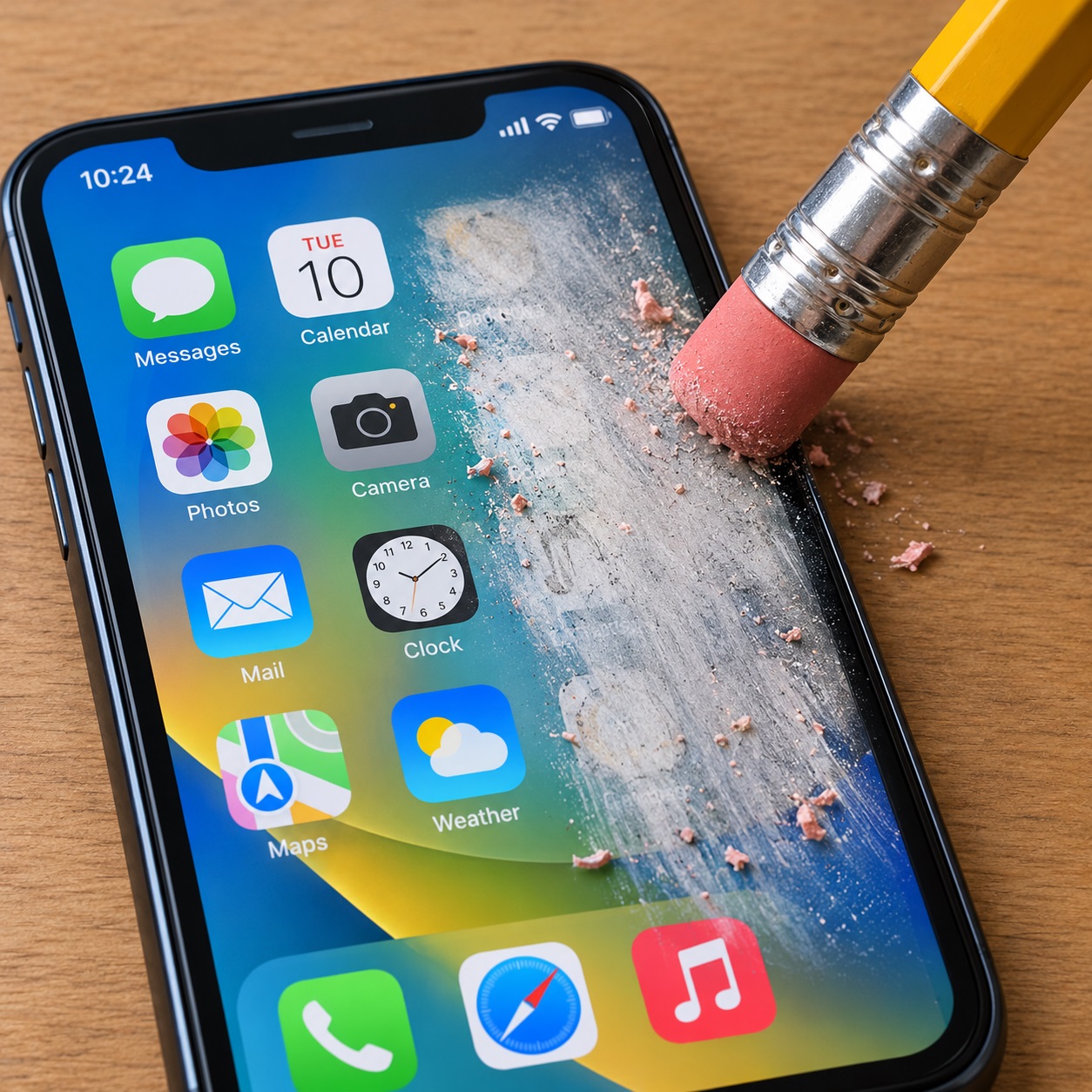
Produced by ChatGPT October 2026
After Stathas’ sentencing, the police agreed to return his car, wallet, and other electronics. If the police had gotten a forfeiture order, they wouldn’t have to return his cellphone at all, but instead they agreed to return the phone only after wiping it “because it contained obscene, sexually explicit conversations between Stathas and the victim, as well as the victim’s identifying information.” “Stathas responded that although he did not object to the government deleting his conversations with the victim, other data on the phone should be preserved because it was meaningful to him personally or relevant to a possible civil lawsuit against the West Bend Police Department.”
The Seventh Circuit says no:
the government’s retention and destruction of the data on Stathas’s cellphone is reasonable under the circumstances. The district court’s finding that the phone was rife with “numerous sexually explicit messages and images” sent to the victim as well as “significant personally identifying information about her” is not clear error. The record reveals that these conversations occurred over multiple apps on the phone and that Stathas also received explicit photos of the minor. The court did not clearly err by crediting the government’s assertion that “no procedure short of digitally wiping” the phone would eliminate all criminal or harmful material. Given the importance of the government’s interest in ensuring none of this material remains on Stathas’s phone, the district court did not abuse its discretion in concluding that the government could delete the phone’s data before returning it.
I haven’t seen a lot of discussion about wiping cellphone as a criminal remedy. In a case like this, it makes sense that the data associated with the crime should not go back into the criminal’s hand. At the same time, a cellphone wipe deletes a lot of data that may have nothing to do with the crime. Depending on the nature of that data and the availability of backups, a cellphone wipe could profoundly affect a person’s life. For example, if the cellphone had the data necessary to establish Stathas’ legal claim against the police, the cellphone wipe might extinguish his legal claim entirely.
The severity of a cellphone wipe brought to mind the Supreme Court’s discussion about the importance of cellphones (in a slightly different legal context) in Riley v. California, 573 U.S. 373 (2014):
The term “cell phone” is itself misleading shorthand; many of these devices are in fact minicomputers that also happen to have the capacity to be used as a telephone. They could just as easily be called cameras, video players, rolodexes, calendars, tape recorders, libraries, diaries, albums, televisions, maps, or newspapers.
One of the most notable distinguishing features of modern cell phones is their immense storage capacity….
The current top-selling smart phone has a standard capacity of 16 gigabytes (and is available with up to 64 gigabytes). Sixteen gigabytes translates to millions of pages of text, thousands of pictures, or hundreds of videos. Cell phones couple that capacity with the ability to store many different types of information: Even the most basic phones that sell for less than $20 might hold photographs, picture messages, text messages, Internet browsing history, a calendar, a thousand-entry phone book, and so on. We expect that the gulf between physical practicability and digital capacity will only continue to widen in the future.
The storage capacity of cell phones has several interrelated consequences for privacy. First, a cell phone collects in one place many distinct types of information—an address, a note, a prescription, a bank statement, a video—that reveal much more in combination than any isolated record. Second, a cell phone’s capacity allows even just one type of information to convey far more than previously possible. The sum of an individual’s private life can be reconstructed through a thousand photographs labeled with dates, locations, and descriptions; the same cannot be said of a photograph or two of loved ones tucked into a wallet. Third, the data on a phone can date back to the purchase of the phone, or even earlier. A person might carry in his pocket a slip of paper reminding him to call Mr. Jones; he would not carry a record of all his communications with Mr. Jones for the past several months, as would routinely be kept on a phone.
Finally, there is an element of pervasiveness that characterizes cell phones but not physical records. Prior to the digital age, people did not typically carry a cache of sensitive personal information with them as they went about their day. Now it is the person who is not carrying a cell phone, with all that it contains, who is the exception. According to one poll, nearly three-quarters of smart phone users report being within five feet of their phones most of the time, with 12% admitting that they even use their phones in the shower. A decade ago police officers searching an arrestee might have occasionally stumbled across a highly personal item such as a diary. But those discoveries were likely to be few and far between. Today, by contrast, it is no exaggeration to say that many of the more than 90% of American adults who own a cell phone keep on their person a digital record of nearly every aspect of their lives—from the mundane to the intimate….
Mobile application software on a cell phone, or “apps,” offer a range of tools for managing detailed information about all aspects of a person’s life. There are apps for Democratic Party news and Republican Party news; apps for alcohol, drug, and gambling addictions; apps for sharing prayer requests; apps for tracking pregnancy symptoms; apps for planning your budget; apps for every conceivable hobby or pastime; apps for improving your romantic life. There are popular apps for buying or selling just about anything, and the records of such transactions may be accessible on the phone indefinitely. There are over a million apps available in each of the two major app stores; the phrase “there’s an app for that” is now part of the popular lexicon. The average smart phone user has installed 33 apps, which together can form a revealing montage of the user’s life.
In 1926, Learned Hand observed that it is “a totally different thing to search a man’s pockets and use against him what they contain, from ransacking his house for everything which may incriminate him.” If his pockets contain a cell phone, however, that is no longer true. Indeed, a cell phone search would typically expose to the government far more than the most exhaustive search of a house: A phone not only contains in digital form many sensitive records previously found in the home; it also contains a broad array of private information never found in a home in any form—unless the phone is.
Case Citation: U.S. v. Stathas, 2026 WL 3061816 (7th Cir. October 13, 2026)