
It’s Hard for Parodic Products to Tarnish Famous Trademarks–Bad Spaniels v. Jack Daniel’s
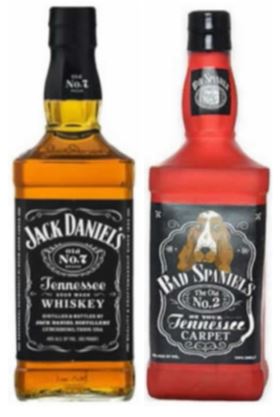 The jurisprudence of parody dog toys and trademark dilution continues to grow. 📈
In this case, “JDPI argues that the Bad Spaniels toy dilutes its marks ‘by associating the famed whiskey with,’ as the Supreme Court put it, ‘dog excrement.'” 💩 However, “as JDPI concedes, the ‘Bad Spaniels’ mark ‘does not itself refer to defecation’ and therefore is not facially tarnishing.”
On remand from the Supreme Court, the Ninth Circuit concluded again that the Bad Spaniels dog toy does not dilute Jack Daniel’s trademark.
The panel defines the scope of dilution by tarnishment: “when conducting a tarnishment analysis, courts may only consider the dilutive effect of a junior mark that is similar to a corresponding famous mark.” This simple principle filters out a lot of Jack Daniel’s arguments:
The only marks JDPI proved famous are “Jack Daniel’s” and its registered trade dress. All other senior marks, including “Old No. 7,” therefore drop out of our analysis….
“Old No. 7” cannot be famous under the TDRA simply because “Jack Daniel’s” is.
For example, Jack Daniel’s objects to Bad Spaniels’ “43% poo by volume,” but Jack Daniel’s use of “40% alc. by vol. (80 proof)” isn’t a trademark at all. The panel’s methodology essentially isolates each parodic element rather than look at the combined effect of the Bad Spaniels’ toy.
Furthermore, “neither ‘Bad Spaniels’ nor the toy’s trade dress facially tarnish JDPI’s corresponding famous marks.” (The court doesn’t define “facial tarnishment” but suggests it occurs when the tarnishing attribute is included in the brand usage). Without that, the court looks to see if tarnishment can be inferred another way. The court suggests:
In some circumstances, an association may dilute the famous mark even where the junior mark is not tarnishing on its face. If a junior mark is not facially tarnishing, the context in which it is used may become relevant to the tarnishment analysis, depending on the facts of the case. For example, using a famous mark or a closely related depiction on a product that is of poor quality or pornographic or illegal may be tarnishing if the other requisites are met.
To bolster its claim, Jack Daniel’s introduced a survey from Dr. Itamar Simonson, which the panel deconstructs. The survey covered aspects that weren’t famous, like “Old No. 2,” and the survey only showed a possible negative connection “between some broad concept of defecation and consumption of food and drink products,” not the specific marks at issue here. The panel concludes:
There is no evidence in the record from which a court could reasonably infer that scatological references made on a dog toy have the same likelihood of generating disgust as identical references on a consumable product meant for humans might. Dr. Simonson’s opinion to the contrary is pure conjecture.
The Supreme Court foreclosed the statutory parody defense in this case, but the panel says that Bad Spaniels’ parodic nature can nevertheless affect the likelihood of tarnishment, and this further undermines Dr. Simonson’s survey:
Dr. Simonson’s analysis ignored the effect of a “humorous difference” on whether Bad Spaniels harms the reputation of JDPI’s famous marks…Parody, however, is inherent in the Bad Spaniels product—indeed, as Dr. Simonson recognized, it was the “whole point.” Failing to consider the effect of VIP’s obvious parody on the likelihood of tarnishment was a critical misstep
The Ninth Circuit dismisses the case.
Implications
- Given the amount of time and money Jack Daniel’s has already spent on this case, I assume it’s headed to the Supreme Court again? However, it would be wild if the Supreme Court decides to take it.
- I’m not clear what constitutes facial tarnishment. It seems like Bad Spaniels was a good wording choice, but would Pooping Spaniels have been a bad choice? Is Enjoy Cocaine facially tarnishing or not?
- The panel glosses over dilution of the trade dress. That might be because of how Jack Daniel’s structured its argument or the scope of Dr. Simonson’s survey. Still, trade dress dilution would have benefited from more explication separate from the word mark.
- The purported flaws in Dr. Simonson’s survey seem easy enough to fix. A couple more questions on the consumer survey could connect the dots concretely between the marks, rather than the more abstract connections between poop and food.
- Even so, the panel’s methodologies will make it very hard for trademark owners to prevail against parodic products. The panel: deconstructed the parody and filtered out the aspects that weren’t within the famous trademark’s scope; required the trademark owner to show how the remaining attributes created a likelihood of dilution; and considered the attempted jokes as part of that likelihood assessment. If this remains the standard, trademark owners face an uphill challenge in future cases.
- It is mind-blowing how much money Jack Daniel’s has spent on this case. It only makes sense if Jack Daniel’s is trying to intimidate future parodists, because the dollar value and consumer exposure of Bad Spaniels has to be trivial absent Jack Daniel’s decade-long litigation to squash it.
Case Citation: VIP Products LLC v. U.S., No. 25-2027 (9th Cir. August 4, 2026)
Prior Blog Posts in this Case