
CJEU Judgment on Geoblocking & Standards for Knowledge of Foreign Copyright Laws and Geoblocking Measures (Guest Blog Post)
by Prof. Marketa Trimble UNLV Boyd Law School
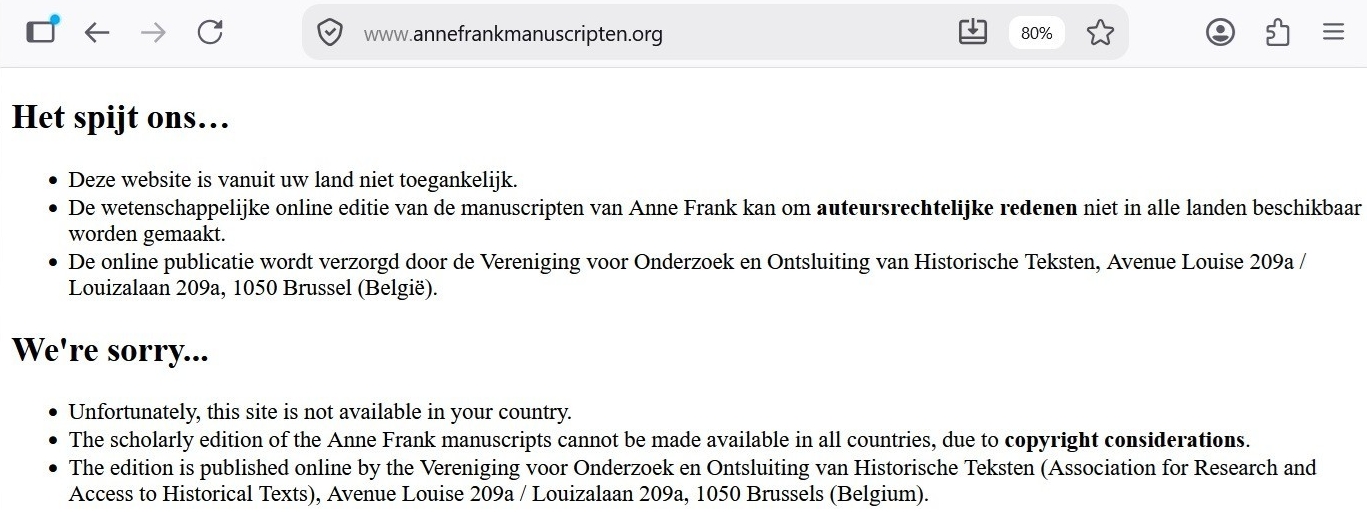
Last month, while sitting at Amsterdam’s Schiphol Airport, a passenger typed www.annefrankmanuscripten.org on her laptop to look up the website at issue in the latest judgment by the Court of Justice of the European Union (CJEU) on geoblocking—the Anne Frank Fonds judgment. The retrieved webpage notified her that “due to copyright considerations,” the content, a scholarly edition of Anne Frank manuscripts, was not available to users connecting from the Netherlands.
Using a VPN service, she connected through a server in Belgium. This time the content webpage appeared, asking her to confirm that she was located in one of the listed “public domain countries.” The page warned her that if she was not located in one of those countries, she was “circumventing protection measures” and possibly “infringing copyrights.”
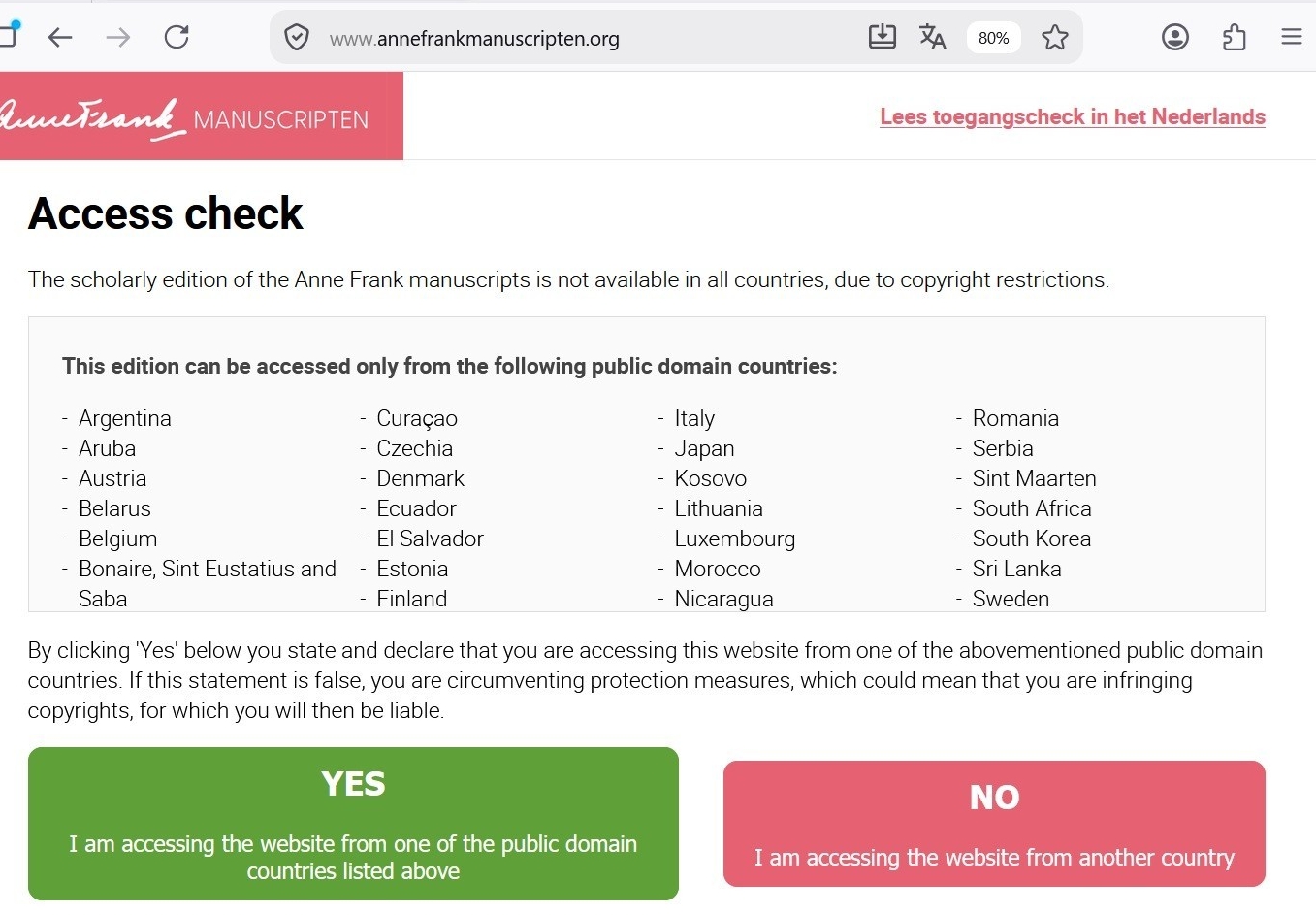
Had she misrepresented her location and confirmed that she was connecting from Belgium, presumably she could have accessed the content, even though she was in the Netherlands, which is not one of the public domain countries of the publication. The content is still protected by copyright in the Netherlands, where the provider of the scholarly edition has no license to make the content available to the public.
The CJEU judgment in Anne Frank Fonds does not address the liability of the cyber-traveling passenger. Instead, it concerns the liability of other actors in the story—the providers of the content and, in the abstract, a VPN provider.
Given the trajectory of prior CJEU judgments that have discussed geoblocking, and the opinion of the Advocate General in this case, the CJEU’s holdings in Anne Frank Fonds are not surprising. Under EU law, a content provider is not liable for copyright infringement by communicating a work to the public in a country where the work is still protected by copyright and for which the provider has no license, if the provider uses an effective–meaning “state of the art”–geoblocking measure. In such a case, the provider is not communicating to the public in the geoblocked country, even if Internet users can circumvent the geoblocking measure with a VPN or similar service. If the geoblocking measure is not effective and therefore a copyright-infringing communication to the public does take place in the country where the work is still protected by copyright, that communication is attributable to the provider of the content and not to the provider of the VPN or similar service.
Several aspects of the Anne Frank Fonds judgment deserve thorough analysis. At the global level, the judgment might raise concerns that it signals the end of a free and open Internet, legitimizes the balkanization of the Internet, and marks a new era of territorialization of the Internet. But none of these trends are new or surprising. In fact, some commentators might argue the opposite. By clarifying how actors on the Internet may lawfully provide a work to users only in countries where the work is in the public domain or for which the actors hold a license, the judgment advances legal certainty for actors who seek to operate lawfully in cyberspace, thus ensuring that more content becomes available online in general.
Clarity about the ability of actors to geographically limit their conduct online might be an argument against the balkanization of the Internet. If access to content can be effectively regulated by content providers, no government intervention should be necessary to wall off the Internet in individual countries. Even the territorialization of the Internet is not new; the Internet has been subject to gradually increasing territorialization from its origins, and the end of the “Wild West era” of the Internet was inevitable.
Any comprehensive analysis of Anne Frank Fonds should be subject to further debate, but two aspects can be highlighted for now: the establishment of the knowledge standard, and the assessment of the effectiveness of geoblocking measures. Both of these aspects will be crucial for the future of the Internet under the legal regime that the judgment has created.
According to the CJEU, the “obligation to adopt effective technological measures to restrict access” to copyrighted content online falls on “any person who knows or ought reasonably to have known” that a work is protected by copyright in some EU member states, even though the work is in the public domain in other member states (par. 42). In the Anne Frank Fonds case, this knowledge standard presents no issue. The defendants clearly knew that the work was still protected by copyright in the Netherlands, as was confirmed by their deployment of geoblocking measures to prevent access from the Netherlands. But in many other cases, the reasonableness of having knowledge about foreign copyright protection might be debated. Will the expectation of knowledge be the same for corporate content providers, individual influencers, and occasional social media users? Imposition of an unreasonably high standard would translate into uneconomic costs that would deter speech, or at least some speech, on the Internet.
Cost considerations might also affect the standard of legal effectiveness of geoblocking measures. While some costs of doing business on the Internet are reasonable, a requirement that would result in unreasonable costs would negatively affect speech on the Internet. Geoblocking tools are not all created equal; their effectiveness varies. If the law is to rely on geoblocking, minimal technical standards must be set to identify geoblocking tools that meet any legal minimum. In the Anne Frank Fonds judgment, the CJEU confirmed, very sensibly, that a possibility of circumvention does not automatically render geoblocking measures ineffective for legal purposes (par. 51). However, the CJEU left it to the national court to decide whether the deployed measure was effective (par. 48).
The CJEU defined “a geo-blocking measure” as “a process that is aimed at enabling or preventing access to the work published on the website depending on the geographical location of the user in the light of the Internet Protocol address (‘IP address’) which he or she uses to connect to the website” (par. 44). We can only assume, and also hope, that by prefacing the court’s definition with the phrase “[i]n the present case,” the CJEU intended the wording not to be the legal definition of geoblocking measures, because newer geoblocking tools no longer rely solely on IP addresses. If the geoblocking measure deployed by the defendants in Anne Frank Fonds relied solely on IP addresses, the question whether the measure was “state of the art” might be warranted (par. 49).