

Court Upholds Instagram’s TOS–Feds for Freedom v. Meta
Feds for Freedom is an anti-COVID vax organization. 🙄 It registered an Instagram account. F4F is upset that Instagram allegedly warned anyone who tried to repost their content that:
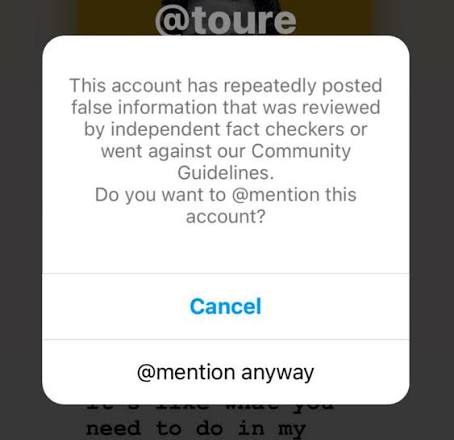
This account has repeatedly posted false information that was reviewed by independent fact checkers or went against our Community Guidelines. Do you want to @mention this account?
There was a more prominent “cancel” button than the option to proceed, implicitly nudging users to cancel. F4F claims that none of its posts were false 🙄 and Instagram didn’t rely on fact-checkers before displaying the interstitial warning.
The filings don’t appear to show the interstitial warning (why not?), but I found this example online:
F4F filed in Virginia state court. Instagram removed to federal court and then sought to transfer venue to California per its TOS. The federal district judge agrees.
F4F argued that Instagram’s TOS formation process was a browsewrap. I couldn’t find screenshots in the filings (why not?), but the court credits[FN] Instagram’s declaration that the signup process said “by tapping ‘Sign Up’ you agree to our Terms, Data Policy, and Cookies Policy.” The court says this is a “hybrid clickwrap,” not a “browsewrap.” I say it’s neither; it’s a standard sign-in-wrap, and we don’t have enough information to know if it’s properly formed without seeing screenshots. 🤷♂️
[FN: The court says it credits Instagram’s declaration on a motion to transfer “given the declarant’s personal knowledge of the information described therein and given that Feds for Freedom’s allegations are consistent with the declaration.”]
F4F said it didn’t read the terms. (Indeed, literacy appears to be a major challenge in the anti-vax community). Quoting Dhruva, the court replies that “when a website provides clear and reasonably conspicuous notice that there are contract terms available by scrolling down or clicking a hyperlink, the user is on reasonable notice of those terms even if she never reads them.” As a result, F4F bears the consequences of its decision not to read the TOS. That’s enough to ship the case to California.
The court’s TOS formation ruling isn’t surprising, but the real action in this case will start when the court considers the legal implications of the interstitial warning. I have raised concerns before about the legal risks of fact-checking and other explanations. Unsurprisingly, the affected accounts really don’t appreciate being called out.
Case Citation: Feds for Freedom v. Meta Platforms, Inc. 2026 WL 2058962 (W.D. Va. July 16, 2026)