

Remember When the Ninth Circuit Rejected Classpass’ TOS Formation? About That…–Blackburn v. Classpass
Last year, the Ninth Circuit issued a blockbuster TOS formation case, Chabolla v. Classpass. The court rejected Classpass’ TOS formation despite Classpass deploying multiple screens where Classpass seemingly got close to formation. The Chabolla case, combined with the Godun case issued shortly after it, upended decades of TOS formation law, suggesting a heightened scrutiny of TOS formation screens that virtually ensured that prevailing sign-in-wrap practices would fail.
This case is a different lawsuit against Classpass, this time over unredeemable Classpass credits. Despite the unmistakable message from the Ninth Circuit that TOS formation screens should be reviewed exactingly, Judge Orrick of the N.D. Cal. district seems to be living in the past. He surprisingly holds that Classpass successfully formed its TOS and sends the case to arbitration. Why did Classpass succeed here when it failed last year at the Ninth Circuit? (If you expect a logical and sensible answer to that question, you must be new to the blog).
* * *
The named plaintiff, Blackburn, navigated through three relevant TOS formation screens. The opinion never precisely identifies which one successfully formed the TOS. It seems like all three did?
(The TOS contained an arbitration clause that everyone agrees applies to this lawsuit if the TOS was properly formed).
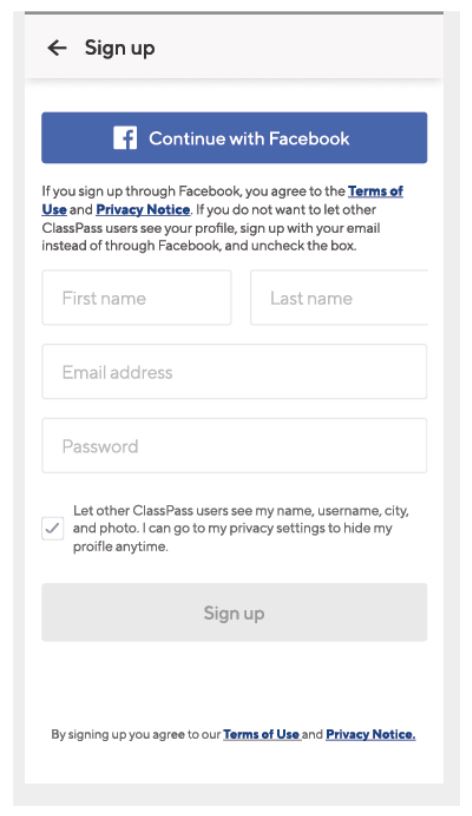
Blackburn created her Classpass account in 2019 by navigating this screen and choosing the option to continue with her Facebook credentials (the 2019 Sign Up Screen):
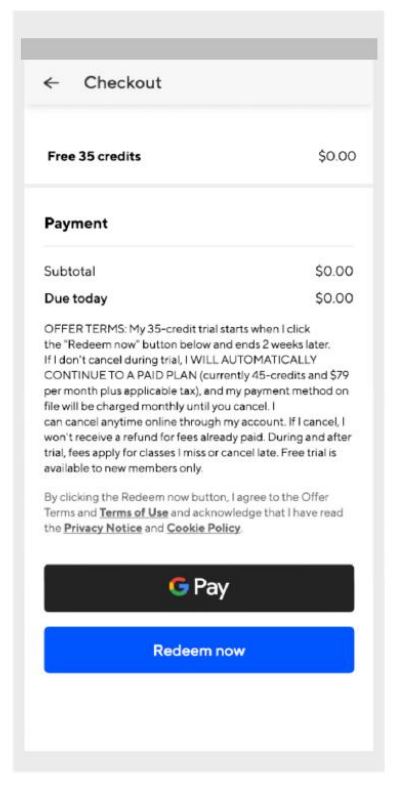
A few days later, in the next screen, she acquired her subscription membership through Classpass’ refer-a-friend program (which entitled her to additional credits) (the 2019 Checkout Screen):
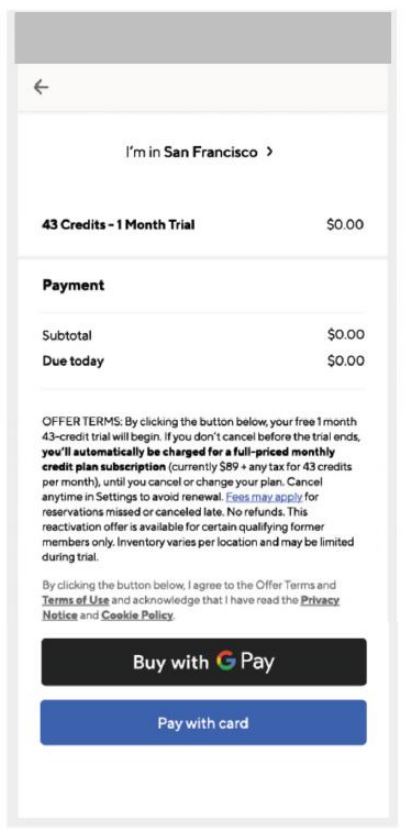
In 2023, Blackburn reactivated her Classpass membership by navigating this screen (the 2023 Reactivation Checkout Screen):
Element 1: Reasonably Conspicuous Notice
Blackburn challenged the 2019 Login Screen’s visibility on three grounds:
- It was part of a 5-screen signup sequence. The court responds “the screens are not cluttered and follow a logical flow.”
- The TOS offer was the smallest font size on the screen. The court says it was the same size as other fonts on the screen.
- The TOS offer language was below the “Continue with Facebook” button she clicked. The court says “the “Terms of Use” is bolded, underlined, and in traditional hyperlink blue. That offsets any real concern that a reasonably prudent Internet user would not know or be aware that those hyperlinks existed just below the “Continue with Facebook” button.”
The court is also OK with the 2019 Checkout Screen visibility. The court acknowledges the TOS offer language in grey font, but says the:
text is still visually set apart from the other font that appears on the screen, despite the fact that it does not appear in blue font….
the hyperlinks are denoted by a bolded light grey font and underline, sufficiently contrasting the white background. Further, the “large text block[]” to which Blackburn refers is actually a two-sentence paragraph separated in space by the one-sentence paragraph denoting the Terms of Use, which makes the presentation of the Terms of Use hyperlink even more noticeable
The court is similarly OK with the 2023 Reactivation Checkout Screen visibility:
The text referring to the Terms of Use is once again just above the commitment button, written in light grey, but bolded font, and while not denoted in traditional hyperlink blue, is set apart from the rest of the text on the screen such that its presence draws the eye. The primary difference between the 2023 Reactivation Checkout Screen and the 2019 Checkout Screen, as Blackburn points out, is that the 2023 Reactivation Checkout Screen includes a black and bolded pronouncement to the user that “you’ll automatically be charged for a full-priced monthly credit plan subscription” and includes, in blue and underlined hyperlinked font, access to information about which Fees may apply. Those decisions to add additional notice of specific terms do not take away from ClassPass’s efforts to make the Terms of Use conspicuous by setting them apart in bolded, underlined font, in a separate paragraph with font color that contrasts the white background.
Element 2: Transaction Context
The Ninth Circuit punted on this factor in Chabolla (wrongly, IMO, because it’s clearly intended to create a long-term subscription), so this court does too. This court adds: “unlike in Chabolla, Blackburn took the additional step and created a ClassPass account by logging in with her Facebook account.”
Element 3: Manifestation of Assent
“Blackburn clicked a button after being presented with a hyperlink to the Terms of Use.”
The court distinguishes Chabolla:
in Chabolla, there was no indication that a user was ever signing up. Here, at the top of the 2019 Sign Up Screen there is a heading that unambiguously reads in bold lettering: Sign up
Blackburn pointed out that in the 2019 Signup Screen, the disclosures inconsistently and ambiguously refer to both “the” TOS and “our” TOS. The court responds that the argument “makes no sense. If a user is signing up through a preexisting Facebook account, that user must have necessarily already agreed to be bound to any Terms of Use or other terms of Facebook. It is not ambiguous to a reasonable Internet user signing up for an account or membership with ClassPass, even by way of Facebook, that any newly presented Terms of Use are those of ClassPass, not Facebook.”
With respect to the 2023 Reactivation Checkout Screen, Blackburn pointed out that the TOS offer language referred to “the” button but there were two buttons below it. The court responds:
“the” in the context of the 2023 Reactivation Screen must mean “either,” because a user attempting to access the 45 free Credits can only click one button to do so, or as the 2023 Reactivation Screen denotes, “the button.”
Normally, “the” connotes a singular reference. Here, the court reads it to connote plural references. ¯\_(ツ)_/¯
In a footnote, the court says: “I do agree with Blackburn that the 2019 Checkout Screen’s language (“By clicking the Redeem now button, I agree to the Offer Terms and Terms of Use . . .”) is curious because it leaves out whether a user who chooses to pay using G Pay is likewise bound. But a reasonable Internet user would likely understand that payment using either method would bind the user to the visibly hyperlinked Terms of Use and it is clear that Blackburn manifested assent via the 2019 Sign Up Screen and 2023 Reactivation Screen in any event.”
Implications
I view the Chabolla and Godun opinions as companion cases. They came out just a couple of months apart, and they both took highly skeptical approaches to online TOS formation. Remarkably, this court doesn’t cite Godun even once. That is a conspicuous omission.
To me, this ruling is another reminder of how TOS formation analysis has descended into Calvinball. As Judge Bybee warned in dissent in the 9th Circuit Chabolla case: “minor differences between websites will yield opposite results….That sows great uncertainty in this area.” Here, comparing this lawsuit to Chabolla, we have the exact same defendant and similar formation processes from around the same historical time period, yet Classpass gets TOS formation when the Ninth Circuit denied it last year. The outcome appears to flip based on tiny differences.
I will also note how many of the court’s assessments turn fundamentally on consumer expectations, except the court doesn’t cite a shred of empirical evidence about what consumers think. The missing empiricism plays a major role in the Calvinball phenomenon.
If the court had been inclined to do so, it could have picked apart each screen and found deficiencies in each. After all, that’s what the Ninth Circuit did in its Chabolla case. Some examples:
- In the 2019 Signup Screen, the TOS offer language refers to “sign up with Facebook” and the button says “continue with Facebook.” Plus, there is a second “sign up” button lower on the screen that the court ignores even though it matches the TOS offer language. All of this may sound ticky-tack, but…in the Chabolla case, the court rejected a screen where the TOS offer said “I agree to” and the button said “redeem now,” and in the Godun case, one of the screens failed because the TOS offer said “I agree” and the button said “connect now.”
- In the 2019 Checkout Screen, the TOS offer language is stacked below a large paragraph of offer terms, and it appears to be a slightly smaller or lighter font than those. The court could say that reasonable consumers would spot it anyway, but that’s an empirical question without empirical support. Many other courts would have treated the text block as so monolithic that no sentence stood out.
- The 2023 Reactivation Confirmation Screen had the text block problem plus (as the court discussed) the imprecision of a reference to “the” button when there were two button options.
To be fair, I don’t necessarily support courts doing this degree of ticky-tack pixel policing. However, that level of exactitude drove the Chabolla and Godun decisions.
The screenshots at issue all predate the Chabolla and Godun decisions. Today, there’s no excuse for weak sign-in-wraps like this. I expect you to do better. The courts will expect that too.
As Judge Bybee said in dissent in Chabolla, “Our decision today will drive websites to the only safe harbors available to them, the clickwrap or scrollwrap agreements.” Want to opt-out of the TOS formation Calvinball? Take the certainty of clickwraps over the chaos of sign-in-wraps.
Case Citation: Blackburn v. Classpass USA Inc., 2026 WL 962734 (N.D. Cal. April 9, 2026)