

If You Don’t Keep Good Records, Don’t Be Surprised if Your TOS Formation Fails in Court–White v. PayPal
“Plaintiffs allege that Honey “misrepresents its ability to find the ‘best discount codes’ for consumers” and instead “prioritizes coupon codes from Honey’s partner merchants,” giving users “inferior discounts, or no discounts at all, while Honey and its merchant partners profit.”” Paypal/Honey (Paypal owns Honey, so I’ll treat them as the same) invoked the arbitration clause in its TOS. It gets a mixed ruling that surely frustrates all sides–but especially Paypal, given how many of Honey’s gaffes could have been avoided.
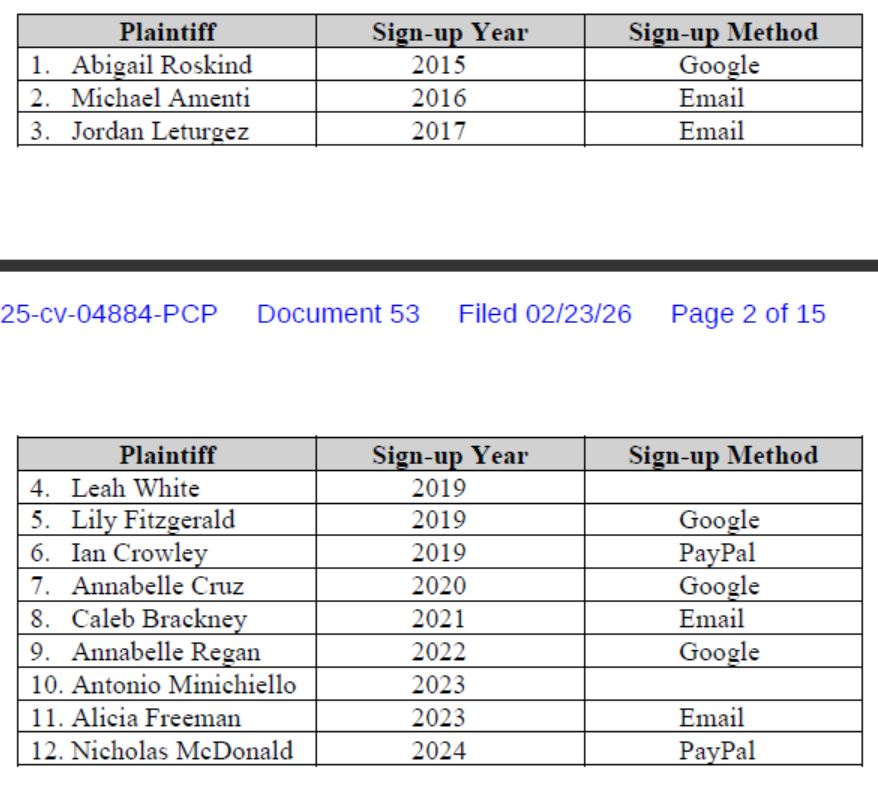
Here is a chart of the various TOS formation timings and modalities:
The court starts by establishing what evidence it can consider.
2015 TOS Formation Evidence. Paypal apparently doesn’t have a copy. It pointed to the Wayback Machine version but didn’t submit a screenshot of that. Arbitration denied.
2019 TOS Formation Evidence. Paypal only has a screenshot of the email TOS formation from Wayback Machine, but none of the plaintiffs apparently signed up via email. Arbitration denied.
2021 & 2022 TOS Formation Evidence. More Wayback Machine screenshots. “The screenshot does not show any language notifying users about terms of service or show what users would have seen after selecting the button for how they would like to join….The Court cannot consider whether notice of any terms was reasonably conspicuous, let alone legible, without knowing what the website looked like.” Arbitration denied.
2016–2018, 2020, and 2023–2024 TOS Formation Evidence. The court says Paypal provided sufficient Wayback Machine screenshots for all but one of the plaintiffs in these periods. (The other plaintiff used the browser extension and may not have created an account). The court accepts the Wayback Machine screenshots because “plaintiffs’ failure to provide competent evidence directly rebutting defendants’ evidence fails to create a genuine issue as to the sign-up process that was presented to those plaintiffs when they created their accounts.”
* * *
Having identified the competent evidence, the court then discusses the screenshots (but it only shows one; the rest it describes textually):
2016-18 TOS Formation Process.
- “The text stating “By joining, I agree to Honey’s TOS & Privacy Policy” was of a size sufficiently smaller than the text on the rest of the screen that many users would likely have had to squint to read it.” Squinting is bad, but I always say that the offer language should never be the smallest font on the screen.
- “The small font size was exacerbated by the color of the text, which was light gray against a white background and in contrast to the two large and colorful buttons on the screen.”
- “the sign-up page told users that by joining, they agreed to Honey’s “TOS.”…the Court cannot conclude that a reasonable user in 2016 or 2017 would have known what TOS meant….Even if a reasonable user might have understood TOS to mean terms of service, Honey’s use of the acronym required an extra mental step for a user moving quickly through the sign-up page.”
- “the very small and faded nature of the text did not render the hyperlinks “readily apparent.””
Arbitration denied.
2020 TOS Formation Process.
Defendants’ declaration states, “The Wayback Machine reflects that in 2020, a user would affirmatively check a box to agree to the Terms of Service.” Nowhere does the declaration aver that a user had to check the box to continue signing up for Honey. Defendants ask the Court to recognize that it is “self-evident” that a user would have had to check the box. But where the Court must draw all inferences in favor of the non-moving party, it cannot conclude that a user was required to check the box and indicate their agreement to Honey’s terms rather than that it was merely optional for a user to do so. This is particularly true given that the box next to the second statement, through which users could choose to “[r]eceive news and offers from Honey by email,” was most likely optional. Nothing in the text of the page states that checking one of the boxes is mandatory while checking the other is not, and in the absence of evidence specifically establishing that users were required to check the first box, the Court cannot conclude that defendants have satisfied their burden to produce evidence of Cruz’s unambiguous assent to Honey’s terms of service.
Ugh. A great reminder that a screenshot doesn’t capture any animation or kinetic elements. So avoidable. A video of the UI, showing that the checkbox was mandatory, would have made this obvious.
Arbitration denied.
2023-24 TOS Formation Process.
Finally, the court shows a screenshot, which the court labels a “clickwrap agreement”:
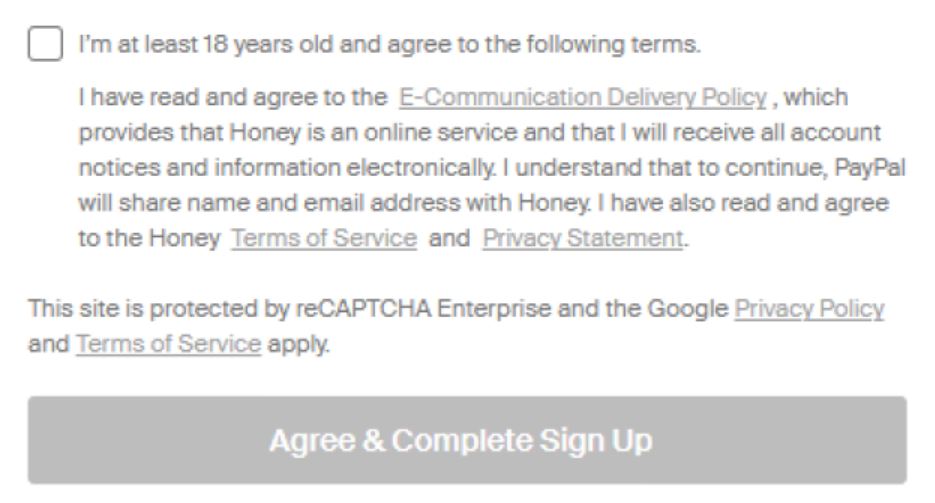
The court explains why this works:
First, the notice was placed above the button to sign up and in the “user’s natural flow.” Second, although the text was relatively small and gray against a white background, the surrounding text was not much larger and was the same gray or black. The pages thus did not distract or draw the user’s eye away from the notice. Third, the hyperlinks are in a slightly different color than the rest of the notice and are underlined to indicate their presence to a reasonable user. Although the terms of service are mentioned in the fourth line of the notice, its placement is not fatal to its otherwise conspicuous disclosure; the first line of the notice indicates that users “agree to the following terms,” and the button to complete sign-up says, “Agree.”
Note that the Godun case might actually reject this process, despite its clarity, because the checkbox lacks an if/then grammar that links the offer language to the button. The court responds: “the button to complete sign-up itself indicated that the user “Agree[d]” to the text above.” But is that clear? Could the user just be agreeing to the sentence to right of the checkbox? The court responds: “the first line of the notice states that users agree to the “following terms,” signaling that multiple terms are included in the notice and correspond to the checkbox. And even if a user might not have understood that the checkbox referred to all of the terms within the notice, the “Agree” in the text of the button provided a further backstop.”
Arbitration granted for these two plaintiffs.
Implications
Courts are being stricter about TOS formation. I continue to believe that Chabolla and Godun were a substantial break with prior TOS formation law, so courts are being much pickier and the bar for TOS formation has gone way up. Here, the court rejects TOS formation for 10 of the 12 named plaintiffs (and for the other two, I believe the court disregarded the Godun precedent). This is the new math of TOS formation.
Watch out for jargon. It was interesting seeing the court reject the TOS term as unclear to consumers at the relevant time. Perhaps that’s true, though with the proper offer language, it shouldn’t matter so long as consumers otherwise understood that terms applied.
(The court dodges the nature of Honey’s relationship with consumers, even though it seems pretty obvious to me that consumers would expect a long-term relationship with Honey and that terms would apply to Honey’s software. If so, Ninth Circuit law might say that consumers were likely to presume that terms applied somewhere).
Similarly, it’s interesting how the court didn’t assume the TOS checkbox was mandatory, but textual references to its mandatory nature (or maybe a red asterisk?) would have helped. I saw this as a cautionary indicator that a screenshot may not be enough to establish a clickwrap, in which case either testimony from an engineer or a video will be required to establish the checkbox’s mandatory nature.
It’s the lawyer’s job to keep the right evidence. I wince every time I see a TOS formation case where the website operator (usually the defendant) relies on Wayback Machine evidence. The Wayback Machine is awesome and I love it, but it’s often not a complete rendering of the page, it doesn’t capture app interfaces, it doesn’t capture screens behind registration walls or paywalls, and it usually doesn’t capture animation or kinetic elements. In other words, submitting Wayback Machine evidence should be your last-ditch failsafe, not your Plan A. You can see how the judge was repeatedly underwhelmed with the Wayback Machine screenshots–almost certainly snatching defeat from the jaws of victory, as least for some of the plaintiffs in this case. The solution is simple: when you’re updating your TOS terms or your TOS interface, capture screenshots and videos to show how the pages look and work.
What’s next? The court’s split decision is a bummer for both sides, because it multiplies the litigation into parallel court and arbitration proceedings. Simultaneous litigation efforts jack up the costs and increase the risk of inconsistent outcomes. As an outsider to the litigation, the Solomonic approach would be to stay the arbitration for now, proceed with the in-court litigation, and then revisit the arbitration piece after the court decisions. That would allow the bulk of the case to proceed, save the duplicative costs, and avoid the risk of inconsistent outcomes. Indeed, it’s entirely possible the parties will know how to settle the arbitrated cases after getting the in-court results, in which case arbitration may never be needed. But Paypal could try to negotiate around this result, weaponizing the threat of litigation multiplication and the associated costs to goad the plaintiffs into arbitration first. An interesting game theory scenario.
Case Citation: White v. Paypal Holdings Inc., 2026 WL 496712 (N.D. Cal. Feb. 23, 2026)