

Appeals Court Accepts That the “Water” Emoji Can Be Slang for Methamphetamine–U.S. v. Reed
This is a federal prosecution against alleged drug dealers. There is substantial evidence beyond the emojis suggesting that Swanagan is a dealer. Prior blog post.
The appeals court didn’t quote Swanagan’s inculpatory message in full. Here it is from the district court opinion:
On October 11, 2021, SWANAGAN sent a Facebook message to HUFF that reads, “pull up need sum [water emoji] plus i got yu on the one tip” and HUFF replied, “I’m not mobile atm dough boi otw to get me tho” followed by a message that reads, “I’m tryna make sum cash boo” to which SWANAGAN replied, “ite” followed by a message that reads, “i see yu gta make et money back huh” and HUFF responds, “Swear”.
DEA Task Force Officer James Budde wrote an affidavit to support a wiretap. The court summarizes:
Budde had interpreted the use of a water emoji in those messages to symbolize methamphetamine. Swanagan argued it represented sexual relations, offering internet dictionary definitions as support, and requested a hearing.
The appeals court says Swanagan’s arguments don’t overturn the search warrant issued based on the affidavit:
Swanagan did not make an adequate preliminary showing that Budde’s interpretation of the water emoji was intentionally or recklessly false, so the district court did not clearly err in finding the affidavit truthful. Swanagan asserts that he “provided dictionary support that a water emoji had a common meaning of sexual relations” and that “the government acknowledged that the water emoji could have other meanings” besides
methamphetamine. At most, Swanagan makes out the possibility that the water emoji in his Facebook messages could have an alternative meaning. That possible ambiguity is not the same as reckless or intentional falsity.The affidavit itself even contains another instance of “water” in a context where the purported sexual connotation would not have made sense….Even if
Budde’s interpretation was mistaken, Swanagan provides no evidence that such a mistake was intentional or reckless. He offers no witness statements or evidence suggesting that Budde was aware of a sexual gloss to the symbol.
Thus, the court says that the “water” emoji was capable of meaning “methamphetamines,” so the search warrant was adequately supported. Swanagan was sentenced to 360 months in prison.
* * *
In case you’ve never referred to the “water” emoji, I believe the court was discussing the emoji typically called the “sweat droplets” emoji:
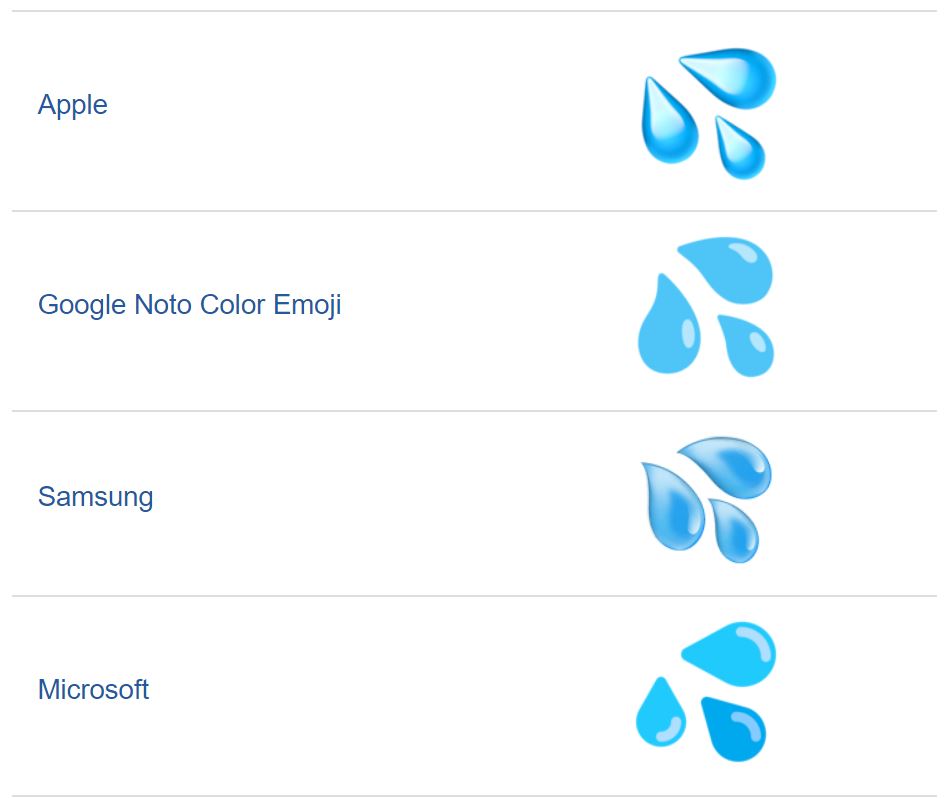
When I do emoji law trainings, I highlight a few lessons from this case:
- Due to the pleading burdens for challenging a search warrant, the law enforcement officer has sufficient expertise to take the position that the water emoji was slang for drugs. The appeals court says that Swanagan didn’t show that the officer knew of its sexual connotations, but that statement relies heavily on the pleading burdens. I believe the “sweat droplets” emoji’s use as slang for male ejaculate is well-known–and certainly would be known to every competent ATF officer. But given the difficulties overturning a search warrant, the court essentially treats the officer’s expertise about emoji meanings as conclusive.
- Prior to this case, I had no idea the sweat droplets emoji was also called the “water” emoji or that it could be slang for drugs. That’s not surprising: drug slang evolves rapidly and many emojis have developed slang meanings in the drug context, even meanings that wouldn’t necessarily be obvious based on the emoji’s design.
- Even if the water emoji isn’t widely understood to have a slang reference meaning methamphetamines, it is still proper to legally recognize the slang meaning among these communicating partners if they developed that idiosycratic meaning.
Case Citation: U.S. v. Reed, 2025 U.S. App. LEXIS 33561 (6th Cir. Dec. 23, 2025)