
The Fifth Circuit Does Fifth Circuit Things in Copyright Embedding Case–Emmerich v. Particle
Here is a real-time video of me trying to read any new Fifth Circuit opinion on Internet Law:

Odds are that the outcome will be terrible; and even if not, the reasoning will be 100% cringe.
* * *

Embed/in bed
This opinion revisits the question of when embedding constitutes copyright infringement. This should have been an easy case. The Ninth Circuit has repeatedly and decisively concluded that embedding doesn’t constitute direct copyright infringement due to the “Server Test,” i.e., direct liability for a public display requires the alleged infringer to have a fixed “copy” of the work stored on a server in its possession or control. The Ninth Circuit reaffirmed the Server Test in a major 2023 ruling, Hunley v. Instagram.
In this lawsuit, the lower court relied on the Ninth Circuit’s Server Test to dismiss the claim. On appeal, the Fifth Circuit finds a way to undo everything in a dense, tendentious, tangent-filled, cringy, and poorly drafted decision. #BringTissues.
* * *
Description of Embedding
The court describes how NewsBreak (by Particle Media) embeds third-party content, including content on Emmerich’s website:
From the NewsBreak newsfeed, users see a thumbnail image of an article and can click it to link to that article. Then, as the embedding webpage, NewsBreak creates an empty frame within its own page and fills the frame according to the instructions it receives from the link; that is, the link connects to the address of the server for the relevant article webpage and receives instructions from that server. The frame typically populates with the linked webpage in its entirety….from the NewsBreak App, users could see the live page of an Emmerich article on an Emmerich site
Rejecting the Server Test
After doing some statutory construction, the panel says “the statutory language in Section 106(5)—“to display the copyrighted work publicly”—translates to the following: To show a fixed work by transmitting it to the public.” The panel believes this rearticulation negates the Ninth Circuit’s approach:
we find the server test is on weak statutory footing. Put simply, the server test focuses on the definition of display—which requires showing a fixed work. The server test rests on the idea that a work is always fixed on a server. But we shift the focus to the definition of displaying a work publicly—which requires transmitting the work. Although rooted in different statutory text, this shift likely provides similar results as the server test in many ways….
both the server test and the test we announce end up in a similar place: a website cannot transmit a work that it does not have.
Why does the Fifth Circuit disagree with the Ninth Circuit? An in-line linker could theoretically create a fixed copy of the linked work:
even though embedded links show live content by way of interpreting HTML instructions from the content host, the embedder’s webpage is not necessarily so fleeting that it could not meet the definition of “fixed,” meaning embodied for more than a transitory duration. Using the Goldman case as an example: the news outlets embedded the copyrighted photo by linking to tweets that included the photo….the server test would falter, in our view, for a simple reason: it is possible for another third-party website to embed the photo by way of linking to one of the news outlets, thereby demonstrating that the news outlet’s showing of the work was sufficiently permanent or stable such that it would be considered fixed for purposes of the statute.
This made my head hurt. No one contests that the content delivered in response to an inline link is fixed. But who is doing the fixing? The user, the linking website, or the linked website? And does it matter? It seems like this panel is saying that the linking website did the fixing and that’s why it “showed” the copy to the user sufficient to jeopardize the Server Test. In contrast, I think either the user or the linked website fixed the copy that appears from the linked website, and that ought to reinforce the Server Test.
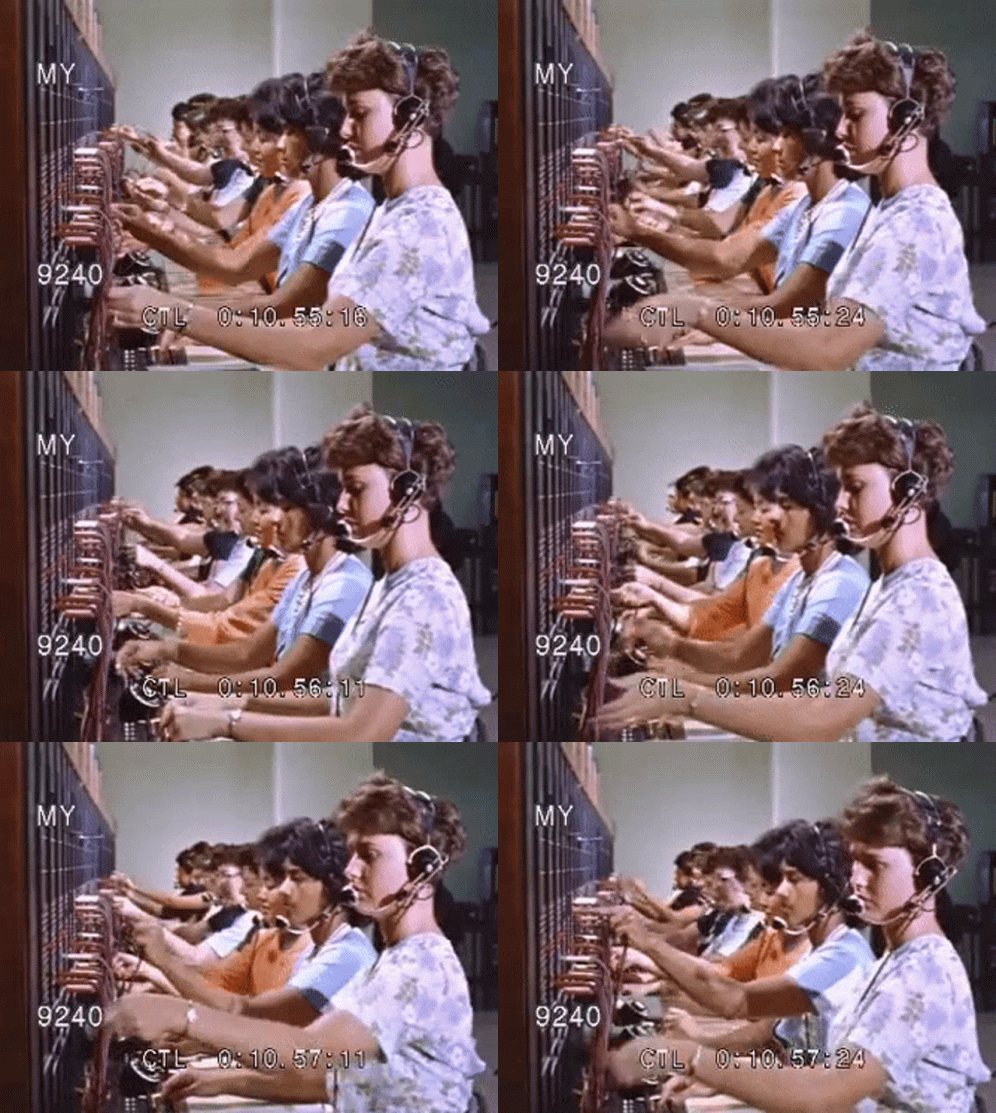 Despite this weird perspective on the responsibility for fixing works, the panel says that the linking website isn’t “transmitting” the content that was fixed (by someone). To support its thinking, the panel invokes an old-school offline analogy:
Think of Particle as a switchboard operator: In the same way a switchboard operator cannot connect a caller without the intended recipient picking up the phone and agreeing to be patched through, Particle cannot connect a user to Emmerich’s content without Emmerich’s transmittal of the content. Just as the critical act in having a telephone conversation is someone picking up the other end, we find that the critical act in the linking process is the transmittal of content, which requires courts to evaluate the party responsible for “communicat[ing]” the copy
 If this opinion really wanted to capture the essence of Internet Law, the panel might have relied on analogies to telegraphs or pigeon carriers instead. 🙄
The telephone switchboard analogy leads the panel to this statement:
pointing or directing a user’s browser to request and receive the copyright owner’s own copy does not involve transmitting, or communicating, the content “beyond the place from which [it is] sent.” If the transmission must come from the content owner in order for a user to see any content at all, then no copyright liability exists for the linking site. If not, we must find where the transmission originates. Simply, one cannot transmit content it does not have.
My head hurts again. I don’t think its statement “one cannot transmit content it does not have” is precise, at least with respect to fixation. The 101 definition of “fixed” says (emphasis added): “A work consisting of sounds, images, or both, that are being transmitted, is “fixed” for purposes of this title if a fixation of the work is being made simultaneously with its transmission.” In other words, the statute contemplates transmission of a work that someone else has fixed. The panel is appears to be saying that the linking website never touches the flow of packets being transmitted, but this is exactly what the Server Test already said.
(The panel also makes mind-numbing segues into the meaning of “volitional” conduct, how websites can opt-out of linking, and how copyright is an opt-in statute).
Although it sure sounds like the court articulated a bright-line test (“If the transmission must come from the content owner in order for a user to see any content at all, then no copyright liability exists for the linking site”), the court goes out of its way to say it is not: “our decision should not be understood to mean that embedding will always be permissible.” It mentions two limits:
Our analysis has rested on two principles: (1) the transmission of the copy is from an authorized source, whereas the embedding webpage only makes a transmission request; and (2) the authorized source could have rejected the request….we therefore do not pass on the application of this approach beyond these circumstances
Does #1 mean that if a user uploads an infringing item to Instagram, and a third-party site embeds it, the linking site is now transmitting/displaying the work even though there is no technological difference in the way the packets are flowing? If so, this suggests the court is actually characterizing an upload as implied permission to embed, which wouldn’t depend on the definition of display or transmission at all. #2 starts to veer into the trespass to chattels arena, where if a website blocks embedding, then it’s controlling its chattel regardless of its rights under copyright law. Otherwise, this sounds again like an implied permission to embed.
The court also has this mind-bending statement that fair use is a limiting doctrine: “when linked according to formats such as Full-Text View or the like, fair use provides a viable pathway to prevent links that rise to the level of infringement, regardless of the test.” I think the judge is trying to say that courts could conclude that the full text displays don’t qualify as fair use, but (1) fair use is a defense, not a limiting principle, and (2) a court only reaches the fair use defense if there’s an infringement, which the court just said there wasn’t. So I’m confused how this limitation could ever be reached.
The court adds that 1201 could also be a limitig principle because content can be put behind registration walls protected by 1201. UGH. While true, we’re seeing rampant 1201 abuse as an anti-scraping doctrine, something courts should definitely not encourage.
So does this ruling create a circuit split? Sort of…?
Yes, because the Fifth Circuit largely rejected the Ninth Circuit’s reliance on the definitions of “display” and “fixed” and instead rested its decision on the definition of “transmit.” Thus, the Fifth and Ninth Circuits are reading the statute differently. Also, this opinion is filled with so many tangents and asides that it kinda conflicts with just about everything.
No, because the circuits mostly reach the same result. Linking to copyrighted material shouldn’t be infringing, whether it’s done as embedding, in-line linking, or other methods that don’t require the user to take any further manual actions to see the linked content.
URLs as CMIs
Having wrecked the law of embedding and 106 copyright infringement, the court next turns its attention to wrecking 1202. This entire topic is mind-bending.
The plaintiff claims that a URL is copyright management information (CMI) for 1202 purposes, and framing “removes” the URL by obscuring it. First, this collapses the distinction between copyright and trademark by treating framing as a form of passing off. Second, if anyone copies any portion of the page without attributing the excerpt to the source page’s URL, would that constitute a 1202 violation? It seems like that would be the natural consequence of this argument.
The Fifth Circuit already gummed up 1202 in Energy Intel. Grp., Inc. v. Kayne Anderson Cap. Advisors, L.P., 948 F.3d 261, 277 (5th Cir. 2020), which held that electronic filenames could be CMI. I don’t have the energy to see how that opinion got off the rails, but that precedent forces this panel into more contortions because URLs are sorta like file names.
This leads to all kinds of tortured statements of how URLs are and aren’t like filenames, and my brain kept breaking with each subtopic. We get ponderous epistemological statements like:
URLs primarily operate as a functional utility of directing someone to the copyrighted work, as opposed to a filename, which is information inherent to the copyrighted work itself.
…and…
we find that a future court could conceivably discern that the URL website descriptor as-applied meets the CMI requirements, similar to PDF filenames. Importantly, though, this question remains a fact-specific inquiry for district courts to conduct in the first instance.
There is also this cringy footnote:
Take, for example, a New York Times article. The title of the article was: “3 Ways Operas Speak to the Moment, With Success and Failure,” yet as evident in the URL, the website descriptor is different entirely. Gabrielle Ferrari, 3 Ways Operas Speak to the Moment, With Success and Failure, N.Y. Times (May 19, 2026), https://www.nytimes.com/2026/05/19/arts/music/american-opera-projectsexperiments-in-opera-heartbeat-opera.html.
Hold on. Apparently, the panel doesn’t know that the NY Times experiments with many headlines but the URL only reflects the first…? SMH.
1202 refers to the word “link,” and this causes the panel to go into a tailspin:
Although intuitively a URL seems to be a link, the question remains whether we must construe “link” as a term of art in a particular way. Caselaw defining “link” under Section 1202(c)(7) is underdeveloped….
To qualify as a link to CMI, the URL would have to connect to an address that displays CMI, such as a page that contained a website’s copyright, disclosures, and permissions. Even still, we recognize that the nature of links is that they can change if the pages they locate are altered….
However, should the link be more stable, should it connect to a qualifying page, and should it provide notice of the CMI it is linked to, the broad language in Section 1202(c)(7) could provide a basis for URLs to constitute CMI.
UGH. Read that last paragraph again. WHAT??? The panel emphasizes that there are scenarios where 1202 could apply to URLs:
Following suit with our approach in Energy Intelligence Group, we leave open the possibility that certain URLs could possess the hallmarks of CMI. But, as described in the foregoing sections, several factors are essential to confirm before reaching that determination, including: whether the domain name corresponds with the copyright owner; whether the copyright is over the website as a whole or specific pages; whether the URL is sufficiently stable and not subject to change; and, above all, whether the URLs are clearly being conveyed for the purpose of communicating a copyrighted work.
What does this even mean? What harm would this approach redress?
One possibility is that the panel’s opinion will be read to create a free-floating obligation to cite a URL for any secondary works based on content from a web page. I don’t think the panel has any clue that it’s opened this Pandora’s box. EVERY online copyright infringement lawsuit in the Fifth Circuit should make a 1202 claim when the defendant’s secondary use didn’t include the source URL. Fun times ahead. The Fifth Circuit ultimately will need to walk back its Energy Intelligence precedent and rethink everything.
The panel has one more brain-breaker topic to mess up: what constitutes removal or alteration of a URL? That leads to the absolute soul-crushing discussion of the possibility that “shortening a URL would be a DMCA violation, even though the URL is just meant to take a user to the location of the copyrighted work. Our court, for example, incorporates permalinks of webpages into opinions to capture the source at the time of its citation.”
I’m not sure what the Fifth Circuit means by “permalinks.” Typically, a permalink includes both a persistent substitute URL and a cached copy of how the source material looked on the specified date. Permalinks cannot be merely URL shorteners, because otherwise, if the underlying URL changes or breaks, the URL shortener breaks too. I seems like the panel didn’t understand any of this…? On the plus side, to the extent that permalink usage could be a 1202 violation, the Fifth Circuit has invited linked sites to SUE THEM for 1202 violations!!!
After all of this hand-wringing and navel-gazing, the Fifth Circuit defers the denouement:
Future cases will need to decide where the line is with respect to such commonplace practices, including whether there is a distinction between using a URL shortener that excludes CMI or removing a URL altogether (e.g., framing the content on another webpage, under a different URL).
In light of the necessity of a fact-specific inquiry, we recognize that workability concerns abound. If certain URLs, but not others, are deemed CMI, further frustrating the lack of notice given externally, we must anchor on whether any alteration or removal was “intentional” to “remove or alter [the] copyright management information.”
I. Can’t. Wait. until these issues bounce back to the Fifth Circuit again so I will get the pleasure of reading more of their judicial handiwork. 🙈
Case Citation: Emmerich Newspapers, Inc. v. Particle Media, Inc., 2026 WL 2530247 (5th Cir. Aug. 27, 2026).