
Scammy Ad Lawsuits Keep Vexing the Courts–Huckabee v. Meta
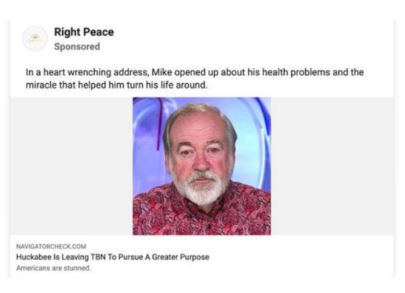 Scammers used Mike Huckabee’s name and image to hawk CBD products in Facebook ads. I’m not in the ad’s target audience, so it blows my mind that anyone would buy anything because Huckabee touted it (or was falsely claimed to).
The question in this case is whether Facebook is liable for the scammy ads. The lower court dismissed the case due to the scienter requirements of Arkansas’ publicity rights statute. At the same time, the lower court rejected Section 230 due to the atrocious Anderson v. TikTok ruling [FN]. Huckabee sought a reconsideration of the court’s initial opinion but got the same result.
FN: In the Third Circuit, publicity rights claims are not covered by Section 230 due to the IP exception. The lower court didn’t address that issue, but Section 230 was unlikely to govern this case either way.
On appeal, with two Trump appointees on the panel (including Judge Bove), the Third Circuit revives Huckabee’s case in an inappropriately brief and inadequately reasoned non-precedential opinion.
The opinion turns on Facebook’s scienter about the scam. A reminder that courts normally don’t reach scienter issues about third-party content (including third-party ads) because Section 230, when it applies, preempts any inquiries about scienter. That’s one of Section 230’s core strengths. When Section 230 doesn’t apply, courts routinely conduct tendentious, epistemological, and often irresolute (or, at least, unpredictable) inquiries into what the defendant “knew” about the third-party content and when. Scienter inquiries are extremely dangerous for online publishers, because courts can often manipulate the scienter standard (in this case, it was set by statute) and plaintiffs can always find some facts that could impute scienter with enough squinting.
Huckabee alleged the following aspects of Facebook’s scienter:
- Meta sells advertisements;
- Meta allows advertisers to pay more to popularize those advertisements;
- Huckabee is a nationally recognized celebrity;
- Huckabee “has been a lifelong opponent of marijuana and its derivatives—i.e., CBD”;
- Meta hosted inaccurate CBD advertisements with Huckabee’s unauthorized name, image, or likeness;
- In one of those advertisements, Meta hosted a fake ‘FoxNews.com’ link;
- Meta approved the advertisements;
- Meta has approved CBD advertisements with fake endorsements from other media celebrities since at least 2021; and
- Meta’s approval and maintenance of the Huckabee advertisements was with actual malice or, at least, with reckless disregard to their truthfulness or accuracy.
 This list of Facebook’s alleged sins looks rote and generic. Similar allegations could be made against almost every online publisher of third party content (ads or editorial). Ordinarily, Section 230 should moot these inquiries.
With respect to publisher liability, the Arkansas publicity rights statute specifies a scienter standard of actual knowledge or constructive knowledge, defined as being “aware of facts or circumstances from which a violation of this subchapter is apparent.” This is a DMCA 512 “red flags”-style scienter level, so I rate it as somewhere between recklessness and negligence.
Here is the unpublished opinion’s entire “analysis” of Huckabee’s allegations about Facebook’s scienter (it was one long paragraph; I added paragraph breaks):
As a baseline, the advertisements are premised on a development that Huckabee, a public figure and “lifelong opponent of marijuana and its derivatives—i.e., CBD”–is now endorsing CBD products. While such a stark change of heart can be convincing, in the context of an advertisement, it also raises questions about the legitimacy of the changed position. Those doubts, by themselves, are not enough to infer that Meta had constructive knowledge of the misuse of Huckabee’s name, image, or likeness.
The original complaint tries to bolster that inference by also alleging that Facebook previously hosted similar, fraudulent CBD advertisements using the name, image, and likeness of other media personalities, and that news outlets reported on those instances. That helps, but even the combined effect of those allegations does not cross the plausibility threshold.
Most critically, however, the original complaint states that one of the advertisements displayed on Facebook’s platform linked to a website falsely purporting to be a Fox News article. That bogus link, when coupled with the unusual association of Huckabee and CBD and the prior fraudulent CBD advertisements on Facebook, suffices for allegations that Meta was plausibly “aware of facts or circumstances” from which the advertisements’ misuse of Huckabee’s name, image, or likeness was “apparent.”
To recap, the court says that Facebook didn’t have scienter about the scammy CBD based on (1) Huckabee’s fame or his putative change of position about CBD, or (2) Facebook hosting other CBD scam ads or reading news reports about the scam. The court doesn’t say why these allegations weren’t enough, or why the presence of the other ads “helps” the plaintiffs but not enough to clear the threshold. So far, the court simply spits out two conclusory rejections of the scienter allegations.
The court then says Huckabee magically crossed over the scienter line by combining the prior two sets of allegations PLUS the allegation that “one of the advertisements displayed on Facebook’s platform linked to a website falsely purporting to be a Fox News article.”
What? I have so many questions, none of which were answered by the court’s conclusory statement:
- How would Facebook know the landing page is bogus? Can you tell the differences between Fox News content and parody?
- How should Facebook check every ad link to confirm the landing page’s veracity?
- Could Facebook run some kind of automated landing page validator that would negate its purported scienter, at least to this panel’s satisfaction?
- Many advertisers use multiple ad landing pages that vary by recipient and by ad copy. Would that matter to any evaluation about whether the landing page was bogus?
- Many ads run through affiliates, who may use their own URLs and copy for landing pages. Would that matter to the bogus determination?
- Is the panel saying that only the ad with the “bogus” landing page is still in play, or because one of the ads had a bogus landing page, Facebook now had scienter about all of the ads? I think it’s the latter, but then the court didn’t explain how one ad’s problems impute liability for all of the other ads.
In other words, because the panel didn’t provide any actual explanation, the court’s ruling doesn’t make sense and leaves open many, many key questions.
The court remands the case for further evaluation of the “merits” of Huckabee’s publicity rights claim.
* * *
This ruling is a microcosm of the broader battles over scammy online ads. Since the Goddard v. Google case in 2009, it was black letter law that online publishers weren’t liable for scammy ads per Section 230. Section 230’s applicability to scam ads was overridden by the Calise v. Meta decision. Since then, courts have found a variety of ways to expose online publishers to increased liability for scam ads, at least at early litigation stages.
To be clear, online publishers absolutely must take steps to protect their audience from scammy advertisers. Otherwise, scam advertisers will abuse the audience’s goodwill towards the publisher to make illegitimate sales, driving out the legitimate advertisers and likely taking the publisher down too. We can debate if Facebook does enough to combat scammy ads (I haven’t formed a definitive conclusion on that question). But this ruling represents an implicit broadside against the automated operation of self-service ad programs, asking Facebook to validate something that isn’t within the four corners of the ad copy. Given that it’s difficult or impossible of the publisher adequately validating that information, imposing a legal obligation like that jeopardizes the feasibility of self-service ad tools. That, in turn, could have dramatic effects on advertisers, publishers, and the entire Internet ecosystem.
Case Citation: Huckabee v. Meta Platforms, Inc., No. 25-2347 (3d Cir. June 23, 2026)
UPDATE: On remand, the district court held that Huckabee’s publicity rights claim could proceed. Huckabee v. Meta Platforms, Inc., 2026 WL 2349690 (D. Del. Aug. 13, 2026). The court says Meta, as opposed to its advertisers, allegedly made the requisite commercial use of Huckabee’s personality: “Plaintiff’s original complaint alleges that
Defendant sells advertisements to support its operations, accepts payments so that certain advertisements appear more prominently on the feeds of its users, “decides which posts appear at the top of users’ newsfeed to maximize exposure to certain posts, including advertisements,” approved and maintained the challenged advertisements, and that the challenged advertisements reached numerous individuals.” To me, this all still sounds like it should be preempted by Section 230… ¯\_(ツ)_/¯
BONUS: Awoye v. Jones, 2026 WL 1847088 (D.N.J. June 26, 2026): In Instagram posts, Jones claims that Awoye scammed her. Awoye sued her and brought Meta along for the ride, claiming it had violated his publicity rights. But there isn’t any New Jersey publicity rights violation here:
The core of Plaintiff’s allegations is that Jones spread allegedly false information about Plaintiff on Instagram. Jones was not selling a product or otherwise soliciting money from her followers. As such, neither was Instagram. Jones’ posts were the “dissemination of news or information” and not made for a commercial purpose.”
Something you don’t see every day: the plaintiff’s lawyer’s law firm bio highlights that he is an “active member of MENSA [and] edits and contributes to Proteus, the newsletter for Delaware Valley Mensa.”