
What Does It Mean to Make a Voice Call in a Post-Telephone World?–Howard v. RNC
In 1991, Congress enacted the Telephone Consumer Protection Act (TCPA). The TCPA is a telephone exceptionalist statute–by design, the TCPA regulates telemarketing phone calls differently than other forms of marketing. I considered some implications of advertising medium regulatory exceptionalism in this paper.
This case involves the following TCPA restrictions (cleaned up): (1) “to make any call using an artificial or prerecorded voice to any telephone number assigned to a cellular telephone service,” or (2) “to initiate any telephone call to any residential telephone line using an artificial or prerecorded voice to deliver a message.” These restrictions depend on the statutory phrases “call,” “voice,” and “make”/”initiate” a voice call.
The Republican National Committee texted Howard’s cellphone with the following message:
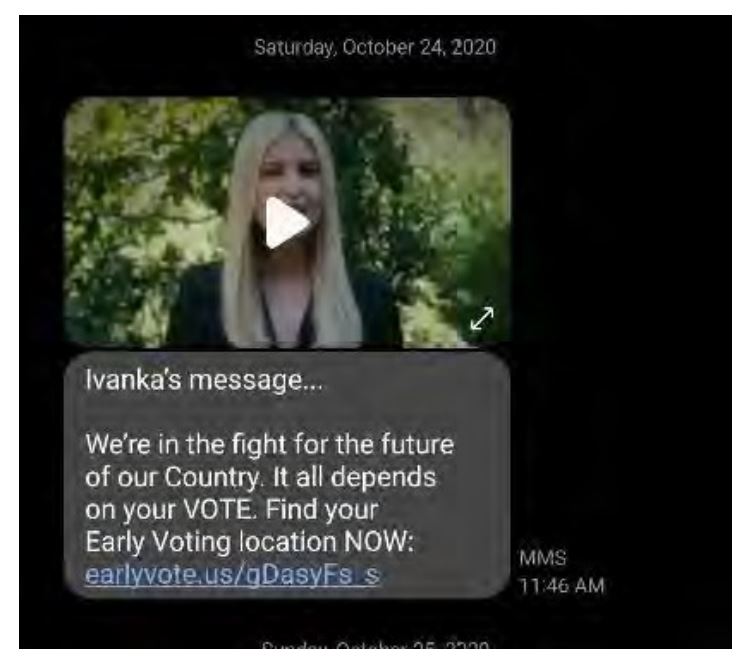
As you can see, the text message included a video file that didn’t play unless the recipient pressed the play button. Howard, the plaintiff, says he never signed up for RNC’s missives. Did the RNC make/initiate a “voice” “call” by sending Ivanka’s video? The majority says no and dismisses the case.
The majority says that a “call” includes a text message. This reiterates long-standing Ninth Circuit precedent (the Satterfield case from 2009).
[In a footnote, the majority adds: “The mere fact that a phone can be set to shut off notifications for text messages does not mean that text messages do not, as a class, fall within the ordinary understanding of a potentially privacy-intruding “call.” A classic telephone call, which typically results in ringing of the phone, remains a “call” even if the particular user has his or her ringer turned off.”]
Citing a 2023 opinion, the majority says “voice” doesn’t include any silent communications.
Putting this together, the majority says the applicable provisions “only limit the use of artificial or prerecorded voices to begin a call.” The statutory concerns about privacy are implicated only when “the person called, upon being reached, is immediately and involuntarily subjected to the nuisance of listening to an artificial or prerecorded voice.” Thus, a voicemail with a prerecorded message implicates the provision, but if a live person asks the call recipient if it’s OK to play a prerecorded message, then the statutory requirements are satisfied.
The dissent calls out the majority for rewriting the statute, i.e., changing the statutory precondition of making or initiating a call into beginning the call.
As applied to Howard, the majority says:
The call at issue here—the text message and accompanying video file—included an artificial or prerecorded voice. But like a telephone call in which a live caller offers to play an artificial or prerecorded voice to the recipient, the RNC’s text message was made or initiated by its textual content and its silent inclusion of a ready-to-play video file….Because Howard’s voluntary engagement with the video file was a necessary intervening action between the RNC’s initial contact and the playing of the video’s artificial or prerecorded voice, any subsequent playing and hearing of the prerecorded voice in the video file is not included within the means by which the RNC made or initiated the “call.”
In a footnote, the majority adds: “We recognize that an individual’s phone settings could conceivably be changed so that, upon viewing a text message containing certain video files, the file would automatically begin to play. That would not change the ultimate result” because configuring that setting would constitute the recipient’s legal consent to play the file.
Implications
The TCPA Has Aged Poorly. The TCPA encoded assumptions about how the telephone system worked in the early 1990s. Obviously, the telephone system circa 2026 works very, very differently.
In the early 1990s, text messages didn’t really exist (though people used the pager system for similar functions), so the TCPA was not designed to cover text messages. Then, as courts extended the TCPA to that new medium, the courts didn’t contemplate that text messages might include multi-media components. This is why are applying a statute designed to regulate incoming telephone calls to a system for delivering video files. None of it makes sense.
In my view, every medium-exceptionalist statute ultimately collapses over time due to medium convergence. Congress misassumed that it could precisely define a telephone call that would accommodate changes in technology and social practices. As my long-standing idiom says, “if you can’t define it, you can’t regulate it.” Keep that in mind with the “social media” exceptionalist laws.
Was the TCPA the Right Tool for this Issue? What other claims could Howard have tried beyond the TCPA? The trespass to chattels claims come immediately to mind.
Political Advertising is Out-of-Control. Anti-advertising statutes routinely exclude political advertising. This makes sense for two reasons.
First, political advertising may receive greater constitutional protection than commercial advertising. Excluding political advertising is a way of bolstering the potential constitutional survivability of the statute.
Second, and I think more importantly, politicians don’t want to restrict their own power. “Do as I say, not as I do.” Today, many politicians are inveterate direct marketers, flooding their supporters (and sometimes their non-supporters) with requests for contributions. Why would they give up that stream of cash flows?
(My egoldman@gmail.com email address is often signed up for political spam by other “E. Goldman”s who are bad at typing, so I’ve seen how voracious political marketers can be).
If politicians really are concerned about marketer overgrazing, they ought to clean their own house–by statute, if necessary.
Case Citation: Howard v. Republican National Committee, 2026 WL 90273 (9th Cir. Jan. 13, 2026)
[Personal note: in 2025, my wife and I FINALLY cut our landline phone service. We now rely exclusively on our cellphones for personal phone service. I know that we’re late adopters to this approach. I don’t miss the landline at all. It was a magnet for telemarketers violating the TCPA. My cellphone number gets occasional telemarketing and text message spam, but it isn’t out of control…yet.]